

Procurement teams, localization managers, legal departments, healthcare organizations, SaaS companies, manufacturers, e-learning businesses, and global marketing teams all end up asking a version of the same question: which of the top translation companies in the USA actually fits this project?
The honest answer changes by buyer. Industry expertise, language coverage, quality workflow, security practices, technology, turnaround, document formats, and project scale all pull in different directions depending on what’s being translated and for whom.
This comparison includes companies serving US customers even when headquartered elsewhere, plus a transparent editorial note: VerboLabs publishes this article and is included below, alongside nine established competitors.
At-a-Glance List of Translation Companies in the USA
Before the detailed profiles, here’s a scannable list of translation companies in the USA worth comparing, based on publicly available information checked against each company’s official website as of mid-2026.
| Company | Best Suited For | Key Industries | Language Coverage | Notable Strength | Worth Confirming |
| VerboLabs | Document + broader localization needs | Healthcare, legal, business, SaaS | 120+ languages | Broad service range, one vendor | Enterprise-scale volume capacity |
| TransPerfect | Large enterprises, regulated industries | Life sciences, legal, retail, finance | 200+ languages | Scale and industry breadth | Fit/pricing for smaller buyers |
| Lionbridge | Software, digital, global-scale programs | Tech, gaming, life sciences, automotive | 380+ languages (interpretation) | Technology-led workflow | Review depth on lower tiers |
| RWS (formerly SDL) | Legal, IP/patent, technical, enterprise | Legal, IP, life sciences, technology | Wide, via patent network | Patent/IP specialization | Patent-specific vs. general need |
| Gengo (by Lionbridge) | Fast, self-service general content | E-commerce, travel, tech | 70+ language pairs | Speed and API integration | Not built for certified documents |
| Tomedes | SMEs, official documents | Legal, medical, corporate, marketing | 270+ languages | ISO/ATA credentials, certified translation | Consistency across project sizes |
| Day Translations | Healthcare, education, government | Healthcare, legal, government | 500+ languages claimed | Broad language claims | Verify language depth directly |
| Straker Translations | E-commerce, media, publishing | E-commerce, media, publishing | Wide coverage | Workflow automation/dashboards | Review level on AI output |
| Morningside (now Questel) | Legal, patent, IP, life sciences | Legal, IP, life sciences | 200+ languages | Deep patent/IP specialization | Narrower fit outside IP/legal |
| The Language Doctors | Government, healthcare, rare languages | Government, healthcare, education | Broad, incl. rare languages | Public-sector experience | Verify certifications directly |
How We Evaluated Translation Companies in the USA
Ranking ten companies that solve genuinely different problems with one numeric score never sits right, so this list skips that entirely. Each provider is here to be weighed against a specific project, not stacked against the others on some universal ladder.
A few things got checked for every one of them: whether the service actually lines up with what a typical buyer needs, how much real industry depth backs up the marketing copy, whether the language count is a solid claim or a stretch, what the linguist and reviewer bench looks like, how each provider’s translation quality-assurance process works, and where the line sits between human work and AI assistance. Security practices, file-format handling, and the ability to scale up as a client grows got the same scrutiny.
All of it was checked against each company’s own site and public records as of July 2026. Worth another look before signing anything, since vendors change their offerings often enough that a few months can make a page-worth of difference.
Top 10 Translation Companies in the USA
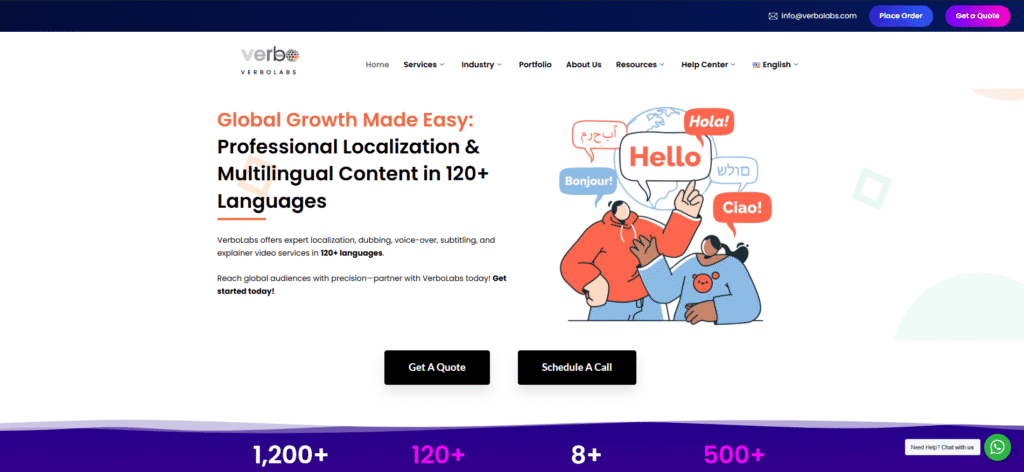
1. VerboLabs
Who is this company best for?
- Businesses that want one vendor handling documents, websites, apps, and video content instead of separate providers for each
What can they help you with?
- Document translation services, website and app localization, subtitling, dubbing/voice-over, and desktop publishing
What makes them stand out?
- Native linguists and a multi-step quality review process across 120+ languages
- Coverage that spans healthcare, legal, general business, and SaaS
What should you confirm before hiring?
- Capacity and turnaround for very high-volume or highly regulated enterprise projects
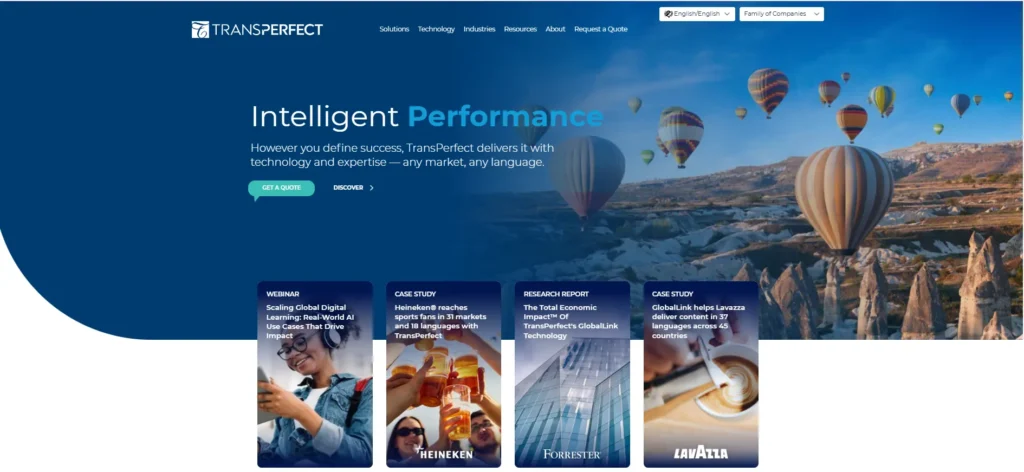
2. TransPerfect
Who is this company best for?
- Large enterprises and regulated industries running complex, multi-market localization programs
What can they help you with?
- Translation, GlobalLink technology platform, legal/eDiscovery support
- Multicultural marketing and multimedia services
What makes them stand out?
- One of the largest privately held language services providers, founded in 1992
- ISO 9001 and ISO 17100 certification
- GlobalLink integrates with CMS, CRM, and marketing systems
What should you confirm before hiring?
- Whether enterprise scale and pricing actually match a smaller buyer’s budget and project complexity
3. Lionbridge
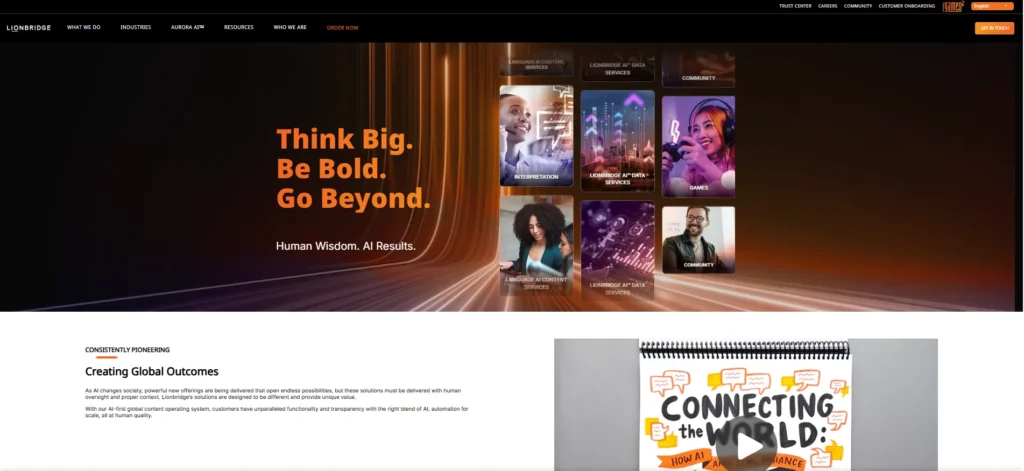
Who is this company best for?
- Software, digital content, and product localization at global scale
What can they help you with?
- Translation, localization, software/app testing, AI training data services, and interpretation
What makes them stand out?
- ISO 27001 and ISO 27701-certified information security
- A tiered service model from self-service tools up to fully managed enterprise offerings, built on its Language Cloud platform
What should you confirm before hiring?
- How much human review applies at each service tier, since the model ranges from lighter-touch self-service to fully managed production
4. RWS (Formerly SDL)
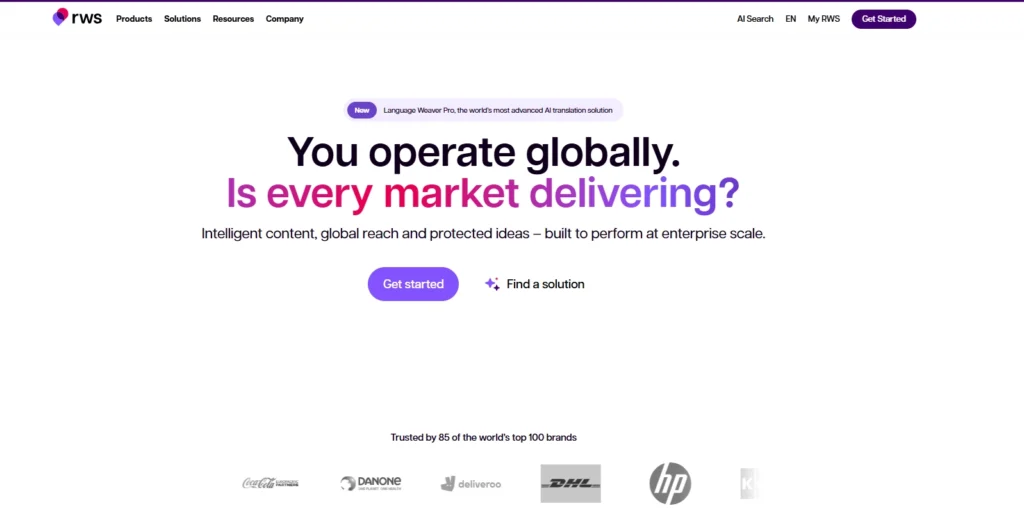
Who is this company best for?
- Legal, intellectual property/patent, technical, and enterprise localization needs
What can they help you with?
- Patent search, translation, and filing
- Regulated-industry translation, software localization, and translation productivity software (Trados)
What makes them stand out?
- Decades of patent-specific translation experience
- ISO 27001-certified information security for its IP services
What should you confirm before hiring?
- Whether a project actually needs RWS’s patent/IP specialization, or whether a generalist provider would serve a broader translation need at lower cost
5. Gengo (by Lionbridge)
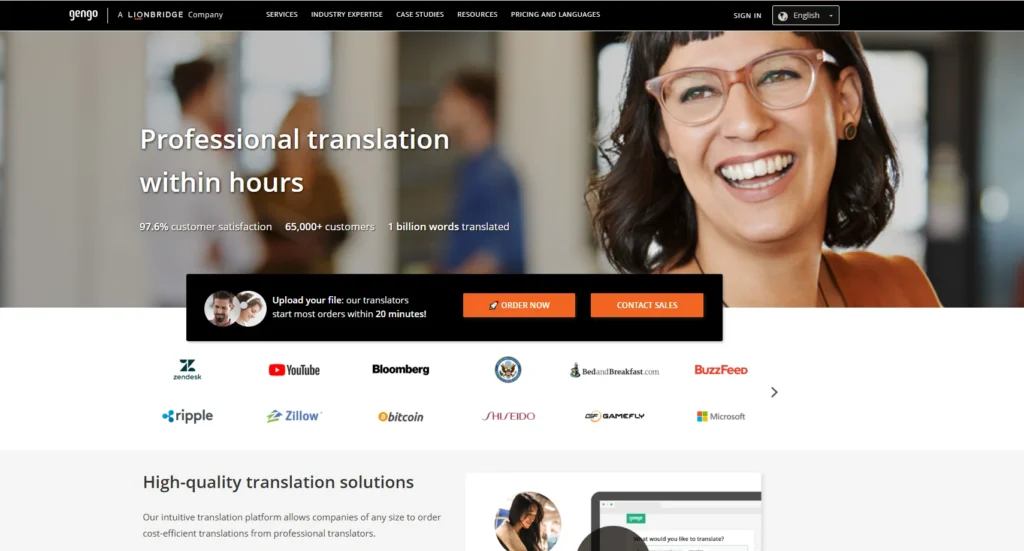
Who is this company best for?
- Businesses wanting fast, straightforward translation for general content without managing individual translators
What can they help you with?
- Self-service ordering platform and API integration for automated workflows
- Tiered per-word pricing for general content
What makes them stand out?
- Speed and a straightforward, developer-friendly API
- Crowdsourced translators tested before joining the platform
What should you confirm before hiring?
- Review depth across the standard versus advanced pricing tiers
- That the content doesn’t need certified translation, which Gengo doesn’t provide
6. Tomedes
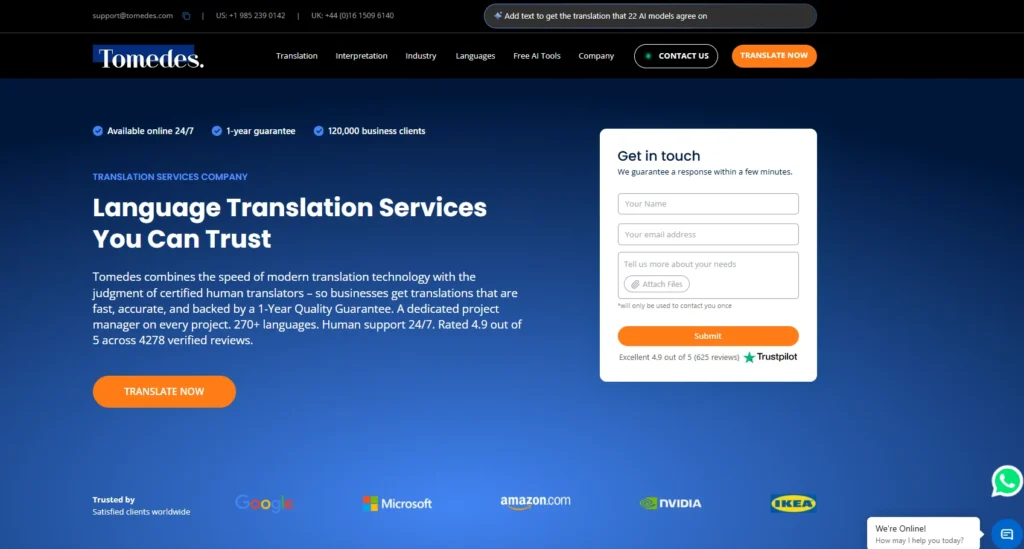
Who is this company best for?
- Small and mid-sized businesses needing legal, official, business, or marketing translation, including certified documents
What can they help you with?
- Document translation, website/software/game localization, interpretation, and transcription
- A hybrid AI-plus-human translation model
What makes them stand out?
- ISO certification and American Translators Association membership
- Certified translations generally accepted by US immigration authorities and other official bodies
What should you confirm before hiring?
- Actual language coverage for a specific pair, since reported coverage varies noticeably across Tomedes’ own sources
7. Day Translations
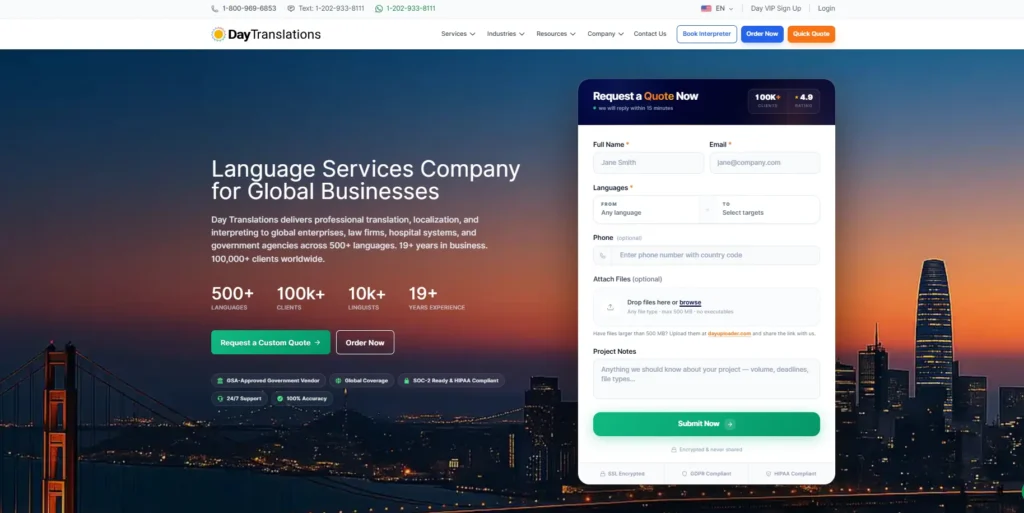
Who is this company best for?
- Organizations needing certified document translation or interpretation in culturally sensitive or public-facing contexts
What can they help you with?
- Translation, certified-document support, interpretation, and transcreation
What makes them stand out?
- Human translation positioned as the core delivery model rather than AI-first
- Relevance to healthcare, education, government, and legal content
What should you confirm before hiring?
- Specific language-pair depth and certification details directly, since broad language claims are worth confirming against the actual project need
8. Straker Translations
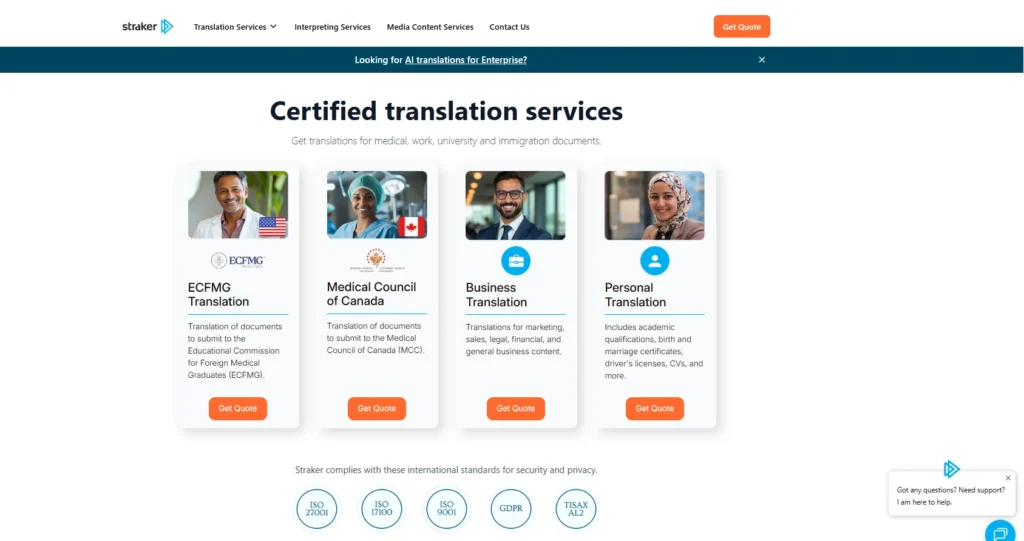
Who is this company best for?
- E-commerce, media, and publishing organizations wanting platform visibility into translation workflows
What can they help you with?
- AI-assisted and human translation
- Certified translation for documents like medical records and qualifications, plus interpreting services
What makes them stand out?
- Workflow dashboards and automation tools for managing multi-language content at scale
- Cited compliance with international security and privacy standards for certified work
What should you confirm before hiring?
- How much human review sits behind the AI-assisted output for a given content type
9. Morningside Translations (Now Questel)
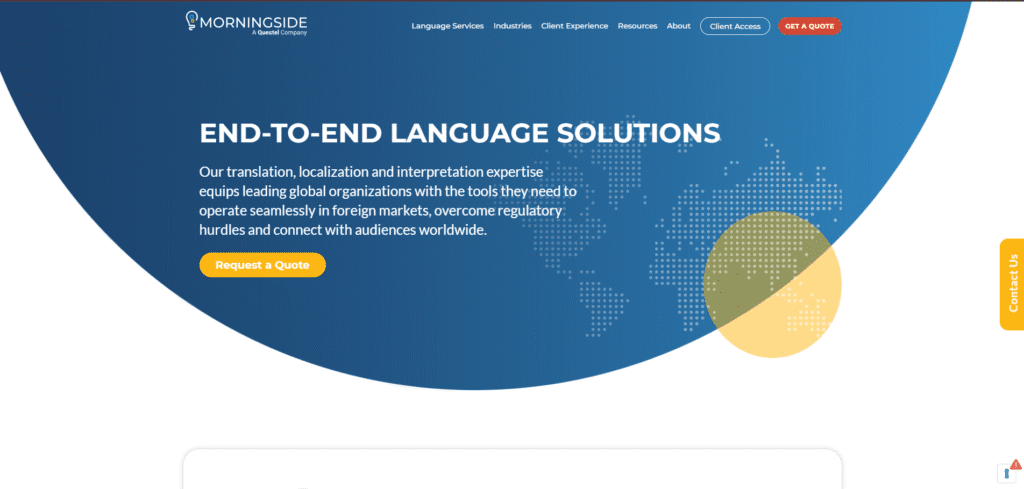
Who is this company best for?
- Legal teams, law firms, and life sciences companies needing patent, IP, or regulatory-focused translation
What can they help you with?
- Patent translation and foreign filing solutions
- Compliance-focused language services, now integrated into Questel’s broader IP platform
What makes them stand out?
- Deep specialization in patent, IP, and regulated legal content since 2000
- Acquired by Questel, a major intellectual property software and services company, in 2021
What should you confirm before hiring?
- Whether a project genuinely needs specialist IP/legal expertise, since a general translation agency may be more cost-effective outside that specific use case
10. The Language Doctors
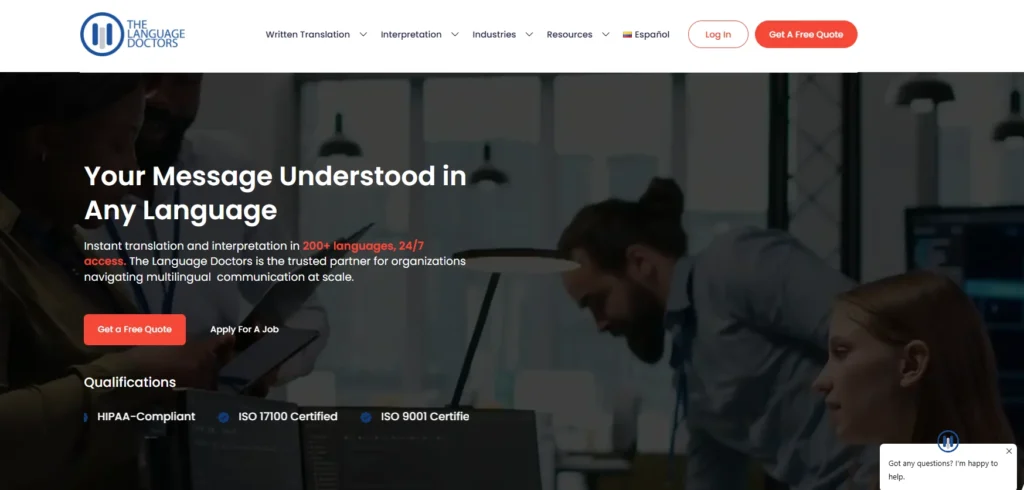
Who is this company best for?
- Government, healthcare, education, and legal organizations needing official-document translation
What can they help you with?
- Translation, interpretation, and certified-document support
- Rare-language and urgent-project support
What makes them stand out?
- Public-sector experience and a confidentiality-focused positioning
What should you confirm before hiring?
- Current certifications, security claims, and rare-language coverage directly, since public-sector requirements often carry specific procurement standards
Which Translation Company Fits Your Project Best?
There’s no universal winner. The right choice shifts with the project. Enterprise programs favor TransPerfect or Lionbridge for scale and platform integration. Legal or patent work points toward RWS or Morningside/Questel.
Healthcare content suits Day Translations, The Language Doctors, or VerboLabs, depending on format needs. Startups and API-driven workflows may prefer Gengo for speed.
E-commerce fits Straker’s automation-first model. Public-sector projects lean toward The Language Doctors. Broader multimedia localization like documents, websites, apps, and video fits providers like VerboLabs that consolidate multiple formats under one workflow.
What Should You Verify Before Signing a Translation Contract?
Most comparison lists stop at price and language count. A few questions matter just as much once ink hits paper:
- What counts as a minimum charge, and what triggers a rush fee?
- How many revision rounds come included before extra costs kick in?
- Does the provider farm work out to subcontractors, and how carefully are they vetted?
- Who owns the glossary and translation memory built up over a project? Is it the client, or the vendor quietly keeping it for the next customer?
- Is any of that data used to train AI systems?
- Is an NDA on the table, what service-level commitments exist if something slips, and what does support look like after delivery?
One of the more reliable ways to cut through this is testing a few shortlisted providers on the same sample content before signing anything larger. Marketing pages rarely tell the whole story, but a side-by-side sample usually does.
Why Growing Global Teams Choose VerboLabs
There’s a familiar pattern in how translation needs sneak up on a growing business: it starts with a document, then a website, then an app, then a training video, and suddenly three or four vendors are involved, each with its own terminology, its own quality bar, its own point of contact to chase down.
That’s the gap VerboLabs is built to close. Document translation sits alongside website localization, app localization, subtitling, dubbing/voice-over, and desktop publishing support, all handled by native linguists working through the same quality process, across 120+ languages. The practical upside for a growing team is fewer vendors to manage, terminology that stays consistent from a PDF to a product page, and a partner that doesn’t need replacing every time a new content format enters the picture. Anyone weighing this against the options above is welcome to bring specific project details and get a straight answer, or request a quote directly.

Ready to go global with confidence?
Partner with VerboLabs for fast, accurate, and scalable document translation in 120+ languages.
Get a free quote now or explore our services today!
FAQs About Translation Companies in the USA
VerboLabs, TransPerfect, Lionbridge, RWS, Gengo, Tomedes, Day Translations, Straker Translations, Morningside (now Questel), and The Language Doctors, each suited to different project types and industries.
Against the same criteria as service relevance, industry expertise, language coverage, quality process, security, technology, turnaround, and pricing transparency, using information checked against official sources as of July 2026.
No. Some, like RWS, are headquartered outside the US but serve US customers extensively, which is why they’re included here.
Match demonstrated industry expertise and content-type experience to the project. A patent filing and a marketing website need very different specializations.
RWS and Morningside specialize in legal and IP content; Day Translations, The Language Doctors, and VerboLabs support healthcare content; RWS and Lionbridge both handle technical documentation.
Minimum charges, rush fees, revision limits, subcontractor use, glossary/translation memory ownership, data retention, AI training use of client content, NDA availability, and post-delivery support.
Rates vary by provider and content type. Self-service platforms like Gengo can run under $0.15 per word for standard content, while specialized legal, medical, or patent translation often runs higher.
Depends on content risk. AI-assisted workflows suit high-volume, lower-stakes content, while legal, medical, regulatory, or brand-critical material generally benefits from full human translation and review.
Most established providers offer desktop publishing support to preserve tables, layouts, typography, and visual formatting across languages.
Look past the per-word rate to what’s included. Review depth, formatting support, confidentiality terms, revision policy, turnaround, and consider testing a few shortlisted providers with the same sample content first.