
Content translation is an important milestone for businesses expanding into global markets, but it is not the final step. Businesses expanding globally often rely on a professional translation service, but translation alone is not enough. Many organisations assume that once content is translated, it is ready to publish. In reality, many translation-related problems appear after the translation process.
Issues such as cultural mismatch, inappropriate tone, broken layouts, SEO problems, or legal inaccuracies can undermine credibility, degrade the user experience, and harm business performance. Even a well-translated text can fail if it does not sound natural or work effectively in the target market.
This blog outlines what to review after translation, using a practical quality checklist to ensure your content remains accurate, professional, and effective across languages.
Why Post-Translation Review Matters More Than You Think?
For effective global content, businesses must review translated content for accuracy, cultural relevance, SEO alignment, formatting, and compliance. A proper post-translation review ensures the content is natural, user-friendly, and optimized for both search engines and AI-driven platforms. A linguistically correct translation alone is not enough.
It can still fail because:
- Local users find it unnatural or robotic
- It can disrupt website layouts, mobile responsiveness, and content readability
- It misses the target-language search intent
- It exposes brand, compliance, or legal risk
A proper post-translation review ensures that your content:
- Sounds natural to the local audience
- Aligns with your brand and business goals
- Works effectively in real user contexts
Post-translation quality checks are not optional. They are the keys to success worldwide. Partnering with experts like VerboLabs ensures that your multilingual content is not only accurate but also aligned with real user expectations.
A Complete Post-Translation Quality Checklist
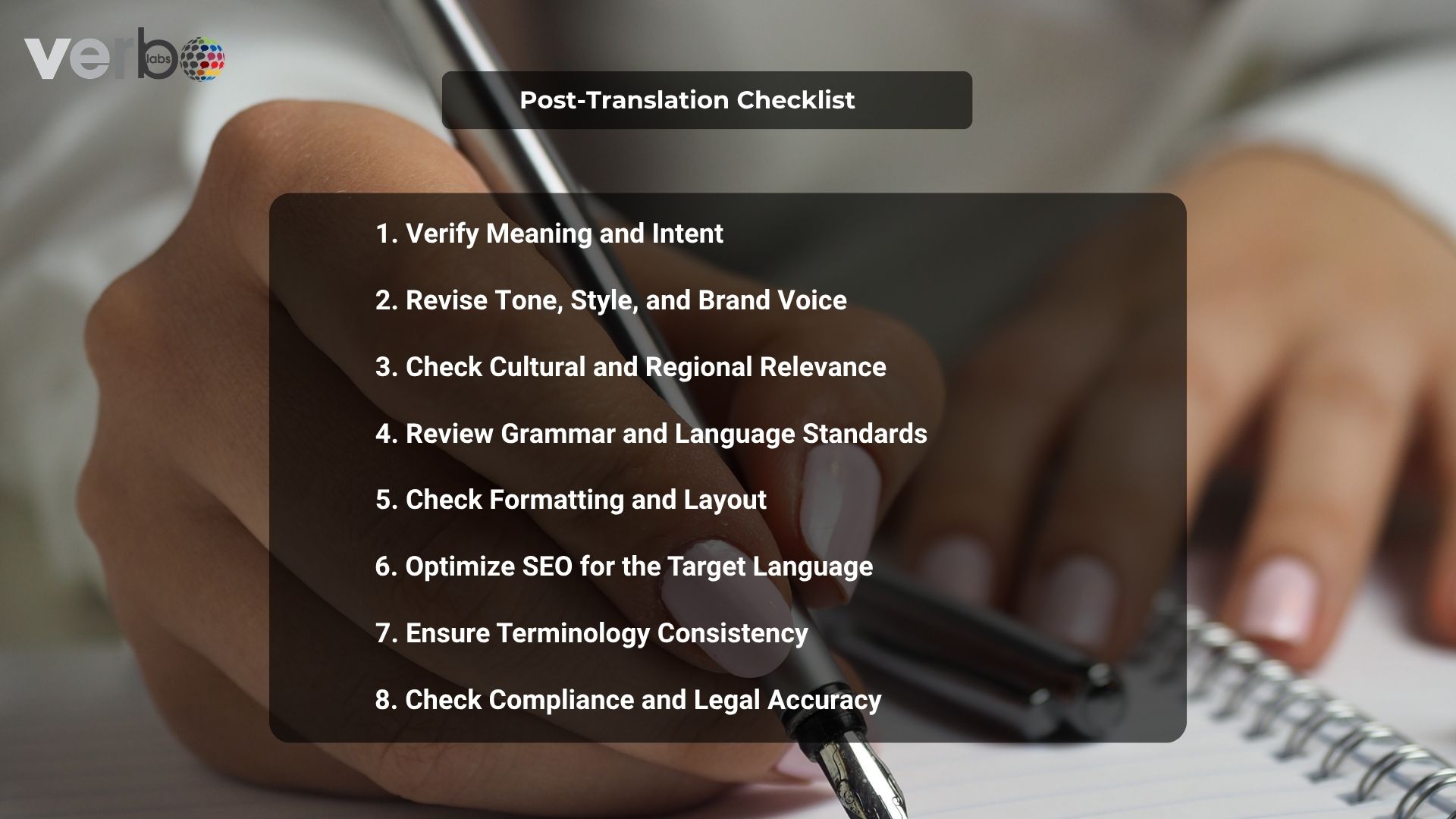
Post-Translation Checklist (At a Glance)
Before publishing translated content, ensure you check:
- Meaning and intent accuracy
- Tone and brand voice consistency
- Cultural and regional relevance
- Grammar and language quality
- Layout and formatting
- SEO localization
- Terminology consistency
- Legal and compliance accuracy
1. Verify Meaning and Intent
The first priority is ensuring the original message and purpose remain intact.
Check that:
- The main message is clear
- No information was unintentionally added, removed, or altered
- Technical, legal, or industry terms are translated correctly
Avoid literal word-for-word translation. Focus on intent, clarity, and accuracy.
2. Revise Tone, Style, and Brand Voice
The brand voice should remain consistent across languages.
Ask:
- Does the tone match the brand (friendly, authoritative, empowering)?
- Is the message appropriate for the local audience?
- Does it reflect the brand personality?
Tone should be adapted to the culture, not copied directly from the source language.
3. Check Cultural and Regional Relevance
Content must be culturally appropriate for the target audience.
Look for:
- Idioms or phrases that do not make sense in the target culture
- References, humour, or examples unfamiliar to local users
- Symbols, colours, or imagery that may carry different meanings
Poor cultural adaptation can damage user trust and brand reputation.
4. Review Grammar and Language Standards
Even small errors reduce credibility.
Ensure:
- Correct spelling based on regional language standards
- Proper grammar, punctuation, and sentence structure
- Appropriate use of formal or informal language
Accuracy is especially critical in legal, medical, academic, and corporate content.
5. Check Formatting and Layout
Translation can change the length of the text and affect the design.
Review:
- Line breaks, spacing, and alignment
- Text overflow in buttons, menus, and forms
- Subtitle timing and readability
- Layout in PDFs, presentations, and app screens
Design should remain clear and usable in all languages.
6. Optimize SEO for the Target Language
Translated content should also be search-optimized.
Check:
- Keywords are localized, not just translated
- Headings match local search intent
- Meta titles and descriptions are included
- URLs, alt text, and internal links are localized
Users search in their own language patterns, not direct translations. For maximum visibility, businesses should combine localization with AI-driven strategies such as AEO and GEO, supported by AI engine-optimized SEO content writing service to improve discoverability in both search engines and AI platforms.
7. Ensure Terminology Consistency
Inconsistent terminology appears unprofessional.
Verify consistency in:
- Product and feature names
- Technical or industry terms
- Legal and financial terminology
Use glossaries or translation memory tools to maintain consistency.
8. Check Compliance and Legal Accuracy
For regulated industries, this step is critical.
Check:
- Disclaimers and warnings
- Data protection and privacy statements
- Medical, financial, or safety claims
- Compliance with local regulations
Incorrect translation in these areas can lead to legal or financial risks.
Test Content in the Real World
Before publishing, verify how the translated content works in real situations.
Examples include:
- Browsing the website in the target language
- Watching videos with subtitles or dubbing
- Checking on-screen text such as notifications, prompts, and error messages
- Sharing the content with native speakers or local teams for feedback
This step helps identify usability and user-experience issues that may not appear in text-only reviews.
Native-Language Review or QA Approval
A final review by native-language experts is essential before publishing translated content.
Professional linguistic QA ensures:
- Natural flow and readability
- Cultural appropriateness
- A smooth and intuitive user experience
This helps the content feel local and authentic rather than obviously translated.
Common Post-Translation Mistakes Businesses Make

Many organizations reduce the impact of their global content by:
- Skipping a second human review before publishing
- Relying only on automated checks
- Ignoring layout and UI issues after translation
- Failing to localize SEO
- Treating all languages the same instead of adapting them
Avoiding these mistakes can significantly improve engagement, trust, and conversions.
How VerboLabs Ensures Post-Translation Quality?
At VerboLabs, translation is only one step in a broader quality-focused workflow.
Each project goes through a structured post-translation review process that includes:
- Context-aware human review
- Verification of industry-specific terminology
- Cultural and regional adaptation
- Multilingual quality assurance (QA) checks
- Support for text, audio, video, applications, and documents
This approach ensures that content is not just technically translated, but fully prepared for real users in the target market.
How Post-Translation Review Supports AI Search (AEO & GEO)
In AI-driven search environments, content must be:
- Clear and directly answer user queries
- Structured with headings and concise explanations
- Contextually relevant for different regions
- Consistent in terminology and intent
Post-translation review ensures that multilingual content meets these requirements, increasing the chances of being featured in AI-generated answers and improving global visibility.
Conclusion
Translation alone does not guarantee effective global communication. A structured post-translation review—covering accuracy, cultural relevance, SEO alignment, and compliance—is essential to ensure content performs across markets and platforms.
In today’s AI-driven search landscape, content must also be optimized for discoverability, meaning it should be clear, structured, and aligned with user intent. Businesses that invest in post-translation quality gain stronger engagement, higher trust, and better global performance.
By partnering with experts like VerboLabs and leveraging professional translation services, organizations can ensure their content is not just translated—but fully optimized for real users and AI engines.

Ensure your translated content truly works worldwide—partner with VerboLabs for expert post-translation quality and localization.
After translation, you should review accuracy, tone, cultural relevance, SEO alignment, formatting, and legal compliance to ensure the content works effectively in the target market.
Translation alone may miss cultural context, user intent, and natural phrasing. Many discussions highlight that localization requires adapting meaning, not just words.
Use a structured review process that includes human editing, terminology checks, cultural adaptation, and real-world testing. High-impact content especially requires human review for accuracy and brand consistency.
Common mistakes include literal translation, inconsistent terminology, ignoring SEO localization, and skipping human review. These issues can reduce trust and performance.
AI can speed up translation, but relying on it alone often leads to errors, unnatural phrasing, and context loss. Many professionals recommend a human-in-the-loop approach for quality and accuracy.
Localization adapts content to cultural expectations, language patterns, and user behavior, making it more relevant, engaging, and effective in different regions.
Users search differently in each language. Proper SEO localization ensures your content matches local search intent, improves rankings, and increases visibility in both search engines and AI-generated answers.