As businesses expand across international markets, the need for seamless global communication continues to grow. Companies now translate large volumes of content, including contracts, websites, product manuals, marketing materials, eLearning courses, and regulatory documents. In this environment, a well-designed translation workflow has become a strategic necessity.
An inefficient workflow can result in inconsistent terminology, missed deadlines, higher translation costs, and compliance risks. For example, one multinational eLearning company reported a 40% increase in turnaround time due to disconnected processes, multiple vendors, and the lack of a structured quality assurance system.
To remain competitive, modern organizations integrate human expertise, machine translation, and structured quality assurance into a streamlined workflow that improves speed, accuracy, and cost efficiency.
What Is a Translation Workflow?
A translation workflow is a structured process that manages how content moves from the original source to the final translated version. It ensures consistency, clear responsibility, and quality at every stage.
A typical translation workflow includes these steps:
- Content preparation – organizing and reviewing the source text.
- Machine or AI translation – generating an initial draft using automated tools.
- Human translation and editing – professional translators refine or translate the content.
- Quality assurance (QA) – checking accuracy, terminology, and formatting.
- Final review and delivery – approving and delivering the completed translation.
The workflow may vary depending on the type of content. For instance, legal and medical translations require stricter quality controls and subject-matter expertise, while marketing content may allow more flexibility in style and tone. Understanding these differences helps businesses choose the most suitable translation approach for each project.
Also Read,
- What Are Translation Services? A Complete 2026 Guide for Businesses and Professionals
- What is Localization? A Complete Guide to Reaching Global Audiences
- What Is App Localization?
Types of Translation Workflows
A. Human-Only Workflow
This workflow relies entirely on professional human translators. It is typically used for high-stakes content such as legal documents, financial reports, or clinical records, where accuracy, accountability, and regulatory compliance are critical.
B. Machine + Human Workflow
In this workflow, a machine translation system produces an initial draft, which is then reviewed and edited by human translators. It balances speed and quality and is commonly used for large volumes of content such as websites, product catalogs, and support documentation.
C. Automation and QA Tools Hybrid Workflow
This workflow combines human translators with Computer-Assisted Translation (CAT) tools, translation memories, terminology databases, automation, and structured quality-assurance checks. It is suitable for organizations handling repetitive or multilingual content that requires consistency, efficiency, and scalable processes.
Key Steps in an Effective Translation Workflow
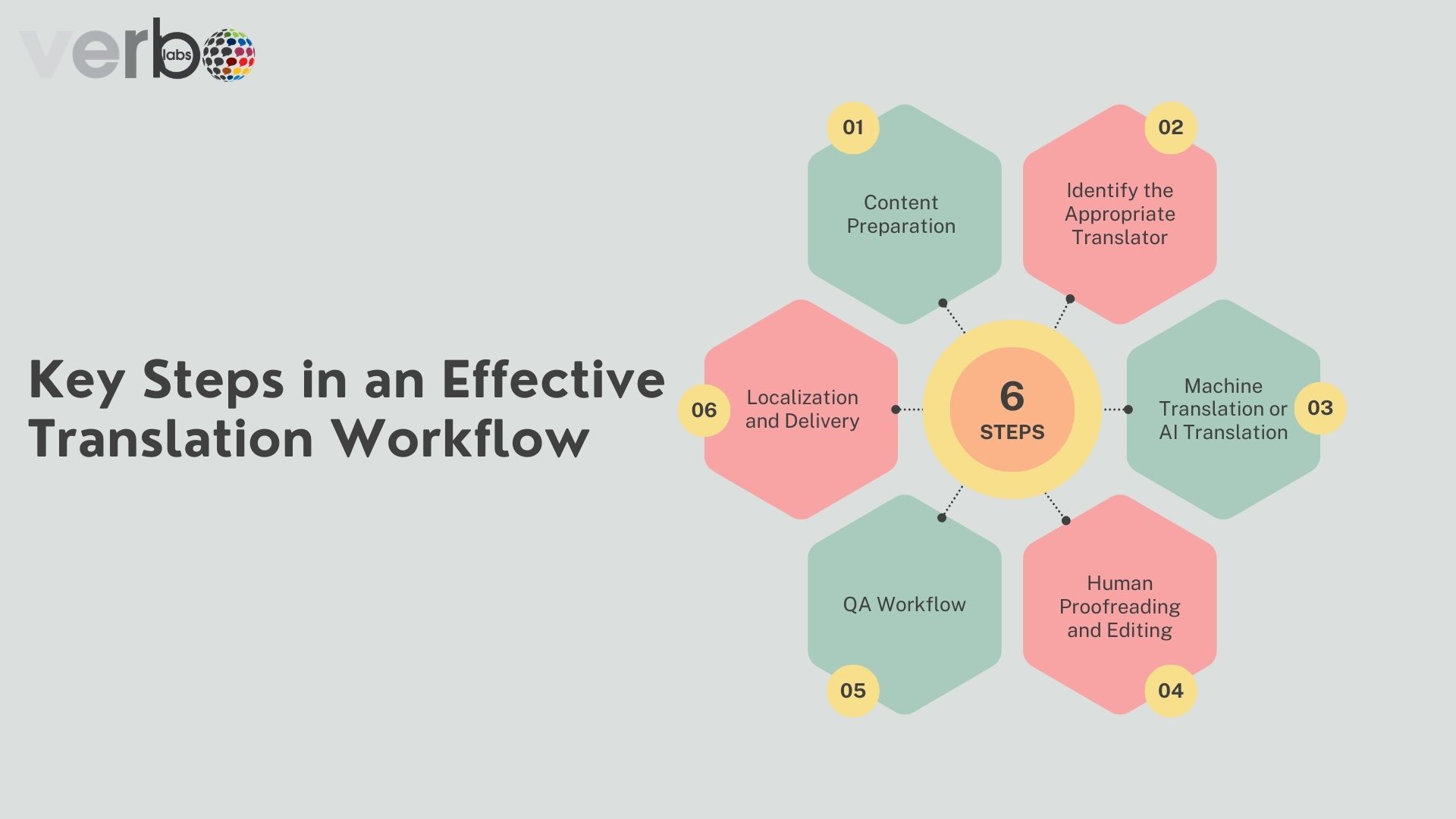
Step 1: Content Preparation
The source content is cleaned, ambiguities are resolved, and a glossary or approved terminology list is created.
Step 2: Identify the Appropriate Translator
A qualified translator is selected based on subject-matter expertise (e.g., medical, legal, or technical) and the language pair.
Step 3: Machine Translation or AI Translation
The text is translated using human translators, machine translation, or a combination of both to improve speed and efficiency.
Step 4: Human Proofreading and Editing
Linguistic experts review the translation to correct grammar, ensure accuracy, and adapt tone and style for the target audience.
Step 5: QA Workflow
Automated and manual checks verify consistency of terminology, formatting, completeness, and linguistic quality.
Step 6: Localization and Delivery
The content is culturally adapted and integrated into the final format (documents, websites, or platforms) before delivery.
This structured workflow is especially important when translating sensitive content such as medical research, where accuracy, compliance, and regional adaptation are critical.
Common Challenges in Translation Workflows
Many organizations struggle with inefficient translation workflows due to fragmented processes.
Common challenges include:
- Inconsistent terminology across projects
- Lack of a structured QA process, leading to errors
- Increased translation costs due to duplicated work
- Delays caused by unclear task assignments and poor coordination
For example, companies that work with multiple translation vendors without a centralized quality assurance system often experience inconsistent quality and frequent rework.
Best Practices for a Smooth Translation Workflow
To improve translation workflows, businesses should:
- Use professional translation services for critical content
- Maintain centralized glossaries and style guides to ensure consistency
- Integrate machine translation carefully with human review
- Use workflow management systems to track and coordinate tasks
- Implement a structured QA process
- Choose translation services that support multiple content formats and languages
These practices help reduce errors, improve consistency, and make translation processes more scalable and efficient.
Benefits of a Well-Designed Translation Workflow

A strong translation workflow delivers measurable business advantages:
- Faster turnaround times
- Lower translation service cost
- Higher quality and consistency, especially for the best document translation service
- Scalability across markets
- Compliance with regulatory standards, particularly for medical translation service projects
- Process design offers the company long-term efficiency and dependability.
How VerboLabs Supports Efficient Translation Workflows?
VerboLabs provides end-to-end translation workflow solutions designed for modern businesses. The company delivers professional translation services in 120+ languages for documents, websites, marketing materials, and technical content.
By combining AI-powered translation with expert human linguists and a structured QA process, VerboLabs ensures accuracy, speed, and consistency. Transparent pricing models help businesses manage translation costs, while scalable workflows support both SMEs and large enterprises.
With a streamlined process and expert oversight, VerboLabs helps organizations reduce errors, minimize rework, and maintain consistent global communication. Request a free quote to find the right scalable solution for your document and website translation needs.
Conclusion
A structured translation workflow is essential for businesses operating in global markets. It ensures efficiency, accuracy, and cost control while supporting international growth.
In contrast, disorganized translation processes often lead to delays, errors, and higher costs. By partnering with a professional translation provider like VerboLabs, businesses can implement a reliable workflow that ensures quality, compliance, and scalability across projects.

Scale your global communication effortlessly with VerboLabs’ smart translation workflows—get started today.
Frequently Asked Questions (FAQs)
It is a structured process for translating content efficiently and accurately from source to target languages.
They combine human expertise, technology, and quality assurance to deliver accurate and culturally appropriate translations.
AI helps with speed but cannot ensure accuracy and context for critical documents; human review is essential.
Costs vary based on language pair, complexity, document type, and urgency.
A QA workflow ensures consistency, accuracy, and adherence to glossaries, style guides, and compliance standards.
VerboLabs combines AI, human expertise, and structured workflows to deliver scalable, high-quality translation services.