

An automated translation service is an enterprise offering that produces and routes multilingual content through a controlled workflow. Most combine machine translation or LLMs, terminology management, quality estimation, human review, integrations and reporting. For Indian enterprises, the stakes are specific: exporters entering new markets, IT and BPO firms handling client content, pharma and BFSI teams under regulatory scrutiny, and edtech or media companies serving Hindi, Tamil, Bengali and other regional audiences.
One warning before the list: software, platforms and managed services are not interchangeable. Software gives you tools and puts workflow ownership on your team. A managed service gives you accountable delivery. Compare like with like, and pilot with your own content.
Quick Shortlist by Enterprise Need
- Managed AI-plus-human pilot: VerboLabs
- Managed AI inside a TMS: Smartling
- Secure or regulated deployments: RWS
- Broad service-led automation: TransPerfect GlobalLink
- High-volume content programs: Welocalize
- Governed self-service: Acolad Lia
- AI-first, controlled deployment: LILT
- Cross-functional platform automation: Phrase
- Customer-service translation: Unbabel
- Private or on-premises MT: SYSTRAN
Automated Translation Services Comparison Table
| Provider | Type | Best-fit workflow | AI/MT and human review | Integrations, security evidence | Public pricing | Key question |
| VerboLabs | Managed service | Pilot for mixed content | AI plus post-editing (vendor-described) | Not publicly stated | Not publicly stated | Which engine and review steps? |
| Smartling | TMS plus services | Ongoing localization | AI, human options | Connectors, API | Not publicly stated | What do you manage vs. Smartling? |
| RWS | Software and services | Regulated content | Language Weaver, linguists | Deployment options | Not publicly stated | Which deployment applies? |
| TransPerfect GlobalLink | TMS plus services | Managed ecosystem | AI/MT routing, humans | Connectors, API | Not publicly stated | Platform vs. service pricing? |
| Welocalize | Services and AI tooling | High-volume programs | AI-enabled, human review | Not publicly stated | Not publicly stated | What baseline metrics? |
| Acolad Lia | Platform and services | Governed self-service | AI, expert option | Verify certification scope | Verify | Usage limits? |
| LILT | AI platform and services | Controlled AI-first | AI, expert verification | Verify deployment options | Not publicly stated | Is your deployment option included? |
| Phrase | Platform | Cross-functional teams | Engines, AI agents | Many connectors | Partly published | Which plan has which feature? |
| Unbabel | AI platform | Support operations | AI, quality estimation | CRM integrations | Verify | Threshold calibration? |
| SYSTRAN | MT software | Private control | Customizable MT, no managed review | Server, private cloud | Not publicly stated | What must you add? |
How We Selected and Evaluated Providers
We included providers with documented enterprise translation automation, workflow or application integration, governance and quality controls, and availability to U.S. enterprise buyers, which also covers Indian firms selling into that market. We applied the same four criteria to each: workflow fit, quality and human controls, integration and governance, and commercial proof. Public pages were reviewed; none of the tools were independently benchmarked, and vendor claims are not independent validation. General consumer translators without enterprise workflow controls were excluded.
The 10 Automated Translation Services for enterprise workflows
Each entry uses four lenses: workflow fit, quality and human controls, integration and governance, and commercial proof. Official product URLs are cited in each heading section.
1. VerboLabs — Best for a Managed AI-Plus-Human Enterprise Pilot
Best for teams wanting accountable delivery rather than a tool to operate. This is a managed service. Item to verify: how much of the workflow is automated versus manual. Official page: https://www.verbolabs.com/
Service Scope and Best-Fit Workflow
VerboLabs describes an AI translation service with human post-editing. Disclosure: VerboLabs publishes this comparison, so first position reflects editorial fit, not independent market leadership.
Evidence and questions: Which content types are in scope? Is post-editing included in the base quote?
Human Review, Terminology, and Quality Evidence
Ask for specifics instead of general quality assurances.
Evidence and questions: Engine or model used, data handling, context assets, reviewer qualifications, quality taxonomy, acceptance rule, and exact human review included.
Pilot, Integration, and Commercial Questions
Start with a representative pilot, including at least one Indian-language pair.
Evidence and questions: Formats and integrations, language-pair evidence, pricing components in INR, GST treatment, reporting, TM and termbase ownership, export on exit.
2. Smartling — Best for Managed AI Workflows Inside a TMS
Best for enterprises that want a translation management system with vendor-managed AI and human options. Verify the split of responsibilities. Official page: https://www.smartling.com/
AIT, AIHT, and Enterprise Workflow Fit
Smartling describes managed AI translation, AI-powered human translation and configurable workflows within its TMS.
Evidence and questions: Which steps does your team configure and which does Smartling run?
Engine Routing, Context, and Human Validation
Confirm multi-engine or LLM access, translation memory, glossaries and human validation options.
Evidence and questions: Language-pair limitations? How is quality evaluated, and on what sample?
Guarantees, Integration, and Total Cost to Verify
Read any quality or satisfaction guarantee for its exact scope.
Evidence and questions: Connectors and API, platform versus service fees, implementation cost, minimum commitments, asset portability.
3. RWS — Best for Secure Enterprise AI and Regulated Environments
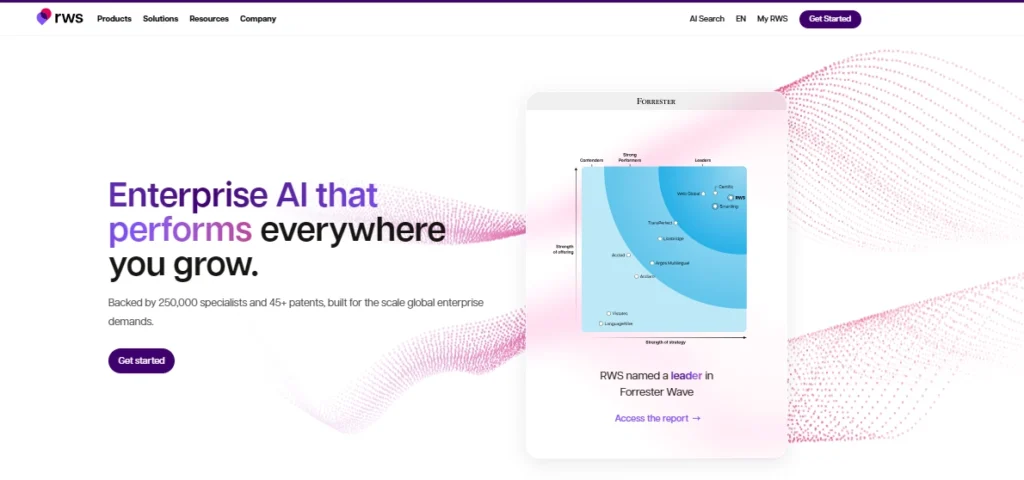
Best for regulated or high-control organizations such as BFSI and pharma. Verify which deployment option applies to you. Official page: https://www.rws.com/language-weaver/
Language Weaver and Service Model Options
Separate Language Weaver MT, Trados integrations, self-service options and managed language services.
Evidence and questions: Which products are in your proposal, and who operates each?
Deployment, Security, and Model Evidence
Ask about cloud, private cloud or on-premises options and data use.
Evidence and questions: Supported languages, customization, benchmark design, customer-specific validation, DPDP-relevant data terms.
Human Expertise and Workflow Integration
Clarify where linguists enter the workflow.
Evidence and questions: When do linguists review? How do exceptions route? Which connectors are included? How are cost and productivity reported?
4. TransPerfect GlobalLink — Best for Broad Managed Localization and Automation
Best for organizations wanting a platform and services from one group. Verify transparency of bundled pricing. Official page: https://www.transperfect.com/globallink
GlobalLink TMS and Service-Led Fit
GlobalLink pairs a TMS with services. Note that TMS automation (routing content) differs from automated translation generation.
Evidence and questions: Which part of your workflow is automated, and which is staffed?
AI/MT Routing and Enterprise Connectivity
Request workflow-specific answers.
Evidence and questions: Engines or models, routing rules, connectors, APIs, human review, terminology and quality controls.
Bundling, Governance, and Exit Questions
Seek line-item commercial detail.
Evidence and questions: Platform and service pricing, implementation scope, named team, security evidence, data terms, asset ownership, transition support.
5. Welocalize — Best for High-Volume AI-Enabled Content Programs
Best for large, recurring content programs such as support, product and e-commerce content. Verify outcome proof on comparable content. Official page: https://www.welocalize.com/
Opal and Language-Service Workflow Fit
Welocalize describes Opal and AI-enabled language services. Programs with steady volume and repeatable content types benefit most.
Evidence and questions: Which of your content programs map to Opal, and which need services only?
Context, Human Expertise, and Quality Controls
Ask how MT, LLMs and NLP are chosen per content type.
Evidence and questions: Linguistic asset use, human review scope, quality measurement, exception handling.
Integration, Data Use, and Outcome Proof
Request architecture detail and baseline metrics.
Evidence and questions: Connectors, model and data governance, implementation, pricing assumptions, customer-relevant pilot.
6. Acolad Lia — Best for Governed Enterprise Self-Service and Managed Localization
Best for teams that want self-service for routine content and experts for critical content. Verify security certification scope. Official page: https://www.acolad.com/
Lia Go and Managed-Service Options
Clarify which use cases run self-service versus expert-managed.
Evidence and questions: How do teams move between modes, and does context carry across?
Governance, Terminology, Review, and Auditability
Confirm governance controls, not just feature names.
Evidence and questions: Terminology and style, reviewer routing, spend reporting, access, audit trail, data region, certification scope.
Pricing, Adoption, and Integration Questions
Ask how self-service and managed charges combine.
Evidence and questions: Flat versus service charges, usage limits, file support, APIs, rollout, training, export.
7. LILT — Best for AI-First Localization With Enterprise Deployment Controls
Best for technical, regulated or public-sector content needing AI with expert verification. Do not assume every deployment option is included. Official page: https://lilt.com/
Platform, Services, and Use-Case Fit
LILT combines an AI platform with services. Fit appears strongest where product, technical or regulated content needs governance.
Evidence and questions: Which deployment and service tier covers your use case?
Security, Deployment, and Human Verification
Ask whether cloud, on-premises or air-gapped options exist for your contract.
Evidence and questions: Model and data terms, governance, expert verification, audit evidence, content-specific quality rules.
Connectors, Migration, and Economics
Check migration effort early.
Evidence and questions: Connectors, API, TM and termbase migration, service levels, pricing basis, productivity evidence, export.
8. Phrase — Best for Cross-Functional Workflow Automation and Engine Choice
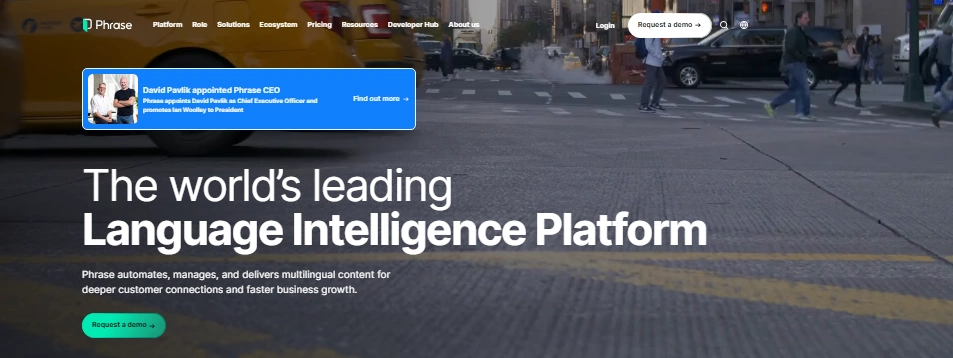
Best for teams that want a platform and can design their own workflows. It is not a managed service. Verify plan-level features. Official page: https://phrase.com/
Language AI, TMS, Strings, Studio, and Portal
Phrase describes Language AI and AI agents across product, document and multimedia workflows.
Evidence and questions: Do you need a platform rather than a managed service, and who will run it?
Engine Profiles, RAG, Terminology, and Quality
Review engine selection, memory, termbases, style rules, automated refinement and quality scoring in official documentation.
Evidence and questions: Which features belong to which plan?
Data Governance, Licensing, and Implementation
Confirm who processes your data and how you are billed.
Evidence and questions: LLM providers and data terms, licensing or consumption model, connectors, human review, implementation ownership, support.
9. Unbabel — Best for Customer-Service and Workflow-Embedded Translation
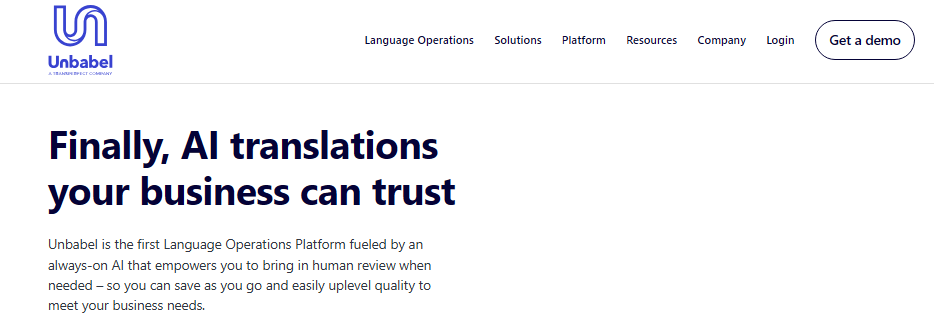
Best for support and customer-operations teams where speed matters, such as Indian BPOs serving global clients. Evidence is strongest in that area; verify beyond it. Official page: https://unbabel.com/
LangOps and Customer-Operations Fit
Unbabel describes AI translation, quality estimation, optional human review and integrations.
Evidence and questions: Which helpdesk and CRM tools are supported natively?
Dynamic Human Review and Quality Estimation
Ask how automated scoring decides what goes to an editor.
Evidence and questions: Threshold calibration, segment routing, terminology and brand voice, performance audits.
Integrations, Coverage, and Cost Controls
Test outside the support use case.
Evidence and questions: CRM and CMS integrations, languages, content types, response times, data handling, pricing, portability.
10. SYSTRAN — Best for Private-Cloud or On-Premises Machine Translation
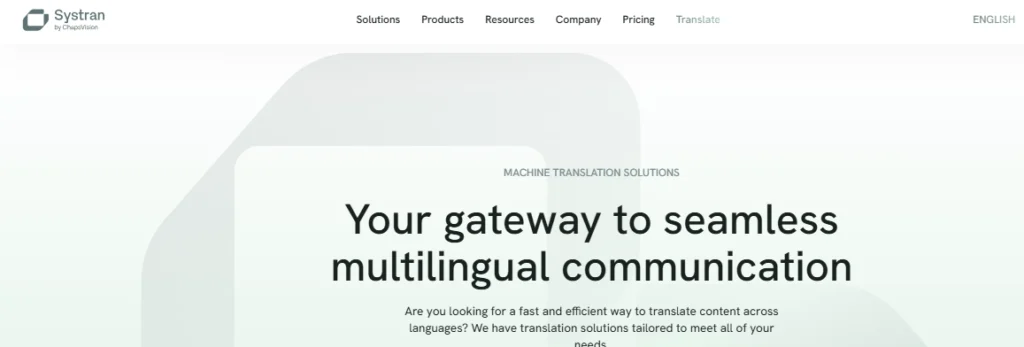
Best for organizations prioritizing internal control and high-volume MT. This is software, not managed human translation. Official page: https://www.systran.net/
Enterprise, Private Cloud, and Server Fit
SYSTRAN offers enterprise, private cloud and server deployment choices. Teams with strict internal-control requirements may find these relevant.
Evidence and questions: Which deployment fits your infrastructure and who maintains it?
Customization, Formats, and Security Claims
SYSTRAN describes model customization with bilingual data and no-store statements. Require current documentation and validate them yourself.
Evidence and questions: File support, SSO and integration, security documentation, Indian-language quality on your data.
Human Review and Localization Stack Gaps
Compare the total operating model, not engine cost alone.
Evidence and questions: Will you add a TMS, post-editing, LQA, terminology governance, and publishing integrations?
How to Choose Between a Service, Platform, and MT Engine
| Model | Internal staffing | Implementation | Human review | Governance | Flexibility | Your responsibility |
| Managed service | Low | Light | Included | Vendor-led | Medium | Low |
| TMS/platform with services | Medium | Moderate | Optional | Shared | High | Medium |
| Workflow platform | High | Heavy | Self-sourced | Yours | Very high | High |
| API/engine | High (engineering) | Heavy | Build yourself | Yours | Very high | Highest |
| Private/on-premises | Highest (IT) | Heaviest | Build yourself | Yours | High | Highest |
Questions to Ask About AI and Data
India’s Digital Personal Data Protection Act, 2023 makes data-handling answers important. Have security and legal teams review the responses.
- Which model and provider process your content?
- Is customer data retained, and for how long?
- Is it used for training or reuse?
- Who are the subprocessors?
- Where is data stored and processed?
- How is it encrypted and who can access it?
- What logs exist, and how are prompts and context handled?
- How is deletion carried out and verified?
- What is the incident response process?
- What content is prohibited, and how is human oversight applied?

Share representative files, your systems, target languages (including Indian languages), content risk, human-review needs and data constraints, and request a scoped pilot before committing.
Frequently Asked Questions
It is a service that generates translations using AI or machine translation and routes them through defined steps such as terminology checks, quality scoring and human review.
Machine translation is the engine that produces text. Automated translation includes the surrounding workflow: integrations, routing, review, reporting and governance.
Review content with legal, medical, financial, safety or brand risk, and any content published externally. Low-risk internal content may need only sampling.
Run a pilot on your own content and language pairs, use a defined error taxonomy and acceptance rule, and have independent reviewers score the results.