
Enterprise translation services are managed language operations that can combine people, workflows, technology, QA, integrations and governance at scale. This guide is for localization, procurement, content operations, product and IT/security leaders. VerboLabs publishes it and is listed first, so read that entry with that in mind.
Quick shortlist: VerboLabs for a flexible pilot, TransPerfect or RWS for broad or regulated programs, Lionbridge for bespoke integration, Welocalize or LILT for AI at scale, LanguageLine for translation plus interpreting, Acolad for centralized workflows, Argos for testing depth and BLEND for API-first teams. The comparison table follows.
TL;DR: enterprise translation services – Key Takeaways
- Match the provider to the operating model: pilot, global suite, regulated, bespoke, AI-first, interpreting, technical testing or API-first.
- Public evidence is thin on pricing, review rules and integration scope. Treat vendor claims as claims.
- Certificates differ by office, standard edition and service line. Verify scope before relying on any badge.
- Ask every bidder to map human review, data use and exit rights in writing.
- Next step: run one representative pilot with identical files, locales, systems and acceptance thresholds.
Quick Shortlist by Enterprise Need
- Flexible multi-format pilot: VerboLabs
- Broad global suite: TransPerfect
- Regulated and strategic localization: RWS
- Highly integrated bespoke program: Lionbridge
- AI-enabled content at scale: Welocalize
- Translation plus interpreting: LanguageLine Solutions
- Centralized regulated workflows: Acolad
- Governed AI-first deployment: LILT
- Technical content, testing depth: Argos Multilingual
- API-first engineering: BLEND
Enterprise Translation Services Comparison Table
Checked 17 November 2026 against official pages. “Verify” means confirm in the proposal.
| Provider | Best-fit buyer | Managed-service scope | Technology/workflow model | Human review model | Integration evidence | Security/certifications to verify | Public pricing | Key limitation/question |
| VerboLabs | Multi-format pilot | Documents, apps, games, media | AI plus human proofreading | Not publicly stated | Not publicly stated | ISO 17100, 9001 listed | Per-word, project quotes; no rates | Named team, data handling |
| TransPerfect | Many-need consolidation | Translation, localization, media | GlobalLink, AI plus human | Not publicly stated | Connector scope unconfirmed | Verify ISO 9001, 17100 | Not publicly stated | What’s included |
| RWS | Regulated, strategic | Localization, content, IP | Trados, Language Weaver, Weava | Expert people plus AI | Connectors page exists | Office-level ISO scope | Not publicly stated | Certificate scope |
| Lionbridge | Complex programs | Bespoke Enterprise service | Language Cloud; MT routing | Dedicated teams | APIs, connectors claimed | Trust Center; verify | Platform “no extra cost” | Included versus scoped |
| Welocalize | High-volume AI | Language services, testing | Opal; MT, LLMs, NLP | Not publicly stated | Not publicly stated | Trust Center; verify | Not publicly stated | Review rules |
| LanguageLine | Written plus spoken | Translation, interpreting | Portals, optional AI | Professional review | Epic listed | Certifications page | Not publicly stated | Split pricing |
| Acolad | Centralized, regulated | Managed Lia Services | Lia: TM, NMT, LLMs | Human-in-the-loop | Connectors, APIs | ISO 17100, 27001, SOC 2 | Lia Go €24/mo; services quoted | Certificate versions |
| LILT | AI-first governance | Platform plus services | Adaptive AI | Expert verification | Connector catalog | SOC 2 Type II claimed | Quote-only plans | Plan boundaries |
| Argos Multilingual | Technical, testing | Localization, testing, DTP | MosAIQ, Rigi | Tailored linguist teams | Not publicly stated | Not publicly stated | Not publicly stated | Asset ownership |
| BLEND | Engineering-led | Translation, API/MCP ordering | Custom AI models | Linguist verification | GitHub, Figma, CMS, API | Not publicly stated | From $0.005/word (vendor) | Like-for-like pilot |
How We Selected and Evaluated Providers
Inclusion required a credible enterprise translation or localization offer, evidence relevant to U.S. buyers, a scalable workflow and enough official documentation. We read each provider’s own pages and applied the same three lenses: fit and scope, delivery and quality, and commercial proof. Inclusion isn’t endorsement, and current capabilities and contract terms must be verified. We didn’t use G2 or Capterra ratings, because a comparable service-provider dataset wasn’t established.
The 10 Enterprise Translation Service Providers
Each entry uses the same lenses, with headings tailored to what differs. Order isn’t a ranking.
1. VerboLabs — Best for a Flexible Multi-Format Enterprise Pilot
VerboLabs, which publishes this article, lists translation and localization in 120+ languages across apps, documents, games, e-learning, technical and multimedia content, using AI drafts with human proofreading. Shortlist it for a multi-format pilot. Its page doesn’t describe enterprise integrations, named teams or reviewer independence, so those need proof.
Pilot Fit Across Text, App, and Multimedia
Evidence: the service page lists app, document, game, e-learning and multimedia work. First position reflects editorial fit, not an independent ranking. Ask: which formats and connectors are in scope?
Human Review and Domain Matching to Verify
Evidence: a five-step process, AI plus human proofreading, and ISO 17100:2015 and 9001:2015 listed in the footer. Ask: named team, reviewer independence, quality taxonomy and data handling.
Commercial Questions for a Representative Pilot
Evidence: per-word and project-based pricing, no published rates. Ask: scope, formats, integration method, turnaround, price components, TM and termbase ownership, reporting and acceptance threshold.
2. TransPerfect — Best for Broad Global Services and GlobalLink Workflows
TransPerfect’s translation page promises AI speed with human expertise in 200+ languages, and company materials tie GlobalLink to its enterprise offer. Shortlist it when consolidating many content types and regions. Size alone doesn’t prove quality, so ask for the team you’d actually get.
Enterprise Breadth and Language Operations
Evidence: 200+ languages and AI-plus-human delivery; the page text we could read was limited. Ask: which services apply to your content today?
GlobalLink and Integration Questions
Evidence: GlobalLink is part of the enterprise proposition. Ask: which connectors, APIs, permissions, analytics and implementation services cover your exact stack?
Cost, Governance, and Service-Team Proof
Evidence: no public pricing found. Ask: named team, escalation path, service levels, security documents, implementation fees and a total-cost schedule.
3. RWS — Best for Regulated Content and Strategic Localization
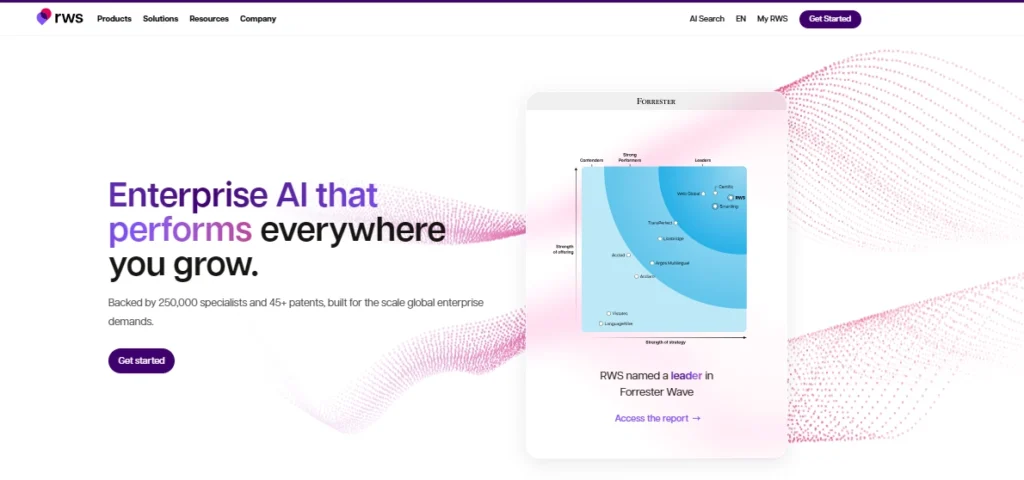
RWS’s enterprise page targets large organizations, citing 8,000 clients in 106 countries and 40,000+ language specialists (vendor-reported), with Trados, Language Weaver and Weava technology. Shortlist it for regulated or strategic programs. The page doesn’t state certifications, so verify them.
Enterprise and Regulated-Industry Fit
Evidence: strategic localization pages, life sciences, legal and government industry pages, and case studies including Jaguar Land Rover. Ask: cases matching your content type and locales.
Human–AI Workflow and Quality Controls
Evidence: expert people plus intelligent technology; ISO 17100 appears on its certification page, scoped by office (September 2023). Ask: actual steps, reviewer independence, quality metrics and exception routing.
Technology, IP, and Implementation Questions
Evidence: Trados and Language Weaver sit inside the offer. Ask: technology dependencies, connectors, data residency, model training and data reuse, asset ownership, migration support and timeline.
4. Lionbridge — Best for Complex, Highly Integrated Localization Programs
Lionbridge Enterprise is a bespoke service for programs with dozens of content streams, channels and formats delivered into hundreds of languages. It lists platform access at no extra cost and dedicated teams. Shortlist it for complex integration. Tailored builds mean governance overhead, and pricing isn’t public.
Bespoke Enterprise Service Model
Evidence: the page describes designing processes, quality standards and dedicated teams per program. Ask: is your program large enough to justify tailored governance?
Language Cloud, Routing, and Connectivity
Evidence: automated routing, selection among five MT engines, APIs, connectors and “any content type.” Ask: a solution diagram, with included and separately scoped parts marked.
Dedicated Team and Performance Evidence
Evidence: a Trust Center page exists; no SLAs are public. Ask: team composition, capacity, service levels, quality dashboard, continuity plan and a comparable reference.
5. Welocalize — Best for AI-Enabled Content at Large Scale
Welocalize, part of Welo Global, describes AI-enabled language services through its Opal platform, combining machine translation, large language models and NLP. Its page lists a New York headquarters and a Q3 2026 Forrester Wave Leader recognition, which it reports itself. Shortlist it for AI-enabled scale. The page gives no pricing or quality metrics.
High-Volume Content and Language-Service Fit
Evidence: promises accuracy, speed and scale without figures; Forrester evaluated 11 providers (vendor-reported). Ask: which claims are measured, and against what baseline?
Opal Platform and Human Oversight
Evidence: MT, LLMs, NLP and workflow apps; a trust center and subprocessor list exist. Ask: content routing, risk detection, what humans review and customer data isolation.
Outcome Measurement and Contract Questions
Evidence: outcome labels such as higher ROI, no numbers. Ask: baseline-to-target metrics, implementation scope, minimums, platform and service fee split, quality remedies and exit plan.
6. LanguageLine Solutions — Best for Translation Plus Interpreting Coverage
LanguageLine’s business page combines interpreting, translation and localization, citing 35,000+ linguists, 410+ translation languages and 270+ interpreting languages. It also pitches vendor consolidation under one master agreement. Shortlist it when you need written and spoken access together. Translation and interpreting pricing aren’t public.
Enterprise Language Access Scope
Evidence: translation, localization and phone, video and on-site interpreting. Ask: where interpreting breadth matters for your program, since this guide covers translation.
Secure Workflows and Regulated Content
Evidence: the page cites secure portals and compliant support; certification and security pages exist. Ask: security, confidentiality, audit, linguist qualifications and review evidence. Don’t reuse accuracy claims without methodology.
Coverage, Response, and Commercial Model
Evidence: 410+ translation languages claimed. Ask: your languages, regional production, urgent-work process, account team, minimums and separate translation and interpreting pricing.
7. Acolad — Best for Centralized Enterprise Programs and Regulated Workflows
Acolad’s enterprise page offers AI, human and hybrid translation through its Lia platform and managed Lia Services. It lists ISO 17100:2015, ISO/IEC 27001:2022, SOC 2 Type II and GDPR. Shortlist it for centralized programs. Its “up to 40% savings” line is a vendor claim.
Enterprise Translation and Regulatory Fit
Evidence: pages cover technical, certified, website and regulated content. Ask: is your need a centralized program or isolated projects?
AI, Human Expertise, and Connectivity
Evidence: Lia Services lists TM, NMT and LLMs, an AI quality estimate and human-in-the-loop correction, plus connectors and APIs. Ask: the proposed model, review gates, data governance and an integration diagram.
Certifications and ROI Claims to Validate
Evidence: the enterprise page lists ISO 27001:2022; its About page lists 27001:2013. Self-service Lia Go lists €24 monthly (17 November 2026). Ask: current certificates, scope, ROI method and included costs.
8. LILT — Best for AI-First Enterprises Requiring Governance
LILT pairs an AI platform with services and expert human verification, with Business, Enterprise and Government plans that are quote-based. Its pages cite SOC 2 Type II and private, on-prem or air-gapped deployment. Shortlist it for AI-first teams needing governance, and confirm which features sit in which plan.
AI Platform and Managed-Service Fit
Evidence: adaptive AI, a human verification network and analytics on one platform. Ask: are you buying software, services or a combined operating model?
Deployment, Security, and Human Verification
Evidence: SOC 2 Type II, GDPR and deployment options claimed; one third-party review says API access and expert verification are Enterprise features. Ask: architecture, model and data use, auditability, verification rules and regulated support.
Integration and Economics to Test
Evidence: a connector catalog including AEM, Contentful, Salesforce, Zendesk, Figma, Jira and GitHub, per a third-party listing of LILT’s pages. Ask: TM and termbase migration, implementation effort, usage and service pricing, and quality baselines.
9. Argos Multilingual — Best for Technical Content, Testing, and Language Assets
Argos Multilingual cites 30+ years serving high-tech, life sciences, HR and financial clients. It lists software localization engineering, linguistic, functional and cosmetic testing, DTP and its AI-enhanced MosAIQ workflow. Shortlist it for technical content where testing matters. Its pages don’t state certifications or pricing.
Technical and Regulatory Content Coverage
Evidence: software localization and testing, DTP, e-learning, voice-over and subtitling. Ask: which services your use case actually needs.
Tailored Linguistic Teams and Asset Management
Evidence: tailored linguist teams, TM creation or alignment, and Rigi linking on-screen text to string IDs. Ask: asset ownership, team qualification and review governance.
AI/MT and QA Questions
Evidence: machine learning described as augmenting linguists; MosAIQ orchestrates AI agents; MosAIQ LQA combines AI scoring with expert validation. Ask: eligible content, scoping and the quality and defect evidence you’d receive.
10. BLEND — Best for API-First, Engineering-Led Localization
BLEND positions API-first translation for engineering teams: custom AI models, REST API and SDKs, GitHub, Figma and CMS integrations, and an MCP server for AI agents to order human translation in 120+ languages. It states it’s part of Tasq.ai. Shortlist it for continuous localization. Its starting price is vendor-reported.
Developer Workflow and Continuous Localization Fit
Evidence: “no TMS required,” REST API, SDKs, webhooks, CI/CD integration and a hosted MCP server. Ask: fit with your repositories and CMS, and what Tasq.ai ownership changes.
Custom Models, Human Oversight, and Controls
Evidence: models trained on your terminology, tone and style, verified by professional linguists. Ask: quality evidence, audit trail, data use and the exact human review included.
Public Price Claims and Pilot Validation
Evidence (vendor-reported, 17 November 2026): starting cost of $0.005 per word. Ask: minimums, exceptions, integration fees and SLAs, then validate in a like-for-like pilot.
Conclusion
There’s no universal winner. Choose by operating model, then test: a governed suite for regulated programs, an engineering-led option for continuous releases, or a pilot-first partner for mixed formats. Whichever you shortlist, require written answers on human review, data use, certificate scope and exit rights before signing.

Send VerboLabs your target locales, representative files, systems, quality requirements, and volume or cadence. We’ll scope a pilot and return a transparent estimate at verbolabs.com/translation-services.
Frequently Asked Questions
Managed language operations that combine linguists, workflow technology, QA, integrations and governance at scale, instead of one-off translation jobs.
Mostly by quote. Public signals are thin: BLEND lists $0.005 per word to start (vendor-reported), and Acolad’s self-service Lia Go lists €24 monthly. Ask for rates, platform and implementation fees, minimums, rush charges and rework terms.
One provider reduces coordination. Several add resilience and specialist coverage but need governance, such as shared assets and a common scorecard. Decide by risk and volume, and require TM and termbase export either way.
Test your own content against a baseline, score errors by type and severity, check where humans review, and confirm data-use and model-training terms. Compare cost per accepted word, not per word translated.
Representative files, target locales, systems, quality requirements and volume. Use one brief for every vendor, a defined acceptance threshold, and a line-item estimate.