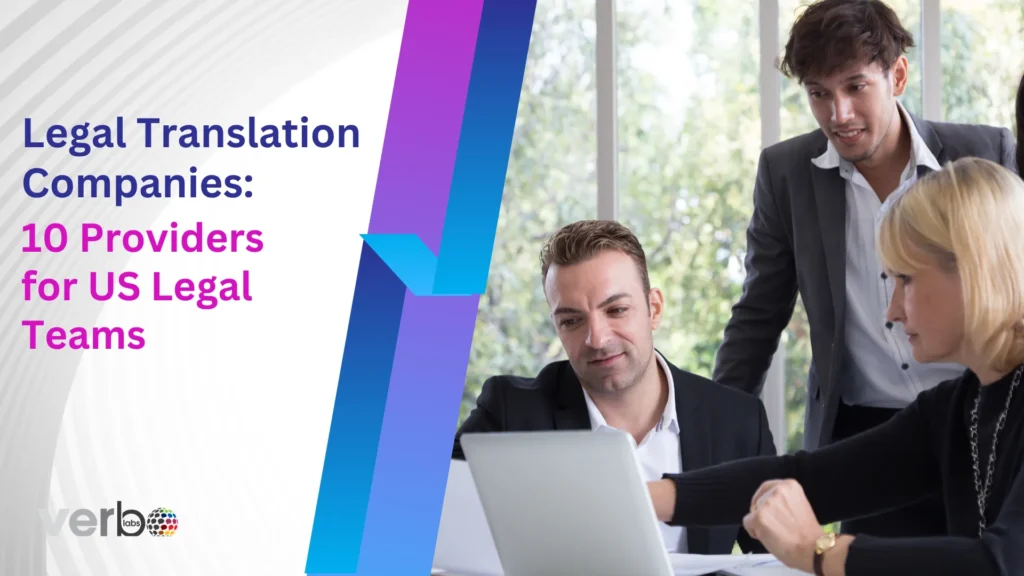
Legal documents minimize the chance of making mistakes. Even a minor change in the clause, wrong spelling of one’s name, or wrong date can lead to confusion and delay in making important decisions. Therefore, it is vital to choose the most suitable legal translation service agencies for law firms, corporate legal departments, and companies active across borders in the USA.
Legal translation isn’t as easy as translating the words from a language to another language. It involves translating a document and not only translating the words; the legal meaning, terminology, names, dates, references, and the format of the document are to be preserved. A word of advice: Buyers ought to learn the significance of words like interpretation, transcription, notarization, and apostille.
TL;DR: Which Type of Provider Do You Need?
TransPerfect Legal and Lionbridge Legal provide great options regarding complicated legal matters like litigation, investigations, and large amounts of documentation. LanguageLine Solutions may cater to organizations that need broader language access in addition to translating documents.
Day Translations and Tomedes provide specialized legal translation services, including services for certified documents. RWS and Questel have better applicability towards intellectual property and something related to patents. VerboLabs provides legal translation and translation of business documents. GTS Translation Services and Gengo necessitate checking their current legal services before putting them on the shortlist.
How We Evaluated These Legal Translation Companies
The introduction to the current comparison has been backed up by evidence. The factors considered in the approach are: legal subject matter fit, human supervision and terminology control, notarization and certification documentation, confidentiality and data management clarity, document type and OCR/PDF support, language range, project management and timelines, e-discovery or IP workflow fit, etc.
Comparison Table: Legal Translation Providers at a Glance
| Provider | Legal Specialization | Human Review / QA | Key Item to Confirm |
| VerboLabs | Legal and business files | Native review & editing | Are non-certified files accepted by your court? |
| TransPerfect Legal | Litigation, contracts, and IP | Bilingual legal review | Are document review and certification separate lines? |
| Lionbridge Legal | Litigation and corporate work | Vetted human and AI review | Does OCR quality handle static or scanned PDFs? |
| LanguageLine Solutions | Legal language access | Dual review & QA | Are translation and live interpreting separated? |
| Day Translations | Contracts and court papers | Legal-linguist review | What exact certification format does the court need? |
| Tomedes | Immigration and corporate matters | Second-linguist review | Does the recipient require notarization? |
| RWS | Patents and IP content | Enterprise specialist review | What are the minimum volume requirements? |
| GTS Translation Services | General and professional text | Human review and QA | Is legal domain experience documented for your pair? |
| Questel | Patent and trademark translation | Specialist IP review | Does this include patent filing or translation only? |
| Gengo | General translation platform | Standard tier review | Is legal subject-matter expertise included? |
1. VerboLabs
VerboLabs provides services related to legal translation and document translation. The company claims capabilities related to contracts and other official documents. For a wider shortlist focused on these files, see these legal document translation services.
Which legal documents fit its documented scope?
Prior to making any requests, one must inform the provider about the kinds of documents and the language pair needed.
What should buyers verify about review and file handling?
Although editing and proofreading services are referred to on the website, customers must determine whether the project will be performed by a legal specialist and whether a separate review will follow.
What must be confirmed before an official submission?
It is important to understand the difference in meanings between translation and translation with certification, notarization, apostille, or sworn translation. Make sure that the deliverables correspond to what the receiving party requires in the written format. If certification is needed, compare certified translation providers for US documents before ordering.
2. TransPerfect Legal
How does its legal-language scope map to litigation and corporate matters?
The documented works involve a variety of contracts, agreements, compliance documents, discovery files, pleadings, witness statements, and issues relating to patents. The variety in these types of documents must assist teams handling several types in one process. Teams handling mainly agreements can also compare legal contract translation services.
What workflow questions matter for complex legal projects?
One should ask how the provider will handle the questions related to terminology, document revision, access rights, etc if it is an important issue. In case one’s team is using e-discovery platforms, one needs to know what tools will be applied for this project.
Which service boundaries need a quote-level check?
Translating, interpreting, transcribing, checking translations, and document processing are different units of work. If recordings must be transcribed before translation, legal transcription services may need to be quoted separately. Verify what specific tasks are included in the price quoted, along with any requirements related to certification, formatting, or filing.
3. Lionbridge Legal

Can it handle scanned or static legal PDFs?
Lionbridge claims to offer PDF and OCR features that can assist in handling image-based documents more effectively. It is beneficial while working with scanned documents and bulk files.
How does it support high-volume discovery and investigations?
Additionally, legal services are geared towards using technology-driven processes to streamline multilingual discovery or investigations.
What certified and interpreting options are relevant?
The company offers certified translation as well as interpretation services, which are to be understood as distinct. You should clarify whether the project involves certified written material, an interpreter in real time, transcription services, or post-editing, while mentioning the purpose of the document.
4. LanguageLine Solutions
When is a language-access provider a fit for a legal team?
An entity may need interpretation services for consultations as well as the translation of documents intended for clients. In such situations, a supplier that provides language services would prove useful. Nonetheless, interpreting deals only with oral communication to complement the effort of translating a text.
What does it say about certified document workflows?
LanguageLine provides information on certified translation regarding certificates of accuracy and related service processes. Request a sample certificate or a description of what is proposed to ascertain whether it is suitable for the recipient’s standards.
How should teams assess sensitive legal content handling?
The legal documents may contain sensitive data about individuals, finances, and business secrets. Check if the supplier has security documentation in place at present, controls of access to information, policies of storage of documents, as well as provisions in relation to data handling proposed by the supplier.
5. Day Translations
Which legal document categories does it explicitly cover?
Their legal service information describes different types of documents, including contracts, court documents, compliance documents, and IP-related documents. You should provide the exact document type to the provider so that it can be recognized that the staff has relevant experience.
How are certification and review described?
The company states that it offers legal translation and certified translation services. You should inquire about the process of assigning translators, whether it includes checking the compliance of terminology and consistency of translation, and what the conditions for formatting are.
What should urgent matters confirm before ordering?
You need to provide the language pair, the number of pages, the quality of the source file, and the required delivery date. You should find out if the stated deadline includes certification of the translation, formatting, and delivery of documents with signatures, and inquire whether charges will apply in case of an urgent order.
6. Tomedes
Which legal subject areas can buyers scope with the provider?
The areas of concern are immigration law, corporate law, intellectual property, and litigation matters. Specify the subject of the law, jurisdiction, source and target languages, and purpose of the translation when soliciting a translation quote. Just because a contractor has vast experience in the legal field, it does not mean the said contractor has translators who are specialized in certain legal fields.
How are AI and human review positioned?
Tomedes, on the other hand, refers to machine-assisted processes for some types of texts, and he maintains that for important documents that need legal certification, it is essential to involve human translators. The client should not assume that the machine-generated text will suffice for a court document or other important materials.
What does the quote need to specify?
Request documentation outlining the number of pages, formats, type of review, certification, and legalization if needed, deadline, number of revisions allowed, and the way files will be processed.
7. RWS
When is IP and patent specialization especially relevant?
Terms such as patent claims, patent applications, prior-art material, patent office actions, and trademark-related content may require specialized terminology. Dedicated IP translation services handle these filings with that terminology in mind. While RWS discusses patent-related translation and IP services, buyers should ensure they know what the individual document requirements and the jurisdiction are.
How can legal teams coordinate multilingual workflows?
For work that is going to be done repeatedly, find out about terminology control, consistency across similar documents, version control, and technologies used in coordinating the job. Confirm with the service provider whether they provide any integration or secure workflow technologies.
Is this the right fit for routine personal documents?
Not every project requires the use of the enterprise provider for IP services. If you are looking to have your Simple Birth Certificate, Personal Affidavit, or another similar document translated, make sure that RWS provides the needed service for the given document’s size.
8. GTS Translation Services
What legal-document evidence is available on its official site?
Look at the latest official service pages for explicit mention of legal translation, document types, and offered languages. If it’s not made clear, assume that they don’t perform every type of legal document, rather than assuming they do.
What review and certification details should be requested?
Find out if the translators have experience in dealing with your specific branch of law, and if independent validation exists. Establish what certificate you expect, along with the possibility of notarizing, confidentiality, and formatting needs of your document.
Why is this a conditional comparison entry?
GTS must stay on your list only if it can provide the services you need right now. Check if they really have some legal experience before sending them any confidential materials or relying on their translations for official purposes.
9. Questel
Which IP-related workflows are relevant to legal teams?
Patent holders and IP departments may require translation services for patent applications filed in foreign markets. Check that the service description is up to date and ask if the provider offers the relevant services for that particular document, language, and jurisdiction.
How should buyers separate translation from IP services?
Intellectual property service providers are likely to be involved in several phases of an intellectual property process. Ask whether the price quote includes only translation, or also services like terminology checking and formatting before filing.
What should be checked before including this provider?
Verify the service name and the exact service page, the available language pairs, types of documents, and availability in the US. Inquire whether the document needs to be certified, but remember that you should not assume that general legal document translation is included in all IP services.
10. Gengo
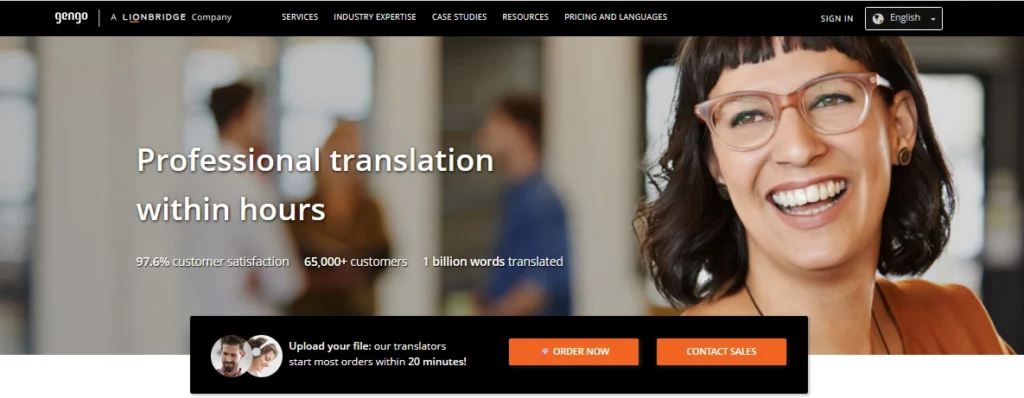
Does the current offering explicitly cover legal documents?
Evaluate the standards of current services to ascertain whether your legal document has ample support. Be sure to check the language pair, file format, service level, and any other limitations before placing an order.
What quality controls apply to sensitive legal content?
Clarify whether the chosen service includes a legal domain specialist, additional proofreading, a confidentiality commitment, and version management.
When should a buyer choose a dedicated legal provider instead?
If the document is intended for court proceedings, submitted to an agency, used in a contract, or involved in an Intellectual Property submission, it may be preferable to go with a specialized legal firm.
Why Choose VerboLabs for Legal Translation Services?
VerboLabs presents translation options for legal and document needs while stating that there are over 120 languages supported, along with editing and proofreading offered as a part of the process. This applies to companies that need multilingual translation of their business documents. The offerings available must be evaluated in the context of specific projects instead of assuming that they fulfill the request, for example by comparing them with other legal language translation services.
Make sure to verify if the person in charge of the file has expertise in legal matters, whether the outside verification is offered, and how the confidentiality of documents is ensured. When dealing with official papers, make sure to ask about verification, notary services, apostille, and certified translations, and to find out about requirements independently.
If you need a document translation, contact VerboLabs.
Conclusion:
The choice of the right legal translation company is dependent on the task at hand. For instance, a law firm that handles discovery documents may require the services of an organization that has legal expertise and the capability of managing high-volume projects. Understanding why legal translation matters more than ever helps define these requirements early.
Examining an intellectual property (IP) team, this unit may be more concerned with patent translation and may prefer to compare dedicated patent translation companies. However, for a company that provides translation of contracts, legal terminology, and quality control may come as the first priorities. Personal and official documents would need to be certified in a special way.

Expand your global reach with VerboLabs! Get accurate, culturally adapted localization services to connect with new markets. Contact us today for expert solutions!
Frequently Asked Questions
A legal translation organization can provide the full spectrum of services: from translating contracts (both international and domestic), agreements, court documents and legal pleadings, such as statements from witnesses and attorney general’s licenses.
No. The requirements depend on the purpose of the document and the organization it is being sent to.
A certified translation generally includes a letter from the translator or translation company confirming the accuracy and completeness of the translation. Notarization usually involves a notary verifying a signature or related formal act; it does not independently establish that the translation is accurate.
No reasonable comparison can assume the same acceptance everywhere. Requirements may differ in the courts, agencies, jurisdictions, and cases. A provider may prepare a document that meets all specifications, but the recipient determines the quality of the translation.
There are a variety of practices. Some provide explanations of measures such as non-disclosure agreements, limited access, secure file transfer, and specific data-processing methods. It is recommended to request updated documents regarding access, storage, storage period, deletion, and any third-party tools used during the processing.
Cost varies depending on the combination of languages, the length of the document, legal complexity, the quality of the source file, the level of review, formatting, certification, and deadlines. Emergency tasks or specialized fields can appear to be more expensive.