

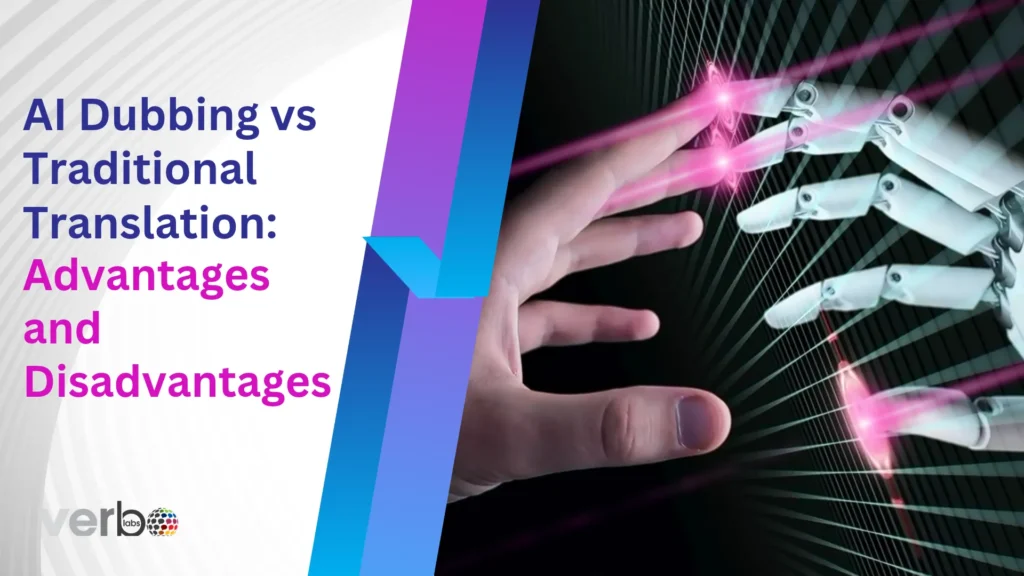
The use of videos allows businesses to easily reach anyone across the globe with any information they want. All sorts of videos, from commercials to product demonstrations to virtual learning sources, have proven to be a powerful way to communicate. However, there are instances where people would not understand the message.
AI dubbing and traditional translation are two methods that should be used to make video content more accessible. AI dubbing uses technology to create a spoken version of the video in a different language. Traditional translation uses human input and consists of making a translation of the script and recording the translated version.
AI Dubbing vs Traditional Translation: The Core Difference
Artificial Intelligence dubbing is a process through which Artificial Intelligence is used to convert the spoken content of a video into other languages. This conversion is done using various tools that may even create synthetic voices resembling that of the original speaker while adjusting the timing in accordance with the video.
AI dubbing begins when speech recognition occurs. The AI identifies the words spoken in the video, translates the speech into the target language, and creates sound in this new language. Some tools also include speaker identification, voice cloning, and automatic subtitle creation. The features will depend on the particular AI used, so when comparing AI dubbing services, ask which of these features are included and where human review happens.
Human dubbing involves people in more stages of the process. The dialogue script for dubbing is written by the translator and may be proofread by the language reviewer. The voice actors lend their voices for the translated dialogues, while the sound engineer and editor complete it by changing the timings or volume, etc. The biggest difference between the types of dubbing is not in the usage of technology or the extent of human involvement in the process. Human dubbing is a way of letting qualified people participate in the process of dubbing and make conscious creative decisions concerning tone, rhythm, humor, and culture.
Advantages of AI Dubbing
AI dubbing helps businesses to produce videos in different types of languages.
- Cost-effective production: AI tools offer the advantage of dubbing audio more quickly than traditional processes that require script-writing, voice recording, and editing in a studio. Organizations can get speedy translated versions of product videos, instructional videos, and internal training materials.
- Affordable production: Using this, eliminates the need for voice actors and the time spent in studios. This can be helpful for companies with limited finances. However, pricing depends on the chosen solution, language pair, amount of editing needed, and the requirements for review.
- Multilingual production support: Some AI dubbing techniques support generating audio files in multiple languages using a single workflow, and that makes it easy to produce content for several segments of markets without having to record audio for each language.
- Reliable output: By using the same synthetic voice across many voiceovers, a brand can maintain its identity in its recorded form of communications. This can help in the creation of tutorial videos, product updates, etc.
- More convenient updates: If a certain function has been changed in a product or an instruction has been revised, the team can just change the script, and the audio will be ready. Compared to organizing a new recording session, this approach is much more convenient, especially for newly released materials.
- Choice of accents and styles: Depending on the platform used for production, people can choose among various voice styles and accents.
Disadvantages of AI Dubbing
AI dubbing helps to render voice so that one can clearly understand what is voiced; however, it is unable to convey emotions similar to those of the human speaker. Knowing the most common AI dubbing translation mistakes helps teams decide which lines need human review.
- An AI-generated voice does not express emotions as effectively as a natural one does. A machine can do everything in the correct form, but can be incapable of communicating the emotions.
- There can be cases when a translation is inaccurate due to misinterpretation of unclear speech, difficult terminology etc. Errors in the source transcription can cause further issues in AI translation.
- Names, local phrases, etc can be pronounced incorrectly by the system/machine. As a result, the audience may feel that the product is not of adequate quality.
- Cultural differences can be dangerous for the process of translation, as phrases that sound good in one language may sound rude, strange, or awkward in the other language. AI translation applications may miss the proper cultural meaning of the phrases, even if the provided translation seems to be correct.
- The synthesized voice won’t be able to copy the inflections and speech patterns of the original speaker.
Advantages of Traditional Translation and Human Dubbing
Services related to human translation and dubbing are significant when it comes to transmitting information in an emotionally meaningful or culturally relevant way, or when conveying exact terminology.
Better understanding of context: Human translators can handle the matter well as they can understand the purpose of the video, the nature of relationships between the speakers, and what the phrase means exactly in the context of the main plot.
Natural emotional delivery: Voice actors are able to select the proper tone, the pace of speech, loudness, and pauses depending on the requirements of a concrete scene.
Cultural adaptation: Human interpreters can notice various jokes, idioms, references, and quotes that may be lost in the target language. They can transform such elements in order to keep the original message and brand intact.
Supervision of voice acting: Producers can choose voice talents according to their age, accent, and speech style. They can also manage the acting process and ask for changes if the results do not meet the demands.
Better creative control: The human-based dubbing teams coordinate the script and sound design. These might be crucial in the audio production of movies, commercials, and videos in cases where the timing or tone is set inaccurately in the beginning.
Human dubbing doesn’t mean 100% accuracy. Errors made during translation, inconsistencies in terminology, and actors’ performances are also possible, and these are the same issues behind most cases of bad dubbing. The quality will depend on the people involved, the guidelines, and the monitoring of the process.
Disadvantages of Traditional Translation and Human Dubbing
- Higher costs: Production costs are expected to rise due to the requirement of hiring a professional translator, voice actor, sound designer, and project manager. Creating versions for several languages might mean recording in each language separately from scratch.
- Long deadline: The process of making several videos for languages would require a thorough translation of the script and preliminary recordings first. Thus, all the team members would have to work together.
- Keeping in mind constant content updates: With regular changes of the educational resources, there will be a necessity to re-record the voices as well. Even minor changes may require a lot of work.
- Problems with team coordination: There will be a number of people involved in the project, such as translators, voice actors, editors, and so on. Coordinating their work is going to be rather difficult.
- Difficulties with the dubbing process: The dubbing of the same text by several voice artists can lead to different results of dubbing and make supervision impossible.
Cost, Speed, Quality, and Scale Comparison
| Comparison Factor | AI Dubbing | Traditional Translation & Dubbing |
| Production Speed | Fast (minutes to hours) | Slow (days to weeks) |
| Cost | Low (software-based pricing) | High (studios, actors, engineers) |
| Language Scale | Dozens to 150+ languages instantly | Limited by available voice actors |
| Emotional Depth | Good, but can lack complex nuance | High (human expression and acting) |
| Voice Options | Synthetic voices or voice cloning | Professional human voice actors |
| Best Use Case | Marketing, training, large video libraries | Films, dramas, character storytelling |
Best Use Cases for AI Dubbing, Human Translation, and Hybrid Workflows
Various video content forms require different degrees of attention. The first step in the selection of an appropriate solution is comprehension of what the video needs to convey.
AI audio dubbing works fine for training videos, simple tutorials, video instructions for software products, educational videos that undergo regular changes, and a large number of informational video materials. Production time is shorter in those cases because several linguistic versions of the videos can be created.
Movies, documentaries, advertisement campaigns, narrative films, and materials that contain humor or cultural references are best translated and dubbed by the human. Human dubbing is also necessary in avoiding the dissemination of incorrect information in certain cases. The hybrid approach uses a combination of technological and human intelligence. For example, the first version of the audio can be performed by robots, while linguists are involved in the accuracy control stage. The discussed solution is capable of streamlining the production process without eliminating quality guarantees. Real results after replacing human voiceovers with AI-dubbed audio show where this human review makes the biggest difference.
Which should you choose? Use-case guide
Make use of AI dubbing when speed, cost-efficiency, and volume of work are paramount, and the content can be verified properly. Checking how much AI dubbing actually costs for your languages and minutes makes this comparison easier.
Think about human dubbing when you want to ensure emotional delivery, creativity, cultural references, or complete control over the finished product. Working with dubbing and voice-over experts is the usual route for this level of control. Before making your decision, try both options on a specimen of your content. It is best to weigh them against each other in terms of the meaning, pronunciation, naturalness, timing, and price.
Conclusion
The process of producing videos in several languages has been made much easier because of both AI dubbing and traditional translation. AI dubbing can speed up the length of the video production process, enable videos to be done in various languages, and help manage the large library of videos effortlessly. On the other hand, traditional translation and human dubbing give one more control over the language, emotions, connotations, and the way something is conveyed to the audience. Reviewing current dubbing prices for both approaches helps you budget for the option that fits your content.

Expand your global reach with VerboLabs! Get accurate, culturally adapted localization services to connect with new markets. Contact us today for expert solutions!
Frequently Asked Questions
AI dubbing tends to be economical, particularly when a business has to translate a number of videos into various languages. It has the potential to cut down on both recording and editing costs. Nevertheless, subscription and usage fees, human checking, and editing may increase the total.
Traditional dubbing is a method that is more appropriate when emotion, timing, and culturally specific voice acting are important aspects of the video. AI dubbing can be used for easier content that does not require much time for production.
Human dubbing is to be utilized in situations such as dubbing movies, advertising, documentaries, dialogues of characters, or when the video’s contents include emotions or cultural values. Furthermore, it may be the best solution for sensitive materials that should not be represented wrongly.
AI dubbing software is used for tone and style alteration, but it can vary. Nonetheless, the ability to produce realistic sounds does not come to the same naturalness as a successful actor.
When it comes to the creation of corporate training videos, there is a particularly valuable necessity to localize the content in different languages. Before being used in corporate video training, the materials should be thoroughly checked in terms of the terminology used, words, timing, and pronunciation.
The hybrid dubbing method combines the use of artificial intelligence technologies with the evaluation made by humans. In this process, artificial intelligence helps prepare the first draft of the voiceover, while the expert analyzes everything to ensure the correctness of the materials from the perspective of the text itself, language errors, and pronunciation.
Brands should bear in mind that incorrect translations and voice errors can lead to different types of concerns and issues, including time, cultural misunderstandings, and voice privacy.

Pingback: Why Game Developers Prefer AI Dubbing Over Traditional VO