

As a business professional, looking for a localization company is crucial, because it impacts your UI, UX, functionality, terminology, release schedules, and overall customer experience.
An expert agency can help brands manage their software by making it more accessible to a larger audience.
In this guide, we have discussed various professional companies that offer best software localization solutions in the contemporary industry.
What Does a Professional Software Localization Company Actually Handle?
Working with a professional software localization company can be easy, if one understands their basic operations and services. An agency can help with adapting the text in the desired language, management of the glossary, localization of the UI/UX, QA through special linguist, pre-testing, and regular updates after the delivery.
How Should You Evaluate a Professional Software Localization Provider?
For a product team, the following factors are useful when comparing providers:
- Software and product localization experience
- Developer integrations, APIs, and automation
- Linguistic and functional QA
- AI and human review model
- Language and locale coverage
- Translation memory and terminology management
- Security and compliance requirements
- Release frequency and scalability
- Industry or domain expertise
- Project ownership and ongoing support
10 Professional Software Localization Companies to Consider
1. VerboLabs
What can they localize?
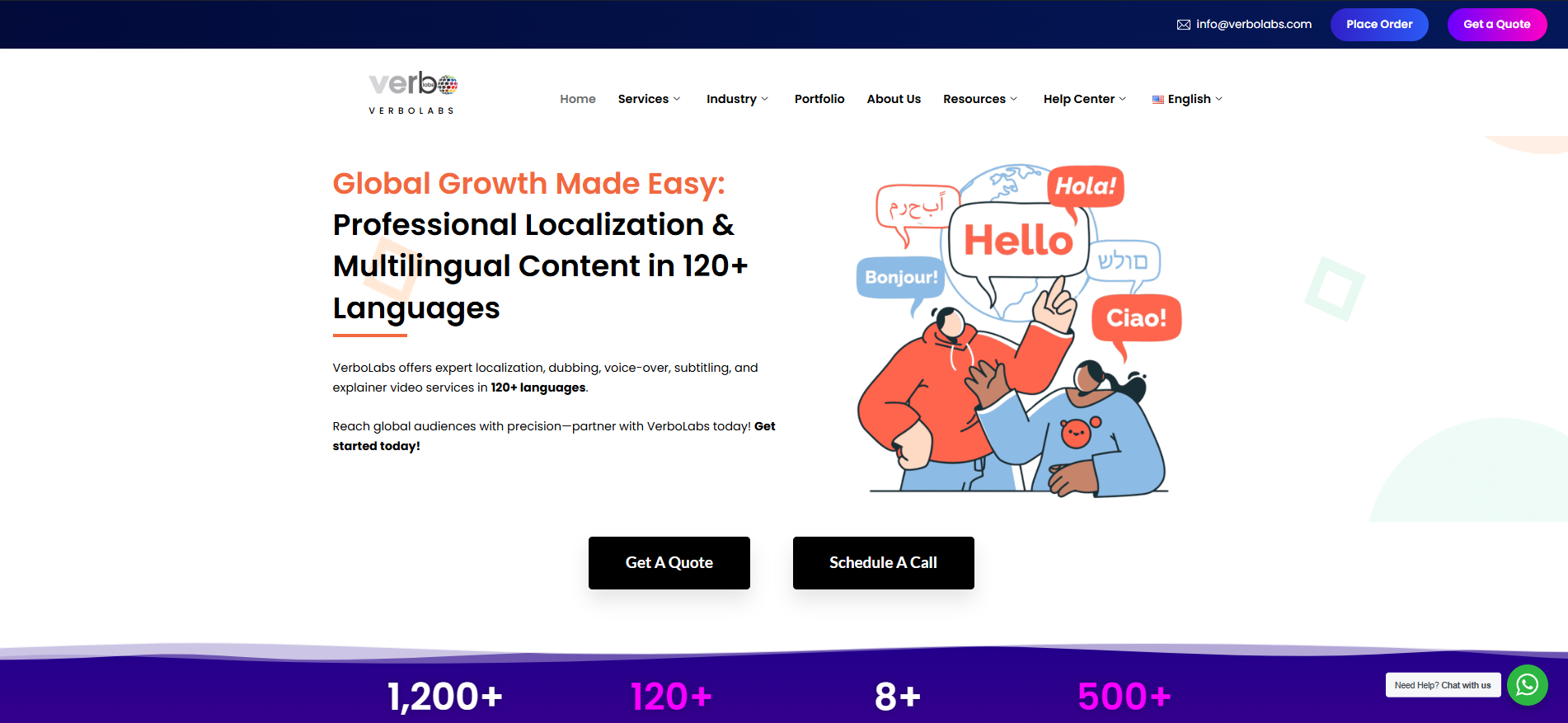
Software, mobile apps, UI content, and supporting digital content across 120+ languages.
How do they fit your workflow?
Their app localization process includes content adaptation, UI compatibility checks, language testing, and delivery support.
How do they ensure quality?
Native linguistic resources, UI checks, and language testing are part of the stated workflow.
What makes them different?
They combine localization services with AI-assisted workflows and multilingual content capabilities.
Who are they best for?
Product teams looking for managed software or app localization with linguistic and testing support.
2. TransPerfect

What can they localize?
Software, mobile apps, UI content, documentation, and related product materials.
How do they fit your workflow?
TransPerfect supports resource-file formats and integrations with version-control systems and code repositories.
How do they ensure quality?
Their process covers extraction, localization, re-engineering, and testing.
What makes them different?
GlobalLink technology and visual localization tools provide technical and contextual support.
Who are they best for?
Organizations needing an end-to-end managed localization setup for complex software products.
3. Lionbridge

What can they localize?
Software, mobile applications, and connected digital products.
How do they fit your workflow?
Services include internationalization, software engineering, and localization support.
How do they ensure quality?
Lionbridge offers linguistic, functional, and user acceptance testing, along with bug fixing.
What makes them different?
Its offering extends from engineering through in-market device testing.
Who are they best for?
Product teams requiring technical localization and testing across multiple platforms.
4. Welocalize

What can they localize?
Software, product content, and technology-related materials.
How do they fit your workflow?
Its OPAL platform supports configurable localization workflows using AI, automation, and expert review.
How do they ensure quality?
Welocalize provides linguistic and functional testing for software, websites, and apps.
What makes them different?
Its model combines industry-specific workflows with AI-enabled service delivery.
Who are they best for?
Larger technology organizations with recurring localization and testing needs.
5. Smartling

What can they localize?
Software, websites, apps, and other digital product content.
How do they fit your workflow?
Smartling supports automation, integrations, and continuous localization workflows.
How do they ensure quality?
Its offering includes automated QA, localization testing, and human linguistic review.
What makes them different?
The platform combines AI-assisted translation with professional linguists.
Who are they best for?
Teams looking to reduce manual localization work while maintaining human review.
6. RWS Group

What can they localize?
Software interfaces, documentation, help content, and supporting product materials.
How do they fit your workflow?
RWS combines localization services with technologies such as Trados and Language Weaver.
How do they ensure quality?
Linguistic review, engineering, and functional testing are included in its software localization approach.
What makes them different?
Its localization technology portfolio includes specialized tools such as Passolo for software interfaces.
Who are they best for?
Enterprise teams with complex multilingual programs and ongoing localization requirements.
7. LILT
What can they localize?
Software, product content, documentation, and support materials.
How do they fit your workflow?
LILT combines localization services with AI-based translation workflows and expert verification.
How do they ensure quality?
Human experts review and refine AI-generated content.
What makes them different?
Its model puts adaptive AI and linguistic expertise together.
Who are they best for?
Enterprise teams managing high-volume multilingual software content.
8. Phrase
What can they localize?
Software strings, web and mobile product content.
How do they fit your workflow?
Phrase provides APIs, CLI tools, webhooks, and CI/CD integrations for developer-led localization.
How do they ensure quality?
Built-in checks identify issues such as missing variables, placeholders, and text-length problems.
What makes them different?
Its developer-first approach is designed around continuous software delivery.
Who are they best for?
SaaS and product teams that want localization closely connected to development.
9. Lokalise
What can they localize?
Mobile apps, websites, games, software, and digital content.
How do they fit your workflow?
Lokalise connects with repositories, design tools, and CI/CD environments, with API and webhook options.
How do they ensure quality?
Review workflows can use screenshots, translation memory, and quality scoring.
What makes them different?
Its workflow is designed to keep localization connected to product releases.
Who are they best for?
Agile product teams that want a platform-led localization process.
10. Crowdin
What can they localize?
Software, mobile apps, games, websites, and documentation.
How do they fit your workflow?
Crowdin supports Git integrations, APIs, multiple file formats, and CI/CD workflows.
How do they ensure quality?
Built-in QA checks, context review, and human proofreading support the workflow.
What makes them different?
Its broad integration ecosystem is built around continuous localization.
Who are they best for?
Development teams that want localization closely tied to repositories and release processes.
Software Localization Providers Compared: Which Model Fits Your Team?
| Provider | Model | Developer Integration | QA/Testing | Potential Fit |
| Verbo Labs | Managed / Hybrid | Supported | Linguistic + UI testing | Software and app teams |
| TransPerfect | Managed / Hybrid | Strong | Linguistic + functional | Enterprise products |
| RWS | Managed / Platform | Strong | Linguistic + functional | Enterprise localization |
| Lionbridge | Managed | Supported | Functional + linguistic | Complex software |
| Welocalize | Managed / AI-enabled | Workflow-based | Linguistic + functional | Large technology teams |
| Smartling | Platform / Hybrid | Strong | Automated + human | Scalable digital products |
| LILT | AI + Human | Workflow-based | Expert review | Enterprise content |
| Phrase | Platform | Developer-first | Automated QA | SaaS/product teams |
| Lokalise | Platform | Developer-first | Contextual QA | Agile product teams |
| Crowdin | Platform | Developer-first | Automated + human | Development-led teams |
How VerboLabs Can Be the Right Software Localization Partner for Your Product
For software teams, VerboLabs offers software and app localization across 120+ languages, with native linguistic resources, UI compatibility checks, and language testing. Its workflow can support teams that need more than translated strings, particularly where UI context, language testing, and ongoing multilingual content matter.
For a scoped discussion, share the product type, source or resource format, target locales, and expected release schedule to discuss the localization requirements and receive a suitable quote.
Conclusion
A software localization provider should fit the way a product is built and released. Consider technical workflow, language scope, QA, security, update frequency and the balance between managed services and platform ownership before making a decision.
Frequently Asked Questions (FAQs)
It can manage translation, cultural adaptation, terminology, UI review, engineering, linguistic QA and functional testing. The exact scope varies by provider and project.
Software localization helps businesses improve user experience, increase adoption rates, and build trust in international markets. Proper localization reduces user friction, ensures compliance with local regulations, and prevents brand misinterpretation, which directly impacts revenue and customer retention.
Software localization companies in the USA provide multilingual expertise, technical integration with development workflows, linguistic testing, and compliance support. They help businesses scale internationally by delivering consistent, high-quality localized software across regions.
A localization company generally provides managed services alongside technology. A platform mainly gives an internal team the tools to manage localization workflows themselves, although some providers combine both models.
Key factors include industry experience, language coverage, technical capabilities, quality assurance processes, scalability, and client reviews. A reliable partner should combine AI-powered tools with expert human linguists for accuracy and speed.
AI-powered localization accelerates translation, maintains consistency using translation memory, and reduces costs. When combined with human review and testing, it delivers fast turnaround times without sacrificing quality or cultural accuracy.
Yes. Professional software localization includes linguistic testing, UI validation, and functional testing to ensure Many do. Services can include linguistic testing, UI checks, functional testing, and user acceptance testing, but the exact testing scope should be confirmed before signing a project.
Yes. Several platforms and providers offer APIs, CLI tools, repository connections, webhooks or CI/CD integrations to move strings between development and localization workflows.

Looking for expert software localization? VerboLabs ensures accurate, culturally adapted translations for seamless global expansion.