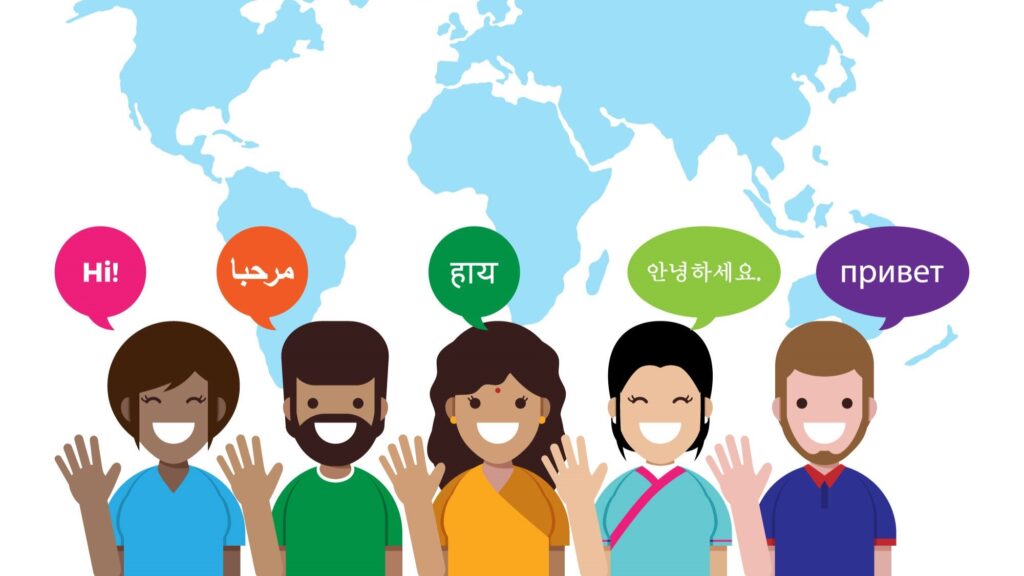

By 2026, the global e-learning market is projected to surpass $400 billion. For US businesses, this isn’t just a statistic; it’s a strategic signal. Whether you’re a Silicon Valley tech company training a remote team in Tokyo or a healthcare provider in Miami launching a digital wellness course for Spanish-speaking audiences, the bridge between your content and your learners is built through professional localization services.
However, entering the world of localization can feel like stepping into a room full of technical jargon. Terms like XLIFF (XML Localization Interchange File Format), LQA (Linguistic Quality Assurance), and transcreation are common in translation and localization workflows. Without understanding this terminology, businesses risk costly miscommunication.
This blog serves as your practical introduction to the key localization and translation terms shaping e-learning in 2026.
What is a Localization and Translation Glossary?
A Localization and Translation Glossary is a centralized reference document that defines approved terms and their correct translations for a specific project, product, or brand.
It typically includes:
- Source term (e.g., “Course Module”)
- Approved translations (e.g., French and Spanish equivalents)
- Definitions or context
- Usage notes (tone, audience, technical constraints)
- Terms to avoid
Its purpose is to ensure terminology consistency, accuracy, and brand alignment across languages. In localization projects—especially in e-learning, software, or multimedia—it prevents inconsistent translations that could confuse users or weaken brand identity.
Also Read,
- What Are Translation Services? A Complete 2026 Guide for Businesses and Professionals
- What is Localization? A Complete Guide to Reaching Global Audiences
- What Is App Localization?
Key Glossary Terms in E-Learning Localization
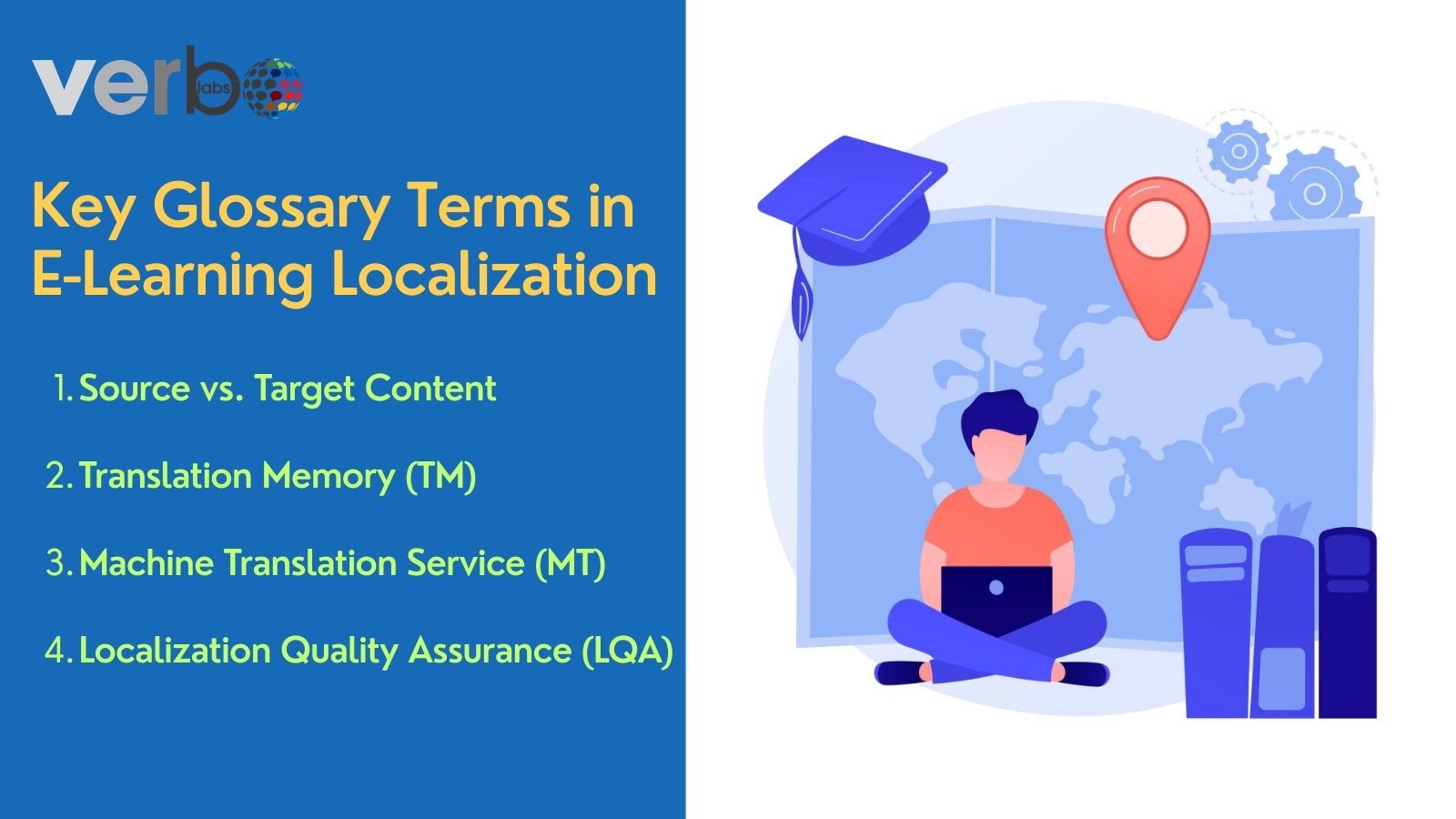
To navigate a translation service for business, you need to master these core concepts:
1. Source vs. Target Content
- Source Content: The original text in its original language (not necessarily English).
- Target Content: The translated version in the target language (e.g., Brazilian Portuguese).
The source language depends on the original material, not the company’s location.
2. Translation Memory (TM)
A Translation Memory (TM) is a database that stores previously translated segments (sentences or phrases). When the same or similar text appears again, it is reused, significantly reducing translation service cost by avoiding paying full price for repeated content.
3. Machine Translation Service (MT)
A machine translation service automatically translates text using AI. While fast and cost-effective, raw MT may lack contextual nuance and stylistic accuracy. In 2026, the industry standard for professional workflows is MTPE (Machine Translation Post-Editing), where a human linguist reviews and edits the machine output to ensure accuracy, consistency, and quality.
4. Localization Quality Assurance (LQA)
Localization Quality Assurance (LQA) is the final validation stage where linguists review the localized course within the Learning Management System (LMS) to ensure linguistic accuracy, correct formatting, proper text display (e.g., no truncation or overflow), functional UI elements, and accurate synchronization of audio, video, and subtitles.
Types of Translation Services Explained
Depending on your industry, you might need different types of language translation services:
| Service Type | Best For | Key Requirement |
| Document Translation | PDFs, Manuals, Handouts | High linguistic accuracy |
| Multimedia Localization | Videos, Audio, Subtitles | Timing and sync expertise |
| Medical Translation Service | Healthcare CME, Clinical Training | Compliance and SME review |
| Professional Localization | Interactive E-learning, Apps | Cultural adaptation of UX/UI |
A translation service for medical document sets requires a highly specialized approach. In healthcare e-learning, you are not just translating content; you are using medical translation services that ensure linguistic accuracy, medical terminology precision, and compliance with strict U.S. regulations such as the Health Insurance Portability and Accountability Act (HIPAA) and international healthcare standards.
Translation Service Cost: What Businesses Should Expect
Budgeting for professional localization services in 2026 requires understanding several variables. It is rarely a one-size-fits-all pricing scenario.
- Per-Word Rates: Common for text-heavy content, typically ranging from $0.08 to $0.25 per word, depending on language pair, volume, and subject matter.
- Multimedia & Engineering: Often priced per minute of audio/video (for dubbing or voiceover) or per hour/project for engineering tasks such as subtitle integration, SCORM re-packaging, or LMS testing.
- Content Complexity: Specialized content (e.g., medical or legal training) costs more due to required subject matter expertise and terminology validation.
- Formatting / DTP: Courses with complex layouts or graphics may require Desktop Publishing (DTP) to maintain native formatting in the target language.
Pro Tip: Partnering with the best document translation service that uses Translation Memory (TM) and terminology management can reduce future update costs by up to 30%, depending on content repetition and change volume.
Choosing the Right Translation Service Company
With thousands of translation service companies competing for attention, choosing the right partner requires more than comparing rates.
In e-learning and multimedia localization, you must look beyond simple text translation:
- Technical Expertise: A qualified translation service for business should support SCORM (1.2/2004), xAPI (Tin Can), and legacy AICC packages without breaking LMS functionality. True expertise includes republishing courses, handling authoring tools (e.g., Articulate, Captivate), and validating LMS compatibility during deployment.
- Cultural & Visual Localization: It’s not just language. Experienced partners review imagery, gestures, voiceover tone, symbols, and compliance-sensitive content to prevent cultural missteps before launch.
- Scalability & Workflow Control: Enterprise-grade providers use terminology management, translation memory, and centralized QA workflows to maintain brand and linguistic consistency—whether launching in 5 languages or 50.
- Functional QA Testing: Beyond linguistic review, they conduct in-course testing to ensure that UI elements, navigation, character limits, text expansion, and audio synchronization work flawlessly in the final LMS environment.
How VerboLabs Supports Your E-Learning Needs?
In the fast-paced 2026 landscape, VerboLabs stands out among leading translation service companies. We don’t just swap words—we adapt experiences.
By combining deep linguistic expertise with advanced multimedia engineering, VerboLabs delivers high-quality translation service for business needs. From corporate compliance modules to complex medical simulations, we provide cost-effective localization solutions that respect your budget while exceeding your quality expectations.
Conclusion
As the global e-learning market accelerates toward a $400 billion future, mastering localization terminology is no longer optional—it’s a strategic advantage. Understanding key concepts like Translation Memory, LQA, and multimedia engineering empowers businesses to control costs, maintain brand consistency, and deliver culturally relevant learning experiences worldwide. Successful localization goes beyond translation; it ensures technical functionality, regulatory compliance, and learner engagement.
With the right partner, such as VerboLabs, companies can confidently expand into new markets while preserving quality, accuracy, and impact.

Ready to localize your e-learning content with confidence? Partner with VerboLabs and take your global training strategy to the next level.
Frequently Asked Questions (FAQs)
The “Big Four” are: Translation Memory (TM), XLIFF (the file format used for exchange), LQA (Quality Assurance), and Transcreation (creative adaptation).
Business translation accounts for brand voice, corporate terminology, and industry-specific jargon, whereas general translation focuses purely on literal meaning.
It includes translation, cultural adaptation of imagery/gestures, voiceover/dubbing, subtitle integration, and technical testing within an LMS.
Text usually costs between $0.10 and $0.25 per word. Video and multimedia tasks are often billed at hourly rates (ranging from $40 to $120) or per-minute of footage.
Human expertise is non-negotiable in medical translation services to ensure patient safety and regulatory compliance.
Companies like VerboLabs, TransPerfect, and Lionbridge are industry leaders known for their ability to handle large-scale, complex US corporate requirements.