
If you are an engineer or work with an IT company, the most important factor is remembering, storing, and managing the key documentation of every product, process, shipment, and error in between. In this, you also have to ensure that the technical translation of this important documentation is done with intensive attention to detail, and no mistakes are left behind. You opt for an AI tool that can help you make your work more strategic, less chaotic, and faster to complete. But you are stuck choosing the correct tool for your business and work. In this situation, you can take the help of this comparison guide. This comparison is not done to score the tools or establish one as better than another, but rather curated for professionals to choose a tool that fits their business best.
TL;DR
These are editorial shortlisting suggestions, not measured winners.
- CENTROID by VerboLabs: AI-led manual localization with quality oversight.
- XTM Cloud: structured technical documentation.
- Smartling: enterprise technical content operations.
- Smartcat: AI and human-review coordination.
- Phrase TMS: multi-team manual translation programs.
- Redokun: document-led manufacturing teams.
- memoQ TMS: technical linguist collaboration.
- Trados Team: cloud collaboration for technical translation teams.
- Pairaphrase: team-based business document handling.
- wxrks (Bureau Works): AI-assisted technical document operations.
Compare the 10 options by buying requirements
The comparison table added below does not state one better than the other, but simply puts their features in a systematic manner for your understanding and decision making.
| Product (category) | Formats to test | Version/change behavior | Terminology & engineering review | DTP/setup dependency | Pricing basis | Key open check |
| CENTROID by VerboLabs (AI-led) | Your authored files | Revised-chapter handling | Glossary, QA oversight | Who owns layout | Contact sales | Update workflow |
| XTM Cloud (enterprise TMS) | DITA/XML, FrameMaker, IDML | Changed-segment reuse | Termbase, workflow steps | Filter setup | Quote-based | Exact filter |
| Smartling (enterprise TMS) | Office, XML, connectors | Connector versioning | Approval routing | Integration effort | Quote-based | Safety sign-off path |
| Smartcat (AI platform) | Office, layout files | AI output after revisions | Glossary to reviewer | Review staffing | Plans plus usage | Reviewer context |
| Phrase TMS (enterprise TMS) | XML, Office, IDML | Cross-site TM reuse | Term and sign-off rules | Workflow design | Quote-based | Vendor governance |
| Redokun (document engine) | Word, Excel, PowerPoint, IDML | Document update sync | Glossary, light review | Complex layouts | Plan-based | Engineering structures |
| memoQ TMS (linguist-led) | Tagged and XML files | Term-change effects | External reviewer access | Server setup | Quote-based | Reviewer handoff |
| Trados Team (cloud collaboration) | Tagged packages | Version return | Team roles, QA | Studio/Enterprise gaps | Subscription | Edition scope |
| Pairaphrase (document platform) | DOCX first | Memory reuse | Glossary, team sign-off | Structured formats | Plan-based | Specialist support |
| wxrks (Bureau Works, AI-assisted) | Confirm required types | Release traceability | Engineering glossary | Format coverage | Contact sales | Technical formats |
What should manufacturers look for in a translation management system?
Five criteria drive the review.
Technical formats and document structure
Check DITA/XML, FrameMaker, IDML and Office as they apply. Test tags, cross-references, warning boxes, tables and diagram labels, and note what needs preprocessing or DTP.
Context-led AI and approved technical terminology
Look at domain context, approved part names, prohibited terms and memory reuse.
Automated QA and specialist review
Automated checks should cover numbers, units, tags, omissions and terminology. Decide who performs engineering review on safety text and who approves the final target content.
Manual revisions and content-system integration
Follow one changed chapter from intake through translation, review and publication. Confirm CCMS/CMS integration, version identity and handling of unchanged translations.
Access, implementation and total cost
Set access boundaries for plants and suppliers. Compare setup, file processing, specialist review, integrations and layout work alongside the subscription.
How did we evaluate the shortlist?
We compared each tool against the five criteria above and listed open checks. Documented features, vendor claims and missing evidence are not used as proof of absence. The current pricing and independent reviews, which includes rating, scale, count, product, URL, and date, must be added before any publication.
The 10 Best Translation Management Systems for Manufacturing Product Manuals
Order is not a performance ranking. CENTROID appears first as the publisher’s own product.
1. CENTROID by VerboLabs — AI-led manual localization with quality oversight
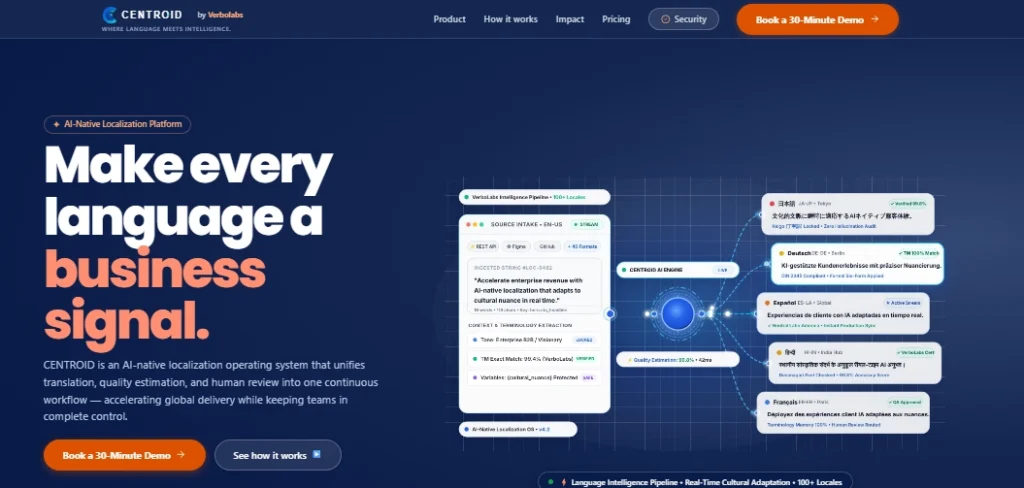
CENTROID by VerboLabs is an AI-powered Translation Management system with a quality-oversight layer, built by this article’s publisher. Its proposed fit is manufacturers that want machine speed on manuals without losing review control.
Why CENTROID by VerboLabs Fits Manufacturing Teams
CENTROID is the best tool available for teams that are looking for localizing manuals with warnings, numbers, and diagrams. You can try working with CENTROID if the key requirement is for AI drafts and structured review system.
CENTROID by VerboLabs: Features, AI & Quality
Review its official materials for machine translation, memory, terminology, automated QA and human review. Confirm how each applies to a revised chapter and which CMS or CCMS integrations exist.
CENTROID by VerboLabs: Pricing & Customer Feedback
Treat pricing as contact sales unless a public page says otherwise. Ask about usage, setup and review charges. No independent rating is recorded yet; add platform, score, count and date.
CENTROID by VerboLabs: Limitations & Buyer Checks
Public details on DITA or FrameMaker support are unverified here, not absent. Pilot a changed torque value and check version identity, reused segments, and layout defects.
2. XTM Cloud — structured technical documentation
XTM Cloud is a cloud translation management system aimed at teams with structured content and configurable workflows. Our proposed fit is structured technical documentation, where DITA, XML, or IDML files must pass through intact. That depends on the filter your authored files actually use, so validate it early.
Why XTM Cloud Fits Manufacturing Teams
Suited to documentation groups with structured authoring and a defined localization process. Its place on this list rests on workflow control rather than on any single headline feature.
XTM Cloud: Features, AI & Quality
Check current documentation for machine translation, memory, terminology, QA checks, review steps, and connectors. Confirm the filter and workflow for DITA/XML, FrameMaker or IDML specifically.
XTM Cloud: Pricing & Customer Feedback
Record any independent rating with platform, count, and date before citing it.
XTM Cloud: Limitations & Buyer Checks
Not every manual is a Word file. Ask which configuration handled your authored file and who verifies output after the next source revision.
3. Smartling — enterprise technical content operations
Smartling can be your next big collaboration if you want to work with a professional AI tool for your translation requirements. They offer translation management, AI-assisted translation and human review.
Why Smartling Fits Manufacturing Teams
You can consider Smartling for your next project if you are also a large organization that has multiple content streams requiring central governance.
Smartling: Features, AI & Quality
The most talked-about features and quality offered by this tool is their glossary control, QA, and emphasis on context of the content while working on connectors.
Smartling: Pricing & Customer Feedback
Add independent review data only with a verified source and date.
Smartling: Limitations & Buyer Checks
Enterprise breadth can mean heavier setup. Confirm how structured manual formats are handled and whether the approval flow fits engineering sign-off.
4. Smartcat — AI and human-review coordination
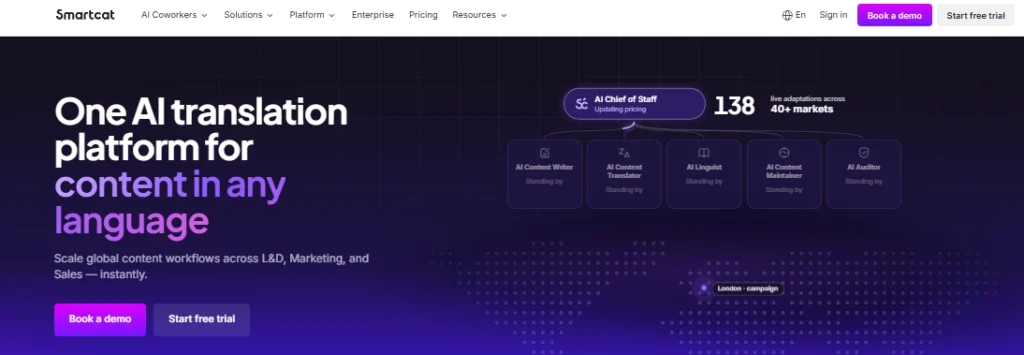
When any brand specifically looks for an AI-led translation platform that can combine the operations of a machine with human review, and easy vendor access, Smartcat is a smart choice. This tool is suggested when a coordination between AI drafts and technical reviewers is needed.
Why Smartcat Fits Manufacturing Teams
Smartcat can be the perfect choice for your team if you also want an AI drafting along with systematic human review within the same tool.
Smartcat: Features, AI & Quality
You can either visit the its website or look at currently published documentation about AI translation, memory, glossaries, QA, and even collaborations.
Smartcat: Pricing & Customer Feedback
Note review staffing costs. Record any independent rating with platform, count, and date.
Smartcat: Limitations & Buyer Checks
Test tagged and layout-heavy manuals, not only simple files. Confirm how revised sources are handled and where engineering review is documented.
5. Phrase TMS — multi-team manual translation programs

Earlier named Memsource, Phrase TMS is a translation management tool that was created for workflow automation that can be used by various teams and vendors. This tool is suggested when your brand needs manual programs spanning factories and product lines, and it follows one constant terminology and consistent reviewers.
Why Phrase TMS Fits Manufacturing Teams
Best for multi-site programs with outside vendors and recurring manual updates. It earns its slot through workflow scale and reuse across product lines.
Phrase TMS: Features, AI & Quality
Review workflow automation, memory, term bases, automated QA, AI options and integrations. Demonstrate terminology and reviewer sign-off across plants.
Phrase TMS: Pricing & Customer Feedback
Expect quote-based pricing unless current public tiers say otherwise. Ask about seats, usage and connectors. Add verified independent feedback with its source details.
Phrase TMS: Limitations & Buyer Checks
Workflow power needs design time. Confirm structured-format handling and who maintains configuration after rollout.
6. Redokun — document-led manufacturing teams
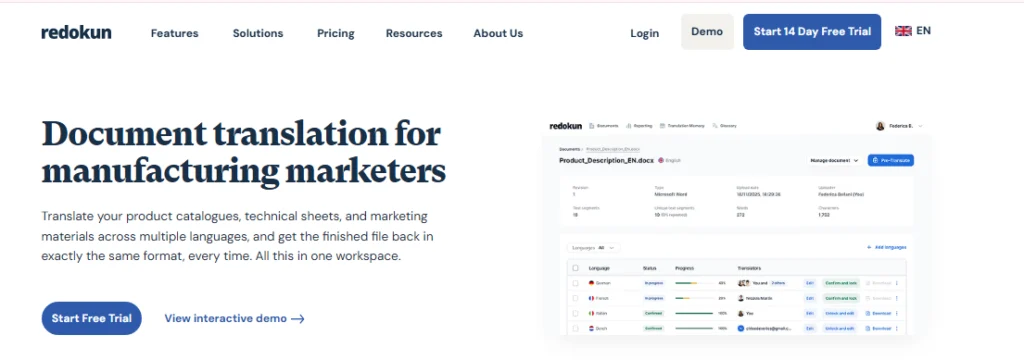
Redokun is a document-focused translation tool built around updating translated files when source documents change. It suits document-led manufacturing teams working mainly in common office and layout formats. It should not be assessed as a full enterprise TMS, so check engineering structures carefully.
Why Redokun Fits Manufacturing Teams
Best for smaller teams whose manuals live in familiar document formats and who value convenient updates. It is a complementary option, not an enterprise orchestrator.
Redokun: Features, AI & Quality
Verify supported file types, memory and glossary handling, update behavior and any review features. Use a layout-heavy manual to separate convenience from engineering-grade structure support.
Redokun: Pricing & Customer Feedback
Check the vendor’s current plans and any per-document limits. Record independent ratings only with platform, count and date.
Redokun: Limitations & Buyer Checks
Confirm support for DITA/XML or complex layouts if you need them. Ask how safety review and approvals are documented.
7. memoQ TMS — technical linguist collaboration
In the memoQ ecosystem, memoQ TMS is a server-side offering that is used by translators and project managers to work together. The proposed fit is collaboration with technical linguists, particularly for engineering review, when the focus is on note service chapters and how term changes affect the reused segments.
Why memoQ TMS Fits Manufacturing Teams
Best for teams with in-house or trusted linguists who want hands-on control of terminology and quality. It fits where translator expertise drives the process.
memoQ TMS: Features, AI & Quality
Review memory, term bases, QA checks, project roles and AI or machine translation options. Test how a changed term affects reused segments.
memoQ TMS: Pricing & Customer Feedback
Confirm licensing and server costs with the vendor. Add independent feedback only with rating, count, platform and date.
memoQ TMS: Limitations & Buyer Checks
Ask how external engineers access content and how reviewer decisions are recorded. Check CCMS integration needs.
8. Trados Team — cloud collaboration for technical translation teams
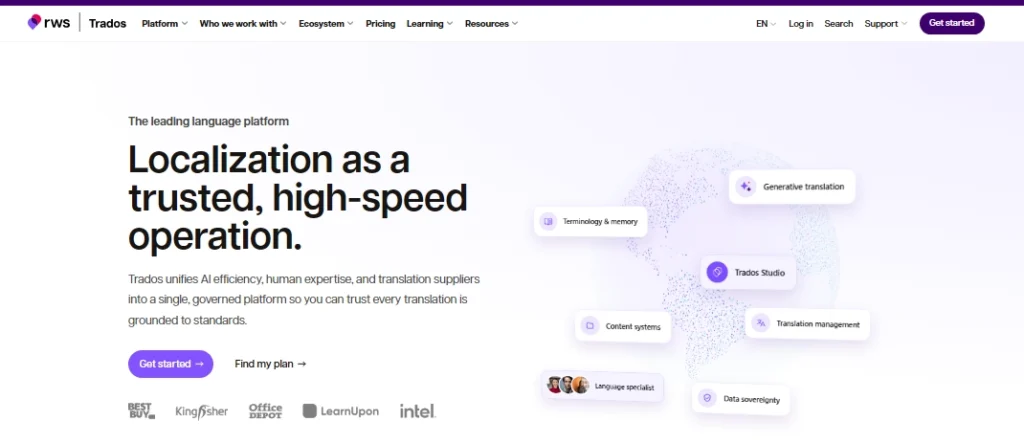
Trados Team is RWS’s cloud option for teams collaborating on translation projects, tied to the wider Trados family. We propose it for technical translation teams that already use Trados tools. Buyers must separate what Team offers from what Studio and Enterprise add.
Why Trados Team Fits Manufacturing Teams
Best for teams with Trados-based processes who want cloud sharing of memories and projects. Familiarity with the toolset is its main draw here.
Trados Team: Features, AI & Quality
Verify memory sharing, terminology, QA, AI options, and role assignment. Use a tagged manual package to test assignment, reviewer handoff, and version return.
Trados Team: Pricing & Customer Feedback
Check current subscription details and edition differences with RWS. Record independent ratings with platform, count and date.
Trados Team: Limitations & Buyer Checks
Edition boundaries cause confusion. Confirm which capabilities sit in Team, Studio or Enterprise before assuming coverage.
9. Pairaphrase — team-based business document handling
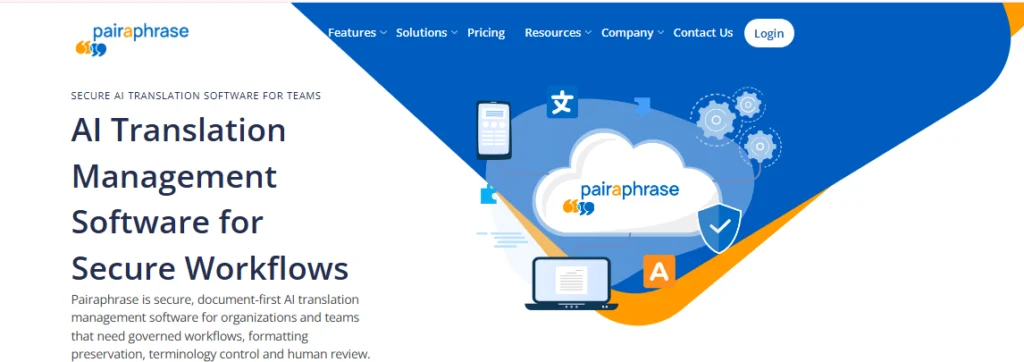
Pairaphrase is a translation platform with shared memory, glossaries and team access, aimed at business documents rather than engineering authoring. Our proposed fit is team-based document handling, such as a DOCX service manual with a defined sign-off. Anything beyond that needs proof.
Why Pairaphrase Fits Manufacturing Teams
Best for teams translating business-style documents who want shared memory and simple collaboration. It is a narrower fit than the enterprise platforms.
Pairaphrase: Features, AI & Quality
Check supported formats, memory, glossary use and any QA or review steps. Evaluate a DOCX service manual end to end.
Pairaphrase: Pricing & Customer Feedback
Review current plans and usage limits on the vendor site. Add independent feedback with source, count and date.
Pairaphrase: Limitations & Buyer Checks
Verify specialist structured-document support before extending the recommendation to DITA or layout-heavy manuals.
10. wxrks (Bureau Works) — AI-assisted technical document operations
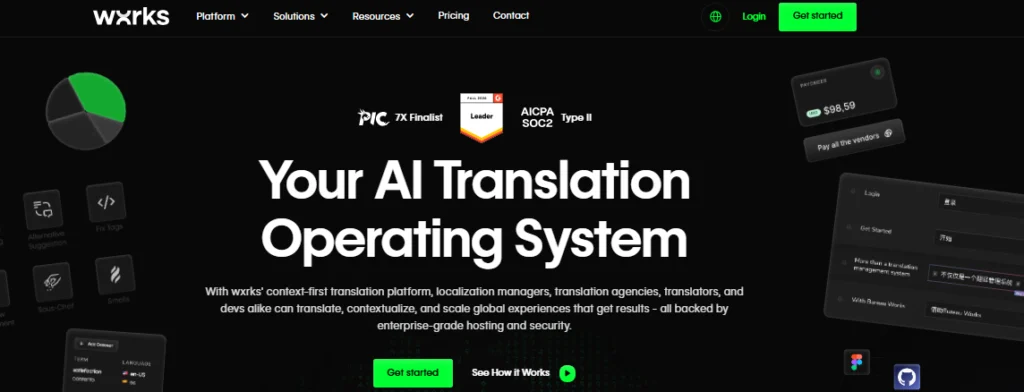
wxrks, formerly Bureau Works, positions itself around AI-assisted translation operations for documents and content. The suggested fit is technical document work where an engineering glossary guides the output. Required technical formats, reviewer decisions and release traceability are all things to verify before shortlisting.
Why wxrks (Bureau Works) Fits Manufacturing Teams
Best for teams wanting AI-assisted operations guided by their own technical terminology. It earns a slot as an AI-forward alternative.
wxrks (Bureau Works): Features, AI & Quality
Review AI translation, context handling, memory, QA and review features. Run a revised service document against an engineering glossary.
wxrks (Bureau Works): Pricing & Customer Feedback
Confirm current pricing or contact sales. Add independent ratings only with verified platform, count and date.
wxrks (Bureau Works): Limitations & Buyer Checks
Public format coverage may not match your authoring stack. Confirm required formats and how release traceability is recorded.
Which shortlist fits structured authoring, layout-heavy manuals or document-focused teams?
| If your priority is… | Consider | Why | Verify first |
| AI-led localization with quality oversight | CENTROID by VerboLabs | AI speed with review layer | Revision handling |
| Structured technical documentation | XTM Cloud | Workflow and structured content focus | DITA/FrameMaker filter |
| Enterprise content operations | Smartling | Scale, governance, connectors | Safety approval path |
| AI and human-review coordination | Smartcat | AI drafts with reviewers | Reviewer context |
| Multi-team manual programs | Phrase TMS | Cross-site workflow and reuse | Configuration ownership |
| Document-led teams | Redokun | Convenient document updates | Layout and structure support |
| Technical linguist collaboration | memoQ TMS | Linguist-centered control | External reviewer access |
| Cloud collaboration for translators | Trados Team | Trados-family continuity | Edition scope |
| Business document handling | Pairaphrase | Simple team sharing | Structured-format support |
| AI-assisted technical documents | wxrks (Bureau Works) | AI with glossary guidance | Required formats |
What should your vendor pilot prove?
Use one current manual and its revision in two target languages. Include a warning, units, part numbers, cross-references, and tables. Keep input, scope, and success criteria identical for every vendor.
Measure critical meaning errors, stale-version incidents, broken references, update cycle time, reused segments, layout defects, and engineering review effort. Record baseline, result, reviewer, and unresolved issues.
Ask each vendor: “Which exact filter and configuration handled our authored file, and who owns verification after the next source revision?” Publish measured findings only after real testing.
Final recommendation
For AI-led localization with review oversight, you can try working with CENTROID by VerboLabs. For good alternatives that can support your files in a similar manner, you can work with XTM Cloud, Smrtling, and Phrase TMS. Other vendors can be connected with for format support, versioning, and review ownership features.
Request a demo with CENTROID with the help of a product manual, glossary, and revised chapter.

Expand your global reach with VerboLabs! Get accurate, culturally adapted localization services to connect with new markets. Contact us today for expert solutions!
Frequently asked questions
Start from your authoring stack. Separate structured DITA/XML from layout formats like FrameMaker and IDML, then test filters, tags, and cross-references. Confirm product-specific support with each vendor.
No. Automated checks can flag issues, but engineering or specialist linguistic review should own the decision for safety-related passages. Name the approver for each language.
Track the source version and changed segments, revalidate reused terms, and publish only after the revised target document is approved. Ask how each tool flags obsolete matches.
File processing, DTP, connectors, implementation, AI usage, and technical reviewer time. Compare vendors on the same manual scope.