
Let’s envision a scenario in which a corporation’s marketing department creates content via a CMS. Product teams perform updates utilizing coding repositories, while the customer service department has its own help desk portal. Each department operates with its own terminologies, translation vendors, and entire approval processes. And now the purchasing department is asking for a single solution.
The following article provides a comparison of ten localization tools suitable for localization directors, enterprise content team members, IT department managers, and heads of procurement departments.
- CENTROID by VerboLabs: An AI-enabled localization solution featuring a quality check process and human verification.
- XTM Cloud: Extensive capabilities for managing and handling vendor-related services and complicated enterprise translation tasks.
- Phrase TMS: Integration of multiple teams and control over various translation processes.
- Smartling: Wide-ranging enterprise solutions in the field of localization, including technology and linguistics.
- Lokalise: Strongly product-centered localization processes.
- Transifex and Crowdin: Options for continuous localization and interdepartmental cooperation opportunities.
- memoQ TMS: Management of linguists’ and vendors’ productive activities.
- Smartcat: The introduction of changes in text operations with the help of artificial intelligence.
- Localazy: Localization with the help of development specialists that can be transformed into a sophisticated system.
Compare the 10 Options by Buying Requirement
| Tool | Main focus | Pricing basis | Important buyer check |
| CENTROID | AI-led localization | Contact sales | Connectors and enterprise controls |
| XTM Cloud | Enterprise translation management | Custom plans | Vendor and workflow governance |
| Phrase TMS | Multi-team TMS | Subscription/custom | Modules, seats, and integrations |
| Smartling | Enterprise platform and services | Plan and usage-based | Service and software responsibilities |
| Lokalise | Product localization | Subscription | Support for non-product content |
| Transifex | Continuous localization | AI usage-based | Content ownership and workflow |
| Crowdin | Collaborative localization | Free and paid plans | Roles and shared assets |
| memoQ TMS | Translation production management | Subscription/custom | Vendor and linguist administration |
| Smartcat | AI-assisted content operations | Annual/custom plans | AI usage and workspace controls |
| Localazy | Developer-led localization | Plan-based | Business-level workflow needs |
What Should Enterprises Look for in Localization Management Tools?
Content Intake and System Connectivity
Large companies publish content via several platforms, such as software repositories, document storage systems, design tools, help desks, and others. When thinking about localization services, one should ensure that the localization platform connects to systems responsible for most of the translation process. However, connectivity mentioned on the website does not mean that it can help with all workflows. Make sure to find out who owns the connections, what kind of movement the content is in, and what happens in case of synchronization failure.
Workflow, Vendors and Permissions
Various departments require different procedures for approval. For instance, legal content may require the review of legal experts, marketing material needs the approval of the brand, and product updates must be done quickly. Check whether it is possible to build the workflow in terms of task assignments, approval process, user roles, and escalation tools.
Shared Linguistic Assets and Quality Policy
Translation memory keeps previously accepted translations, while glossaries record the required vocabulary and its translations. It makes it easier for team members to be consistent in the use of language within different markets. Not every department has to comply with the same requirements, as a product interface has different terminology requirements from legal documents and marketing campaigns.
It is recommended to check if the platform allows for shared or limited access to language assets and whether departments are able to use them without losing the data that was previously approved by other departments.
Reporting and Operational Visibility
Managers have to be careful about monitoring the number of ongoing projects, delays, and localization expenses. Practical reports may provide such information as the turnaround time, project progress, vendor performance, translation volumes, delays during editing, and the amount of money spent.
Enterprise Readiness and Total Cost
Enterprise buyers must evaluate security, single sign-on (SSO), user provisioning, access logs, terms of data protection, and support packages. Subscription costs are just one component of the expenses incurred. The total cost may be higher due to additional users, implementation, integrations, usage of AI, training, migration, and ongoing maintenance.
How Did We Evaluate the Shortlist?
The comparison is based on online research on vendor and product information relevant to enterprise localization processes. No direct testing has been conducted. The comparison has considered content intake, process management, vendor roles, linguistic assets, reporting, integrations, and provision of services for enterprises. Vendor functions do not guarantee meeting all company requirements.
Taking into account the prices and information obtained from independent clients should be done before placing an order. In case of a lack of public information about certain integrations, plan limitations, or enterprise control, the buyer needs to request a demo.
The 10 Best Localization Management Tools for Enterprise B2B Teams
1. CENTROID by VerboLabs – AI-Led Orchestration with Quality Oversight
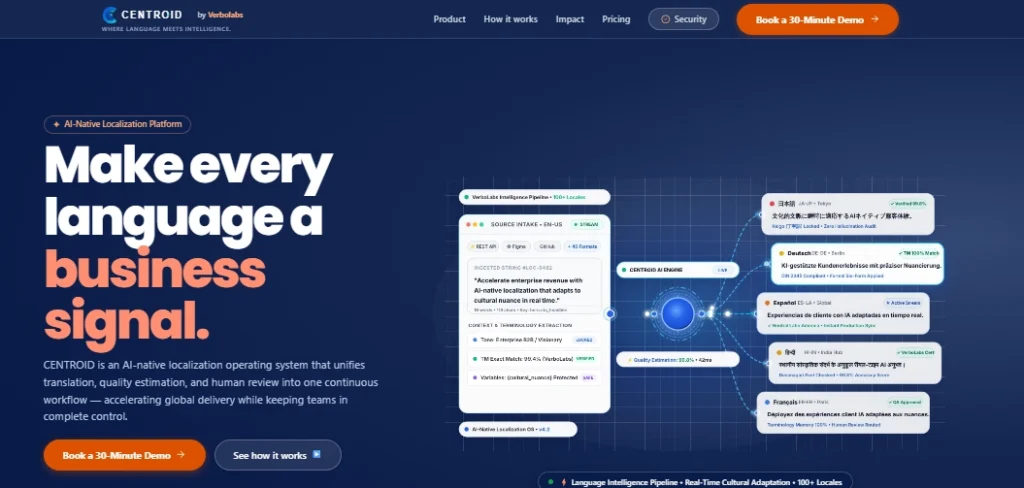
The Translation management system entitled CENTROID, developed by VerboLabs, presents various tools for the achievement of localization in different stages. It can be useful for companies looking to streamline translation as well as other processes, including terminological work, quality assurance, and human checking of translations in a single space.
Why CENTROID by VerboLabs Fits Global Teams
CENTROID serves well for those who require working with a large amount of multilingual content. According to the publicly provided information on the platform, users can utilize predefined workflows, namely, content input processes, translation, quality verification, as well as vendor management.
CENTROID: Features, AI and Quality
The main features of the platform include translation with taking the context into account, editing of translations, terminology management, scoring the quality of translations using MQM methodology, automated quality checks, as well as human checking.
CENTROID: Pricing and Customer Feedback
CENTROID does not provide any information on its website concerning the prices and asks customers to get in touch to obtain its demos.
CENTROID: Limitations and Buyer Checks
Before making the choice in favor of CENTROID, it is crucial to obtain a demonstration based on real-life use scenarios taken from different functions like marketing and product. Analyze your needs for integration with CMS and the repository, and check how many user roles, permissions, reporting, and data settings the platform can support.
2. XTM Cloud – Complex Enterprise Translation Programs
Why XTM Cloud Fits Global Teams
XTM is a tool to consider for translation tasks involving several departments, external language service companies, and constant content refreshing. Its broader platform has vendor and localization management functionalities as well.
XTM Cloud: Features, AI and Quality
The features that are already available include translation memory, terminology management, workflow templates, project dashboards, vendor assignment, and reporting. The AI functionalities of XTM are translation assistance and quality checking.
XTM Cloud: Pricing and Customer Feedback
XTM has a custom pricing model that is set according to users, workflows, content volume, and integration requirements. According to XTM’s pricing policy, you may find different plans for enterprises.
XTM Cloud: Limitations and Buyer Checks
Implementing the platform might take time. It would be reasonable to learn about implementation, connector pricing, hosting methods, licensing policies, and transferring language resources into the system. Since every department can use the platform, it would be wise to check how the vendor transition goes.
3. Phrase TMS Multi-Team TMS Governance
Why Phrase TMS Fits Global Teams
The Phrase solution may appeal to companies that look for centralized translation management while allowing departments to work in accordance with their own procedures.
Phrase TMS: Features, AI and Quality
The list of available capabilities contains customizable workflows, translation memories, term bases, machine translation functions, AI technology, reports, and vendor management tools.
Phrase TMS: Pricing and Customer Feedback
Phrase offers a variety of subscription plans with commercial and corporate options included. The prices are dependent on the selected components required by the organization.
Phrase TMS: Limitations and Buyer Checks
While Phrase TMS and Phrase Strings fulfill different localization requirements, it’s important to check what modules are included in the agreement and whether the advanced control mechanism, integration facility, and reporting services need upgrades.
4. Smartling – Enterprise Platform Plus Language Services
Why Smartling Fits Global Teams
Organizations with vast translation programs, such as marketing and product development, can take advantage of the system.
Smartling: Features, AI and Quality
Enterprise features incorporated with the technology include customizable workflows, translation memory, glossary and style guide management, integration, quality assurance, reporting, and translation services.
Smartling: Pricing and Customer Feedback
Smartling provides various plans depending on the type of business. The pricing of translation varies depending on the type of service, volume, and level of human participation.
Smartling: Limitations and Buyer Checks
Distinguish between the system charges and the charges for translation transactions, and clarify who works with contractors, who approves the text, and whether they can provide their own translators.
5. Lokalise – Product-Led Localization Operations
Why Lokalise Fits Global Teams
This may be applicable to companies and organizations that develop a large number of revisions in a relatively short period of time and use the services of designers, programmers, and translators.
Lokalise: Features, AI and Quality
The published price plans include translation memory, glossary creation, automated workflows, machine translation and AI tools, merging and integrations. Some services depend on your plan.
Lokalise: Pricing and Customer Feedback
Lokalise has different plans for smaller and bigger teams. You should compare the amount of AI access, workflow features, number of users, and support.
Lokalise: Limitations and Buyer Checks
The product-specific advantages may not be applicable for all types of documents and content workflows. You need to check how legal documents, marketing content, and support content will be managed when they are included in one localization process.
6. Transifex – Continuous Content Localization
Why Transifex Fits Global Teams
Organizations that aim to integrate content sources with translation and review processes instead of doing each project manually need to consider this.
Transifex: Features, AI and Quality
The current platform provides details about AI translation, translation memory, glossary, human review, automatic quality assessment, reporting, and integration. Moreover, it supports content types like software files and documents.
Transifex: Pricing and Customer Feedback
Transifex’s pricing system is now based on the number of AI-translated words, with a separate review and post-editing process.
Transifex: Limitations and Buyer Checks
Find out if the current pricing scheme works in the context of your use of AI translation and other language service providers. Make sure it is clear how your own reviewers and partners will work together.
7. Crowdin – Cross-Team Digital Localization Collaboration
Why Crowdin Fits Global Teams
It might be a good choice for companies that need to organize different teams on projects while allowing them to have access to some translation resources together.
Crowdin: Features, AI and Quality
Crowdin Enterprise is designed to help organizations manage their projects and provide user roles, create different project groups, implement customized workflows, manage translation memory, create glossaries, and work with vendors. It can also help with simple translations as well as proofreading.
Crowdin: Pricing and Customer Feedback
Crowdin has free and paid services, with prices determined by the size and requirements of the business. Check limitations and contract details.
Crowdin: Limitations and Buyer Checks
Make sure that project structure and workflow features can be utilized by your departments without making management a problem. Review user rights and how multiple project resources can be shared and used.
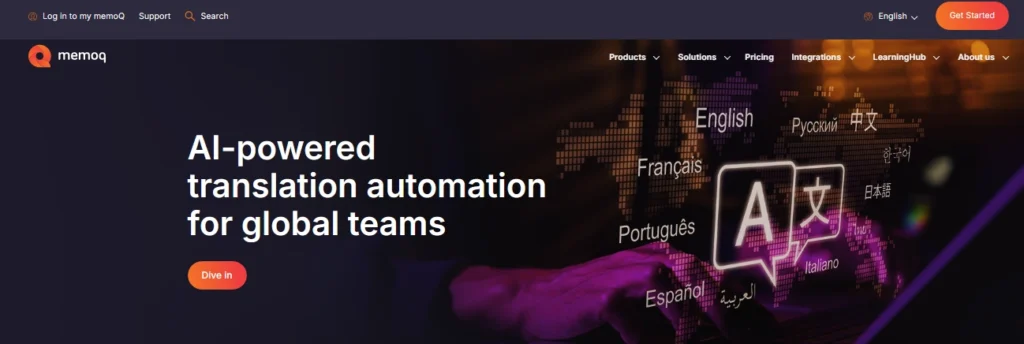
8. memoQ TMS – Linguist and Vendor Production Governance
Why memoQ TMS Fits Global Teams
It is advisable to consider the point at which translation production requires structured assignments, use of resources, and efficient project management.
memoQ TMS: Features, AI and Quality
The application offers translation memories, terminology, project management, and collaboration. TMS plans of the system are made for teams requiring project manager and language specialist access.
memoQ TMS: Pricing and Customer Feedback
memoQ offers various plans such as What’s New Starter, What’s New Essential, What’s New Professional, and What’s New Enterprise. All larger plans require contacting sales for a customized quote.
memoQ TMS: Limitations and Buyer Checks
Make sure to check the number of project manager and linguist licenses that are included, whether vendor access, hosting, and integrations are required. It is also good to know how the system fits into any other content systems already in use in the company.
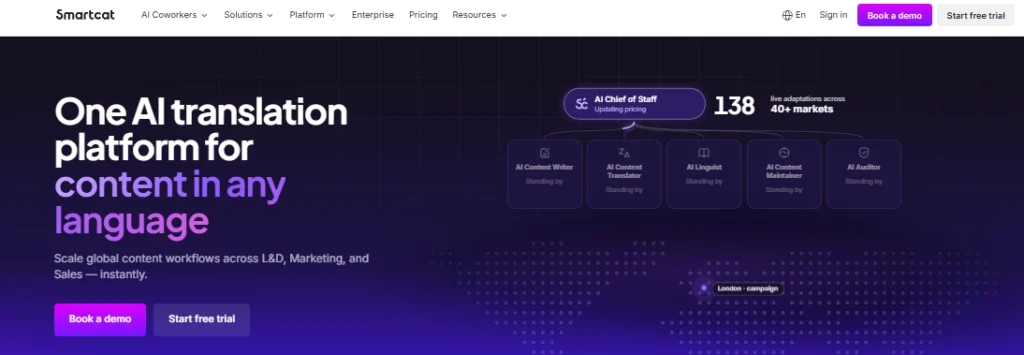
9. Smartcat – AI-Assisted Enterprise Content Operations
Why Smartcat Fits Global Teams
It is advisable to take into account firms requiring translation assistance for marketing, product, and corporate documents that have both in-house reviewers and outsourced linguistic specialists.
Smartcat: Features, AI and Quality
Smartcat provides a description of AI translation, creation, editing, QA, collaboration, and access to linguistic specialists. Moreover, its pricing model includes adaptation at different levels of efficiency and enterprise-level controls.
Smartcat: Pricing and Customer Feedback
Currently, Smartcat offers the following plans: Adapt, Accelerate, Anticipate, and Autonomy. The price of the plan depends on its type and the volume of annual usage, and it also offers custom prices for larger volumes.
Smartcat: Limitations and Buyer Checks
Check the limits of AI use, workspace separation, vendor access, data flow policies, and verification mechanisms. Make sure that the selected service plan meets all the reporting and integration needs of the company.
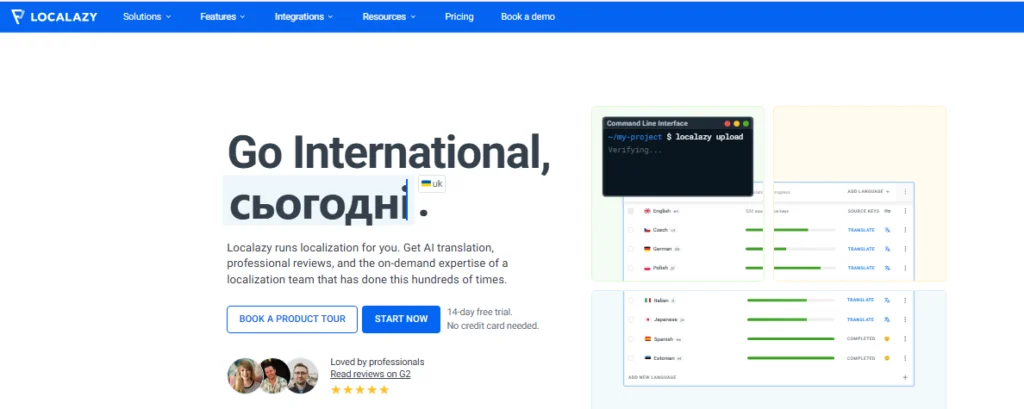
10. Localazy – Developer-Led Programs Scaling Beyond Files
Why Localazy Fits Global Teams
This could be a good fit for companies that started out managing localization by themselves and may want to build upon the system over time as the content grows.
Localazy: Features, AI and Quality
Its marketing materials mention the use of translation management, translation memory, glossaries, screenshots, command-line interface (CLI), API, file conversion, project branching, etc. Higher tiers include many more integrations and features for managing teams.
Localazy: Pricing and Customer Feedback
Localazy has a few subscription plans that differ in source keys and AI translation limits. It’s necessary to check the current plan thresholds prior to choosing the subscription plan.
Localazy: Limitations and Buyer Checks
The Localazy solution is not designed to meet the needs of large companies as far as vendor management, finance reporting, and cross-department coordination are concerned. Make sure you check if such capabilities are available or if you will need to use an additional solution.
Which Shortlist Fits Your Enterprise?
| If your priority is… | Consider | Why | Verify first |
| AI-led localization with quality oversight | CENTROID | Centralized AI and review workflows | Connectors and enterprise controls |
| Complex enterprise translation programs | XTM Cloud | Project and vendor management | Implementation and integrations |
| Multi-team TMS governance | Phrase TMS | Customizable workflows | Modules and plan limits |
| Enterprise platform plus language services | Smartling | Software and translation services | Service responsibilities and cost |
| Product-led localization | Lokalise | Product team collaboration | Non-product content support |
| Continuous content localization | Transifex | Ongoing translation workflows | Vendor and reviewer setup |
| Cross-team digital collaboration | Crowdin | Organization and workflow controls | Permissions and asset sharing |
| Linguist and vendor production | memoQ TMS | Translation project management | License and vendor access |
| AI-assisted content operations | Smartcat | AI & human collaboration | Usage and workspace controls |
| Developer-led localization | Localazy | CLI & automation | Enterprise reporting and vendor needs |
What Should Your Vendor Pilot Prove?
Prior to choosing a platform, try out a couple of workflows. For instance, evaluate a product release and marketing campaign. Be sure to involve both an internal reviewer and an external vendor.
See what happens to your content once it gets into a system, how it is assigned, how approvals proceed, and how final translations come back to an original site. Run tests on a failure of synchronization and escalation of approval.
Perform measurements for the following criteria:
- Failed handoff of content.
- Duplicate or inconsistent translation resources.
- Time spent waiting for approvals.
- Administration efforts.
- Cost of each process per workflow based on the same calculation method.
Ask the vendor the following question: Who is responsible for a failure of data synchronization, and how will a business user be able to detect, repeat, and escalate the issue, while not losing approvals?
Implement the same input and requirements for all tests you are going to run. Write down the results, evaluator, baseline, undissolvable issues, and the like. Do not rely solely on a beautifully made presentation.
Final Recommendation
It is not possible to find a single localization management tool for each and every company. The choice to be made will depend on various factors like the number of teams taking care of translation, the type of texts to be translated, existing tools, vendors, and the amount of control needed.
Existing translation tools like XTM Cloud, Phrase TMS, Smartling, and memoQ TMS will suit companies with structured translation processes, whereas companies like Lokalise, Transifex, Crowdin, and Localazy use their own methods of translation and localization. Smartcat is relevant in the area of AI-related processes.
For those companies interested in AI-related translation, CENTROID developed by VerboLabs deserves attention. The best program available is the one that has the best mobility and makes it possible to control various processes within the company.

Expand your global reach with VerboLabs! Get accurate, culturally adapted localization services to connect with new markets. Contact us today for expert solutions!
Frequently Asked Questions
A Computer-assisted Translation tool is used by translators for translation task management and editing using translation memory, terminology, and quality assurance. A localization management system encompasses a wider solution where there is coordination between content sources, people, vendors, processes, approvals, and delivery of work from different departments.
Some tools may support multiple types of content, but their workflows might vary. For example, a tool suitable for software localization might require a few more add-ons or services to work for legal documents, marketing content, and customer service content.
Begin with the tools that generate the highest volumes of translation. The tools could be a content management system, software repository, help center, or document sharing platform. Check the synchronization direction, the error-handling method, the approval process, and the person responsible for the support of each integration.
Make use of the real content of the company and test at least two different workflows. Involve the in-house reviewers and the external service providers wherever applicable. Evaluate the quality of translation, speed of delivery, the number of failed hand-offs, approval delays, the amount of administrative work done, as well as the overall costs.