

A project clears translation without a hitch, yet the vendor PO is in one spreadsheet, the revised quote in another, and the client invoice in a third. Then the source file changes late. Who approves the extra cost? Who resets the deadline? Nobody knows, and the PM ends up chasing three tabs to find out.
TL;DR
- CENTROID by VerboLabs: AI-led project orchestration candidate
- Plunet BusinessManager: translation business operations
- XTRF: LSP vendor and business operations
- Phrase TMS: translation production workflows
- XTM Cloud: enterprise translation project workflows
- Smartling: enterprise projects with language services
- memoQ TMS: translation-production project coordination
- Crowdin: digital-product localization project delivery
- Lokalise: product-team localization scheduling
- Protemos: small and midsize translation business operations
Compare the 10 options by buying requirement
| Platform/category | TMS/TBMS | Intake/analysis | Vendor assignment | Approvals | Quote/PO/invoice | CAT/accounting link | Pricing basis |
| CENTROID (AI orchestration) | Verify | Verify | Verify | Verify | Verify | Verify | Contact sales |
| Plunet (TBMS) | TBMS | Quoting | Yes | Verify | Native | Connectors | Contact sales |
| XTRF (TBMS) | TBMS | Quoting | Portals | Verify | Native | Integrations | Contact sales |
| Phrase TMS (TMS) | TMS | Analysis | Jobs | Workflow | Verify | Verify | Plan or quote |
| XTM Cloud (TMS) | TMS | Analysis | Workflow | Workflow | Separate | Verify | Quote |
| Smartling (platform + services) | Hybrid | Verify | Provider or internal | Verify | Verify | Verify | Quote |
| memoQ TMS (TMS) | TMS | Analysis | Yes | Bilingual review | Separate | Verify | Verify |
| Crowdin (product localization) | Adjacent | Strings | Tasks | Workflow | Not core | Verify | Public tiers |
| Lokalise (product localization) | Adjacent | Strings | Tasks | Workflow | Not core | Verify | Public tiers |
| Protemos (TBMS) | TBMS | Quoting | Yes | Verify | Native | Verify | Verify |
What should operations teams look for in translation project management software?
Five criteria sit behind the comparison.
TMS versus TBMS scope
A TMS runs production: files, workflows, language assets, review. A translator workbench is the editor linguists actually work in. A TBMS covers the business side, meaning quotes, vendor costs and invoices. Work out which one each platform is. And a generic project board, however tidy, isn’t a translation system just because someone renamed the columns.
Intake, scoping and assignment
Try the real thing. Submit a request, upload files, check the analysis and estimate, set language pairs and due dates, then assign a vendor. Don’t assume a tool that does one of these does all of them.
Review gates, dependencies and escalation
Follow a job from translation through revision and client review to delivery, and note who owns each step. Then break it on purpose: change the source late, or leave one language half finished. How the tool responds tells you more than any feature list.
Vendor, financial and reporting functions
If you need vendor records, rates, purchase orders, invoicing or margin reports, ask for each one by name. Then ask whether it’s built in or comes through an integration. Those are very different answers.
Integrations, migration and total cost
Look at CAT and TMS connections, the accounting handoff, moving existing assets, and what each user type costs. Also count the time your administrator will spend, plus any paid implementation help. Licence fees are rarely the whole bill.
How did we evaluate the shortlist?
This is a desk-researched shortlist. It rests on official vendor sources and how relevant each product is to the workflow, and nobody has tested any of these tools hands-on. Each platform is read against the five criteria above, and the open questions are noted rather than glossed over.
Before this goes live, current pricing needs to be added, along with independently verified customer feedback, each entry with rating, scale, review count, product, URL, and date. Throughout, documented features, vendor claims, and unknowns are kept apart. And an absence of public information isn’t evidence that something doesn’t exist.
The 10 Best Translation Project Management Software Platforms for B2B Teams
The order comes from the supplied reference and isn’t a performance ranking.
1. CENTROID by VerboLabs — AI-led project orchestration candidate
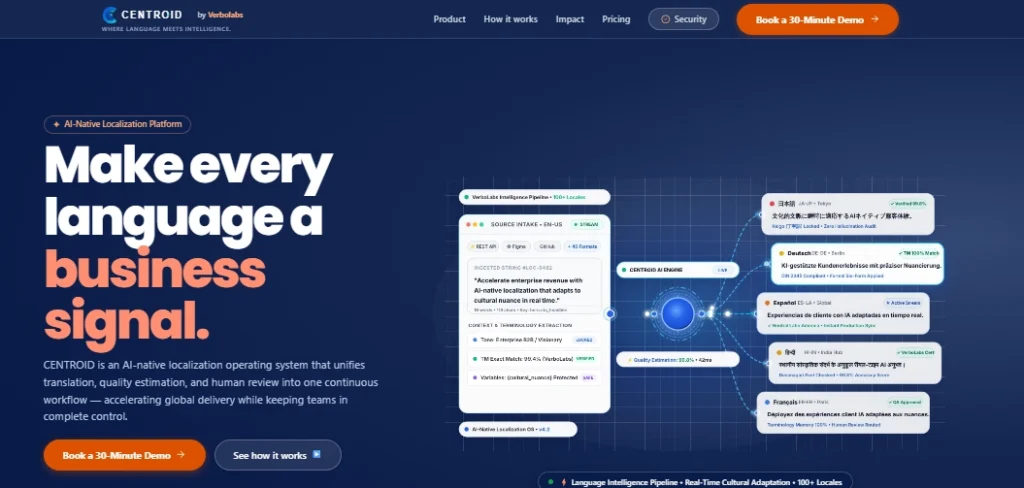
CENTROID by VerboLabs is presented as an AI-led translation management system (TMS) designed to manage translation projects from intake through delivery. The pitch is clear ownership of each task plus quality gates along the way. What isn’t settled is how far it goes on budgeting, vendor management and finance, so don’t assume it’s a full business system.
Why CENTROID by VerboLabs Fits Localization Teams
This one is for teams tired of stitching together intake, assignment and review across separate tools. It earns its place here as the orchestration-first candidate. Check the workflow claims against current official material before relying on them.
CENTROID by VerboLabs: Features, AI & Quality
The useful question is how AI translation, translation memory, terminology, automated QA and human review connect inside a single flow. Cover only what the vendor documents, and skip anything that’s merely implied.
CENTROID by VerboLabs: Pricing & Customer Feedback
Treat pricing as contact sales unless a public page says otherwise. There’s no independent rating on record yet. When one is found, log the platform, score, review count and date.
CENTROID by VerboLabs: Limitations & Buyer Checks
The big one: are quoting, POs, vendor payments and invoicing native, or do they live elsewhere? Ask directly. Anything the vendor hasn’t published is unverified, which is not the same as missing.
2. Plunet BusinessManager — translation business operations
Plunet BusinessManager is a business administration system for translation companies and language departments. It suits teams who want quoting, vendor operations and invoicing in one place, with CAT or TMS production connected to it rather than replaced by it.
Why Plunet BusinessManager Fits Localization Teams
If your headaches are administrative (quotes, vendor orders, billing), this is the kind of tool that addresses them. It represents the business-system half of the TMS/TBMS divide in this comparison.
Plunet BusinessManager: Features, AI & Quality
Look at workflow automation, vendor management and how production tools plug in. Linguistic quality features mostly sit in the connected CAT or TMS, so the quality of that connection matters more than anything on Plunet’s side.
Plunet BusinessManager: Pricing & Customer Feedback
Plan on contact sales, and ask what implementation and different user types add. Independent ratings still have to be collected and dated before anything is published.
Plunet BusinessManager: Limitations & Buyer Checks
It isn’t a translator workbench. Run a late source change through it and watch whether the revised quote and the connected CAT tool both update.
3. XTRF — LSP vendor and business operations
XTRF is a business platform for language service providers, built around client and vendor portals and the flow of business between them. It fits LSPs coordinating many vendors. Don’t confuse it with XTM Cloud, which is a separate product with a different job.
Why XTRF Fits Localization Teams
LSPs that want clients and vendors working through portals, alongside quoting and job flow, are the natural audience. It handles business operations. Linguistic production happens elsewhere.
XTRF: Features, AI & Quality
Review the portals, workflow automation and CAT/TMS connections. QA checks and termbases usually belong to whichever production tool is plugged in, so confirm where each capability actually lives.
XTRF: Pricing & Customer Feedback
Assume contact sales, and ask what implementation covers and which add-ons cost extra. No independent feedback is recorded yet. When it is, note the source, rating, count and date.
XTRF: Limitations & Buyer Checks
Find out which production tools it connects to, how much the portals can be configured, and who owns a late change across the client and vendor views.
4. Phrase TMS — translation production workflows

Phrase TMS is a translation management system for production work. It’s a fit for teams that assign jobs, follow status, and manage language assets and review in one environment. Where its financial management stops is something to verify.
Why Phrase TMS Fits Localization Teams
Localization teams and LSPs whose main worry is production control will find the case here: who translates, who reviews, and where each job stands right now.
Phrase TMS: Features, AI & Quality
Check the workflow steps, translation memory, termbases, machine translation options, QA checks and integrations. Then ask which of those sit behind a particular plan.
Phrase TMS: Pricing & Customer Feedback
Confirm whether current pricing is public or quote-based, and what limits apply by plan. Independent ratings should go in with source, count, and date once someone has gathered them.
Phrase TMS: Limitations & Buyer Checks
Ask how much quoting, PO, and invoicing it handles natively versus through a business system. Then test a revised job with two vendors and see what happens.
5. XTM Cloud — enterprise translation project workflows

XTM Cloud is a translation platform aimed at enterprise project workflows, for organizations that want production standardized across languages and teams. If you also need quoting and invoicing, XTRF or another business tool may have to sit beside it.
Why XTM Cloud Fits Localization Teams
Enterprise localization groups with many projects and vendors tend to want configurable workflows and shared language assets. That’s the use case here.
XTM Cloud: Features, AI & Quality
Look at workflow configuration, translation memory, terminology, machine translation, QA, and integrations. What your plan includes may differ from what the website shows, so ask.
XTM Cloud: Pricing & Customer Feedback
Assume quote-based pricing until a public page proves otherwise. No independent ratings have been gathered. Record platform, score, count, and date when they are.
XTM Cloud: Limitations & Buyer Checks
Pin down what it leaves out on finance and vendor payments, then test how it pairs with a business system in a real handoff.
6. Smartling — enterprise projects with language services
Smartling pairs a translation platform with language services. It’s aimed at enterprises that split delivery between their own people and outside providers. What matters most in the review is working out who owns delivery, revisions and reporting.
Why Smartling Fits Localization Teams
Companies that want technology and services under one relationship, but still need to know where internal duties end and provider duties begin, will find it relevant.
Smartling: Features, AI & Quality
Review workflow, translation memory, glossaries, AI or machine translation, human review and reporting. Keep platform features separate from the ones delivered through services.
Smartling: Pricing & Customer Feedback
Expect contact sales. Ask which parts are subscriptions, which are usage and which are services. Independent feedback still has to be sourced and dated.
Smartling: Limitations & Buyer Checks
Ask how revisions are scoped and billed, and whether you can bring your own vendors. And ask who owns a late source change, because the answer may surprise you.
7. memoQ TMS — translation-production project coordination

memoQ TMS coordinates translation production around memoQ’s editing environment. It suits teams who want assignment, bilingual review and delivery handled in production, while quoting and invoicing are mapped to a separate business system.
Why memoQ TMS Fits Localization Teams
Teams already working in memoQ get the most from it, since project coordination stays tied to the editor and the language assets they already use.
memoQ TMS: Features, AI & Quality
Check translation memory, term bases, QA, bilingual review, machine translation options and project workflow. Rely only on what current documentation supports.
memoQ TMS: Pricing & Customer Feedback
Verify the current licensing or subscription model, and whether server or per-user costs apply. Independent ratings go in with source, count and date.
memoQ TMS: Limitations & Buyer Checks
Map the handoff to whatever handles quotes and invoices. Then run a job with bilingual review and a source revision landing halfway through.
8. Crowdin — digital-product localization project delivery
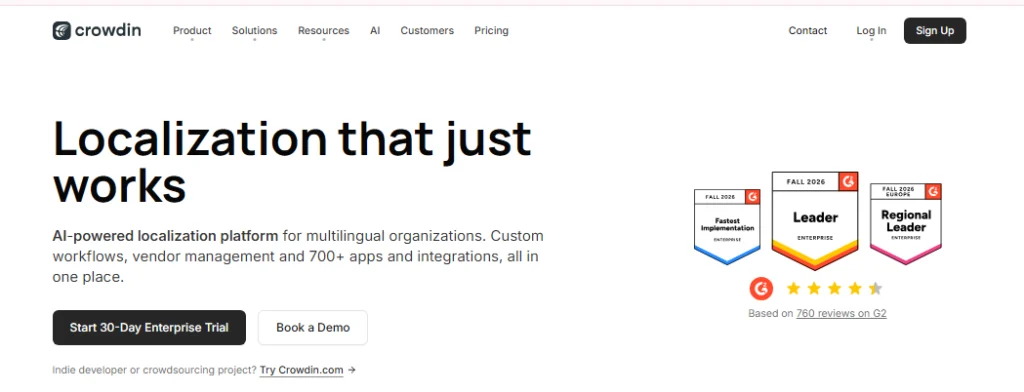
Crowdin handles localization for digital products, organized around strings, tasks and contributors. It’s a good match for product teams tracking release readiness. Anyone who needs full financial operations should expect gaps.
Why Crowdin Fits Localization Teams
Software and content teams that localize continuously need clear task ownership and contributor status for each release. That’s the strength here.
Crowdin: Features, AI & Quality
Review translation memory, glossaries, machine translation, QA checks, task assignment and repository integrations, and confirm which depend on plan.
Crowdin: Pricing & Customer Feedback
Check the public plans and limits on the vendor’s page, and any usage charges. Independent ratings should be recorded with platform, count and date when collected.
Crowdin: Limitations & Buyer Checks
It isn’t a business system. Find out how vendor costs, POs and invoicing would be handled, and decide whether that gap matters to you.
9. Lokalise — product-team localization scheduling
Lokalise helps product teams schedule localization across designers, translators and reviewers, so it suits release-driven teams. It tracks workflow progress. That’s not the same thing as billable project accounting.
Why Lokalise Fits Localization Teams
Product organizations that need translation lined up against release dates, and checked by product stakeholders, are the intended users.
Lokalise: Features, AI & Quality
Look at translation memory, glossaries, AI or machine translation, QA checks, review tasks, design-tool links, and integrations. Verify by plan.
Lokalise: Pricing & Customer Feedback
Check public plans, seat limits, and any usage charges on the vendor site. Independent feedback still needs a genuine, dated source.
Lokalise: Limitations & Buyer Checks
Ask whether it supports vendor payments, POs, and margin reporting. If it doesn’t, you’ll need a separate finance process.
10. Protemos — small and midsize translation business operations
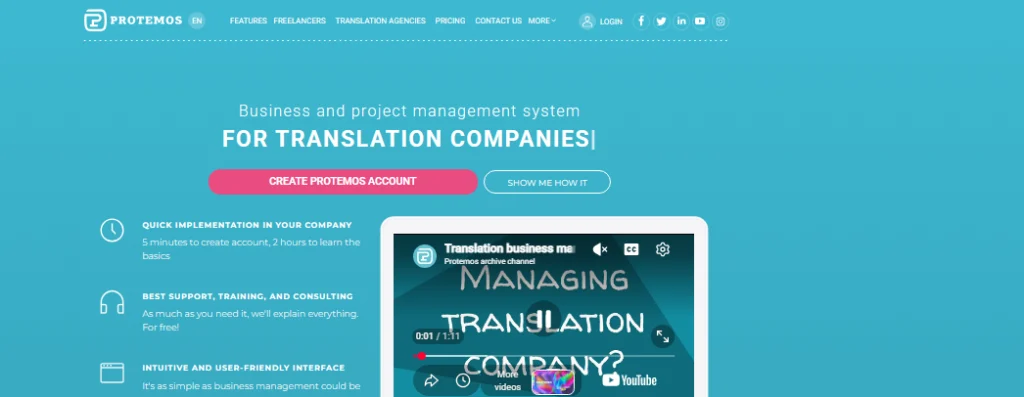
Protemos is a business management system for smaller translation companies. The idea is to run quotes, vendor allocation, delivery, and invoicing in one tool, with the translation itself happening in a separate system.
Why Protemos Fits Localization Teams
Small and midsize agencies that want a working business flow without an enterprise-sized implementation are the target.
Protemos: Features, AI & Quality
Look at quoting, vendor allocation, delivery tracking and invoicing. If it has linguistic quality features, confirm them rather than assuming.
Protemos: Pricing & Customer Feedback
Confirm whether pricing is published or by contact, and what limits apply. No independent rating is recorded yet.
Protemos: Limitations & Buyer Checks
Ask which CAT or TMS tools it connects to and how the accounting handoff works. Then push a revised quote through from start to finish.
Which shortlist fits in-house production, an LSP business system or product-release coordination?
| If your priority is… | Consider | Why | Verify first |
| AI-led project orchestration candidate | CENTROID by VerboLabs | Intake-to-delivery ownership | Finance and vendor scope |
| Translation business operations | Plunet BusinessManager | Quoting and vendor admin | CAT/TMS connection |
| LSP vendor and business operations | XTRF | Client and vendor portals | Portal configuration |
| Translation production workflows | Phrase TMS | Job assignment and review | Finance boundary |
| Enterprise translation project workflows | XTM Cloud | Configurable production | Separate business tool |
| Enterprise projects with language services | Smartling | Platform plus services | Responsibility split |
| Translation-production project coordination | memoQ TMS | Editor-linked coordination | Business handoff |
| Digital-product localization project delivery | Crowdin | Strings, tasks, releases | Financial gaps |
| Product-team localization scheduling | Lokalise | Release-based scheduling | Billing gaps |
| Small and midsize translation business operations | Protemos | Lightweight business flow | Production tool link |
What should your vendor pilot prove?
Run one job with three languages, two vendors, a late source revision, and staged approvals. Track who owns what and what runs overdue. If you need it, trace the quote through to the invoice in the business system. Measure unowned tasks, on-time delivery, quote-to-invoice variance, vendor reconciliation, and the minutes your PM spends on administration. Put one question to every vendor: “Can one revised job be traced from quote and vendor PO through linguistic approval, delivery, and invoice without a reconciliation spreadsheet?”
Final recommendation
Pick by workflow, not by a universal winner. If production control is where things fall apart, begin with a TMS. If the trouble is quotes, POs and invoices, look at a TBMS. If you want one owner from intake to delivery, CENTROID is worth a demo, next to the alternatives above and with its financial scope still open. Ask CENTROID to demonstrate an intake-to-delivery project and to identify any separate business systems you’d still need.

Expand your global reach with VerboLabs! Get accurate, culturally adapted localization services to connect with new markets. Contact us today for expert solutions!
Frequently asked questions
A TMS typically manages translation production: files, assignments, language assets and review. A TBMS handles the business side, such as quoting, vendor costs and invoicing. Where one ends and the other begins varies by product, so confirm each tool’s scope.
Some do. Others connect to a separate business system. Verify every finance step you need, plus the accounting handoff, in a full pilot.
Identify which files or segments changed, then reassess cost and deadline and tell the owners. Reopen the required review gates before the revised version goes out. Check how your platform supports each of those steps.
Turnaround, on-time delivery, approval delay, rework and cost are the useful ones, as long as each has a clear definition. Use margin metrics only where your business workflow can actually support them.