
In today’s multimedia-driven world, video and audio content spread faster than ever. But for global audiences to truly understand and engage with that content, accuracy and accessibility become essential. That’s where transcription and subtitling play a major role.
Though many people use these terms interchangeably, each carries a distinct function. Understanding the difference is important whether you’re a content creator, business, educator, or filmmaker looking to scale your reach across markets.
This guide breaks down what transcription is, what subtitling is, how they differ, where each is used, and why they matter for accessibility and global content consumption.
Understanding Transcription
Transcription is the process of converting spoken audio—from meetings, interviews, podcasts, webinars, movies, or YouTube content—into clean, readable text.
Professionally, transcription involves a trained transcriptionist carefully listening to the audio and typing out every word with clarity, correct grammar, and context.
Transcription becomes extremely useful for:
- Businesses (meeting documentation, Zoom recording transcription, interview records)
- Legal and medical professionals
- Researchers
- YouTube creators who need transcripts for YouTube videos for SEO and accessibility
- Anyone wanting written documentation of spoken material
If you need high-quality audio-to-text conversion, professional providers like Verbolabs Transcription Services offer accurate, industry-specific transcription for global use cases.
Why Transcription Matters Today
Modern workflows often rely on searchable text. A transcript helps with:
- Content repurposing
- SEO indexing
- Translation and dubbing processes
- Accessibility for people with hearing loss
- Reviewing Zoom or Google Meet recordings
- Compliance and documentation
Whether you’re looking for transcription and translation services or you need the transcription of a Zoom meeting, this process ensures nothing gets lost.
Diving Deep Into Subtitling
Subtitling is the process of displaying text on-screen that reflects video dialogue, narration, or meaningful audio cues. Most people know subtitling through their experience watching foreign movies, Netflix shows, or YouTube videos with subtitles.
Subtitles bridge language gaps and offer an easy way to consume content from different cultures. If someone wonders what is subtitling, it can be simply defined as:
“The text that represents spoken dialogue and helps audiences understand video content, even when they don’t know the original language.”
Subtitling translation goes beyond simple text conversion; it involves:
- Localizing cultural expressions
- Matching reading speed
- Maintaining tone
- Timing the text with frame-accurate dialogue
- Ensuring readability
For creators who want professional multilingual subtitling, Verbolabs Subtitling Services provide expert, time-coded subtitles for films, OTT platforms, YouTube, marketing videos, and corporate content.
Subtitles vs Captions — What’s the Difference?
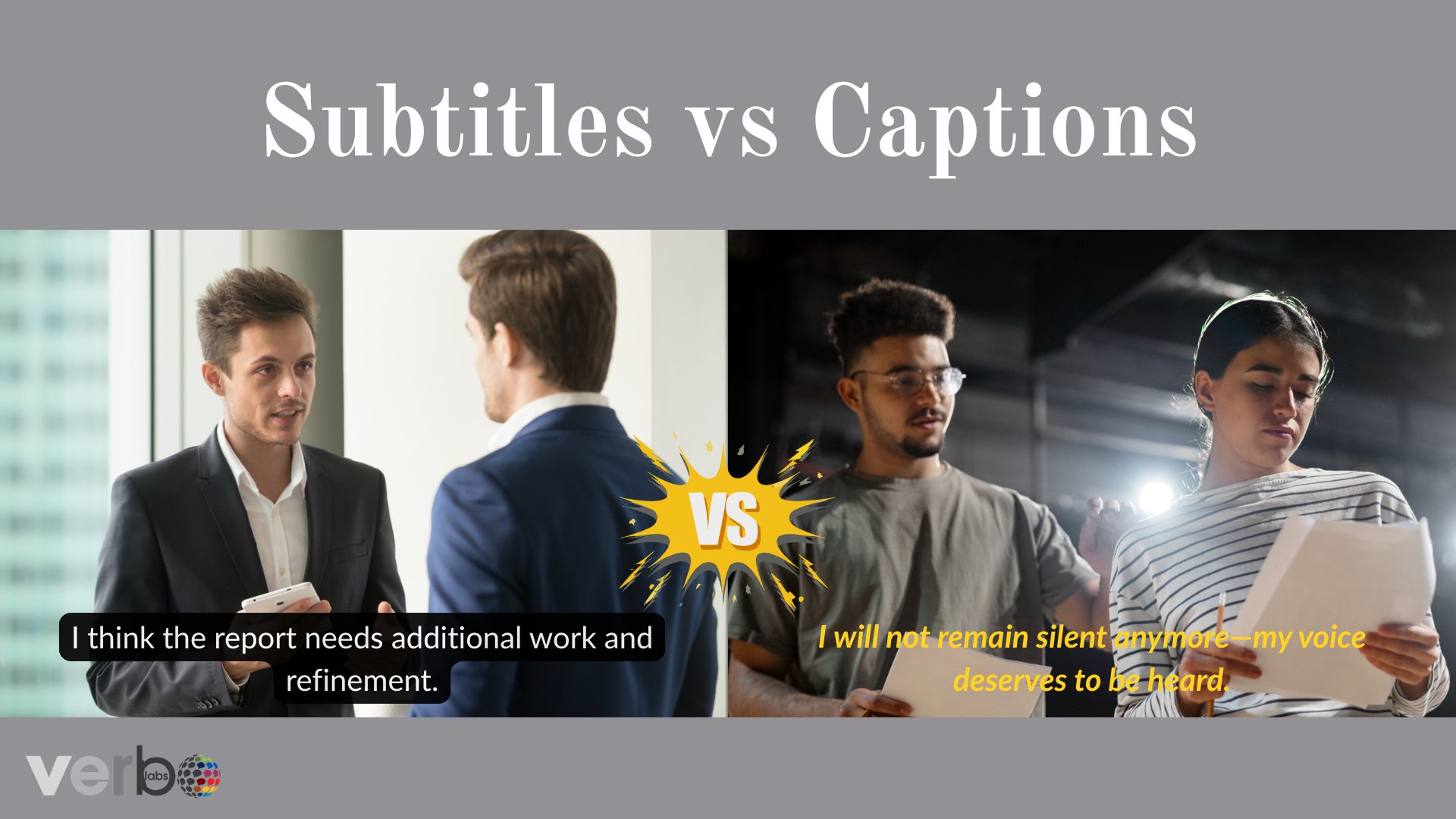
Many users often confuse subtitles and captions, but they are designed for completely different audience needs.
Subtitles
- Mainly created for viewers who don’t understand the original language.
- Focus on translating spoken dialogue into another language.
- Do not include background sounds, music, or speaker labels.
- Commonly used in movies, OTT platforms, international films, and global marketing videos.
Captions
- Designed for people who are deaf or hard of hearing.
- Include the full audio experience through text—
- Dialogue
- Sound effects
- Music cues
- Speaker identification
- Aim to recreate everything the viewer would hear, making content fully accessible.
A frequent question is: “Why are subtitles not working?”.Often, this occurs because platforms treat subtitles and closed captions as separate features, each serving a different purpose.
Closed Captions vs Subtitles
Closed Captions (CC):
- Can be turned on or off (e.g., YouTube’s CC button).
- Include all audio elements—dialogue, music cues, sound effects.
- Critical for accessibility compliance in education or corporate videos.
Example: When a character whispers “I’m here” and the caption shows [door creaking], [footsteps], and the dialogue.
Subtitles:
- Typically, language-based and shown depending on user preference.
- Display only spoken dialogue, not background sounds.
Example: English subtitles translating a Spanish movie line: “¿Dónde estás?” → “Where are you?”
Understanding this difference helps creators select the most suitable format for their audience.
Also read,
- Closed Captions vs Open Captions: Top 10 Difference Explained
- Top 10 Subtitles Translation Service Providers in India (2025)
- Subtitles vs Closed Captions: What’s the Difference and Which One Should You Use?
Transcription vs Subtitling — The Real Difference

Here’s the simplest explanation:
| Feature | Transcription | Subtitling |
| Purpose | Converts speech into text | Displays text on-screen for video |
| Output | Text document | Time-coded on-screen text |
| Includes sound descriptions? | No | Only in captions, not subtitles |
| Used for | Documentation, SEO, research, meetings | Movies, YouTube videos, Netflix content, global audiences |
| Involves translation? | Optional | Very often (in multilingual subtitles) |
A common search query is “What is the difference between transcription and subtitling?” The answer: Transcription is text-only. Subtitling is text displayed in sync with the video.
If you need both—say for YouTube video transcription and subtitling—professional linguistic support ensures accuracy, timing, and clear communication.
Why Subtitles Are Important
Subtitles go beyond simple translation—they enhance the overall viewing experience and broaden content accessibility. They:
- Increase global viewership by making video content understandable across languages.
- Improve accessibility for deaf or hard-of-hearing audiences.
- Boost engagement on muted social media videos where most viewers watch without sound.
- Support language learning by allowing viewers to read and listen simultaneously.
- Improve retention for educational and training videos.
- Expand reach to non-native speakers and international audiences.
This is why subtitles for movies, YouTube content, and Netflix-style videos have become standard expectations.
Why Transcription Is Important
Transcription plays a crucial role in enhancing content accessibility and usability. It:
- Makes audio content fully searchable, helping users find information instantly.
- Allows creators to repurpose podcasts, webinars, and interviews into blogs, social posts, or scripts.
- Supports translation and localization, acting as the base text for multilingual content.
- Enables accurate referencing in academic or research work.
- Helps organizations maintain clear documentation of meetings and discussions.
- Is essential for legal, medical, and compliance-related records where precision is mandatory.
Both transcription and subtitling expand reach, but each serves a different purpose.
When You Need Both: Transcription + Subtitling
Many scenarios require a combination of services:
- Converting Zoom meeting recordings → transcript → multilingual subtitles
- Turning YouTube interviews into blogs + subtitled videos
- Creating micro-content from long podcast episodes
- Translating corporate training videos into multiple languages
This workflow is especially useful if you need transcription and translation for video, or subtitles for multilingual audiences.
Conclusion: Which One Do You Need?
Transcription and subtitling aim to make content more accessible and user-friendly, but they serve different purposes.
- Choose transcription when you need written documentation, analysis, SEO value, or accessible text versions.
- Choose subtitling when you want to reach global audiences, translate content, or make videos accessible and engaging.
For brands, content creators, or businesses aiming to expand worldwide, combining both ensures maximum clarity, accessibility, and audience impact.
If you want reliable, industry-specific, and professional support for global content, explore Verbolabs — a trusted partner in transcription, subtitling, translation, and localization. Their specialized teams help you deliver accurate text, natural subtitles, and multilingual communication for every platform.

Ready to make your audio and video content accessible worldwide? Get professional transcription and subtitling services from VerboLabs to improve accuracy, reach, and engagement.
FAQs
Transcription is the process of turning spoken audio into a written document. It captures all spoken words but isn’t linked to video timing or on-screen display.
Subtitling is the creation of text that appears on a video to represent dialogue or narration, often including translated versions for viewers who speak different languages.
Transcription provides a standalone text version of speech, while subtitling delivers time-synced on-screen text. Subtitling also requires careful timing, readability, and screen-space management, which transcription does not.
No. A transcript isn’t time-aligned with the video, so it won’t appear in sync with the spoken dialogue. Subtitles are necessary for proper on-screen understanding.
Use transcription when you need a written record of spoken content for documentation or searchability. Choose subtitling when viewers need real-time text on-screen, especially for multilingual or accessible video experiences.
Often they do, especially when viewers don’t know the original language. However, subtitles can also appear in the same language to support hearing-impaired users or clarify foreign dialogue in a scene.
No. Although all three convert audio to text, they differ in purpose: transcription creates a full text document; subtitles display spoken lines on-screen; captions include dialogue plus sound effects and speaker labels for accessibility.
Captions and subtitling—especially closed captions—are often required to meet accessibility standards. A transcript alone usually does not meet accessibility compliance needs.
Transcripts typically offer greater SEO value because they make spoken content searchable. Subtitles enhance viewer engagement, but transcription is better suited for repurposing content into articles, blogs, and written resources.
Yes. Many providers, including Verbolabs, deliver both services together—starting with a transcript and then converting it into accurate, time-coded subtitles for video. This ensures consistency and speeds up the workflow.