
Picture a scanned discharge sheet. One line gives a dosage; the next says “do not” combine it with another medication. OCR drops the “do not,” translation runs on the shortened text, and the finished PDF looks clean and official. Nothing about it looks wrong.
This comparison is for healthcare language access, document operations, clinical content reviewers, IT and procurement teams weighing ten platforms. Our thesis: selection must connect extraction, medical meaning, and release responsibility, because a correct-looking PDF can hide an OCR or dosage error.
TL;DR
Editorial shortlisting suggestions, not measured winners. VerboLabs, the publisher of this article, builds CENTROID.
- CENTROID by VerboLabs: AI-led medical content workflow candidate.
- Pairaphrase: healthcare document translation teams.
- Smartling: enterprise healthcare localization and services.
- Phrase TMS: controlled medical content workflows.
- XTM Cloud: complex healthcare documentation programs.
- Trados Studio: translator-led medical document production.
- memoQ TMS: specialist medical translation production.
- DeepL Pro / Enterprise: paid document drafting with medical review.
- SYSTRAN: enterprise MT with healthcare deployment constraints.
- Smartcat: AI-assisted healthcare content operations.
Compare the 10 options by buying requirements
These products sit in different categories. Pairaphrase is document-focused; Trados Studio is a desktop CAT tool; DeepL and SYSTRAN are MT engines; the rest are platforms. Cells list what to check, not scores.
| Product (category) | Document-risk scope | OCR/extraction | Dosage/negation controls | Medical reviewer workflow | Layout/accessibility | Applicable data contract | Release evidence | Pricing basis |
| CENTROID (AI workflow candidate) | Synthetic text first | Confirm | Glossary, QA | Reviewer roles | Confirm | Confirm | Approval records | Contact sales |
| Pairaphrase (document platform) | Patient documents | Scans, per vendor | Terminology | Editor review | Office, PDF | BAA offered | Audit logs listed | From $285/mo |
| Smartling (platform + services) | Enterprise programs | Confirm | Glossary, LQA | Services option | Connectors | HIPAA claimed | Audit trail | Quote |
| Phrase TMS (enterprise TMS) | Governed workflows | Confirm | Termbases, QA | Workflow steps | File formats | Confirm | Job history | From $27/mo; quote |
| XTM Cloud (enterprise TMS) | Complex documents | Confirm | Terminology, QA | Workflow | Structured formats | HIPAA claimed | Workflow logs | Quote |
| Trados Studio (desktop CAT) | Translator-led | Outside tool | Termbase, QA | Separate | Many formats | Varies | Review files | Subscription |
| memoQ TMS (TMS) | Specialist production | Outside tool | Termbases, QA | Reviewer handoff | Confirm | SOC 2 listed | Project history | From ~$242/mo; quote |
| DeepL Pro / Enterprise (MT engine) | Drafting | Confirm | Glossaries | Outside engine | Document upload | HIPAA announced | None | Per user |
| SYSTRAN (MT engine) | Deployment-led | Confirm | Dictionaries | Outside engine | File translation | On-premise option | None | From ~$26/user/mo |
| Smartcat (AI platform) | Content operations | Confirm | Glossary, QA | Editors | Confirm | Confirm | Version history | From $1,200/yr |
What should healthcare teams look for in document translation software?
Five criteria frame the review, each tied to a buyer task. Some functions depend on plan or deployment, so ask what your tier actually includes.
Medical meaning and approved terminology
Test dosages, units, abbreviations, contraindications, and negation with medical-language experts. Treat automated scores as triage, not proof of clinical safety.
File fidelity, OCR and accessibility
Check forms, tables, scan quality, instructions and readable output. Judge layout and accessibility separately from the text itself.
Privacy and contractual controls
Look at data-processing terms, access, retention, subprocessors and a BAA where your US HIPAA workflow requires one. This is a procurement checkpoint, not a legal conclusion or a compliance claim.
Medical review and release accountability
Define qualified linguistic or clinical review, approval records, and version control by document risk. Administrative, patient-facing, and regulated product content need different handling.
Workflow, integrations and total cost
Confirm the real handoff to your document system and don’t assume EHR integration. Budget for OCR cleanup, desktop publishing, specialist review, seats, usage, and training.
How did we evaluate the shortlist?
This is a desk-researched shortlist built from official pages, public pricing, and review sites. Nobody on our side has tested these tools hands-on. We compared each against the five criteria and noted open checks. We kept documented features, vendor claims, and unknowns separate, and we don’t treat missing information as proof a feature is absent. Prices, ratings, and compliance statements were read in November 2026, often via third-party trackers. Compliance statements are vendor claims, not our findings.
The 10 Best Document Translation Software Platforms for Healthcare Teams
Order isn’t a performance ranking.
1. CENTROID by VerboLabs — AI-led medical content workflow candidate
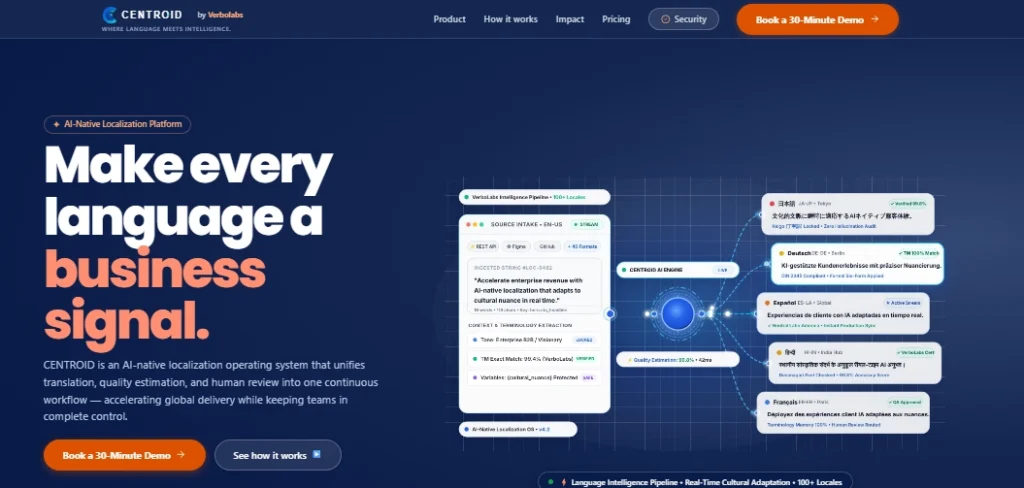
CENTROID by VerboLabs is an AI-led medical content workflow candidate, built by this article’s publisher. Proposed fit: patient-facing text with a glossary and defined reviewers. Test it on synthetic documents, and settle data terms, reviewer availability, and sign-off responsibility before any sensitive use.
Why CENTROID by VerboLabs Fits Healthcare Teams
Best for teams wanting an AI-led workflow built around approved terminology. As the publisher’s product, it gets stricter scrutiny.
CENTROID by VerboLabs: Features, AI & Quality
VerboLabs’ public pages describe neural MT with human post-editing, and recommend human-only translation for medical or compliance content. We found no CENTROID documentation, so ask about OCR, memory, QA, and review steps.
CENTROID by VerboLabs: Pricing & Customer Feedback
No public pricing found; assume contact sales. No independent CENTROID rating found either.
CENTROID by VerboLabs: Limitations & Buyer Checks
Verify data terms, specialist reviewer availability, and who signs off. Unpublished isn’t absent.
2. Pairaphrase — healthcare document translation teams
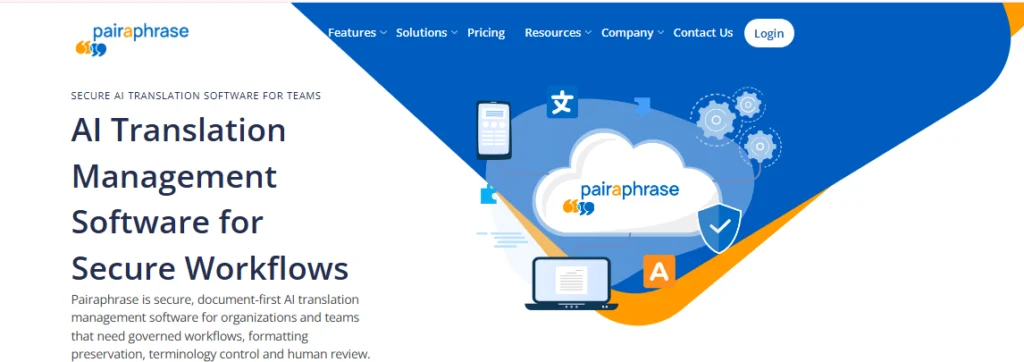
Pairaphrase is a document translation platform with a dedicated healthcare offering. Proposed fit: teams translating forms, consent papers, and discharge instructions with reviewers in the loop. Contract, PHI scope, file handling, and human review all need checking.
Why Pairaphrase Fits Healthcare Teams
Best for document operations teams wanting file-based translation with terminology and review in one place.
Pairaphrase: Features, AI & Quality
Its pages describe scanned-document support, terminology resources, reusable translations, and an editor where qualified staff review output. A medical terminology translation guide can help reviewers identify the abbreviations and dosage terms to include in that test. It lists MFA, SAML SSO, and audit logs.
Pairaphrase: Pricing & Customer Feedback
Bronze is listed at 285monthly (3,420 yearly 600,000 words); Silver is $499 and Gold $835. Capterra shows 4.3/5 from 25 reviews.
Pairaphrase: Limitations & Buyer Checks
It says BAAs are available, but customers stay responsible for configuration and retention. Test degraded scans with seeded negations.
3. Smartling — enterprise healthcare localization and services
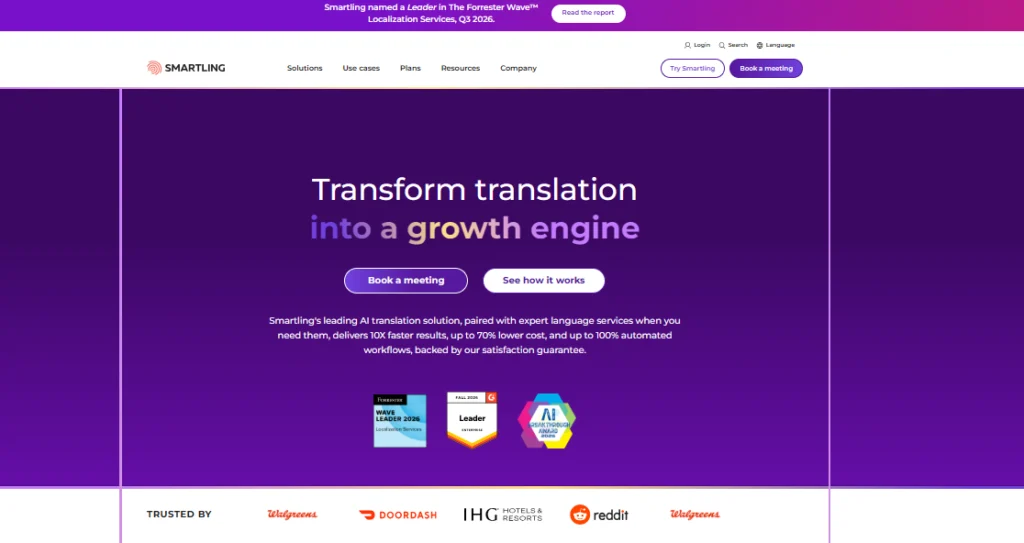
Smartling combines a translation platform with optional language services. Proposed fit: enterprise healthcare localization. Separate platform capabilities from medical language services, and verify both scopes.
Why Smartling Fits Healthcare Teams
Best for large programs wanting platform and services under one contract.
Smartling: Features, AI & Quality
It markets AI, human review, 50+ integrations, and an audit trail of models and edits. One review site says AI Hub and advanced post-editing need add-on pricing.
Smartling: Pricing & Customer Feedback
Quote-based. G2 shows about 4.4/5 across roughly 677 reviews; Software Advice shows 3.4 from 18.
Smartling: Limitations & Buyer Checks
Smartling’s page lists HIPAA among its security standards. That’s a vendor statement, so confirm contract scope and ask which medical reviewers are provided.
4. Phrase TMS — controlled medical content workflows
Phrase TMS is a translation management system with workflow automation, memories, and term bases. Proposed fit: controlled medical content workflows. Assess medical termbases, access controls, and human approval without inferring clinical validation.
Why Phrase TMS Fits Healthcare Teams
Best for teams running governed workflows with defined roles across many documents.
Phrase TMS: Features, AI & Quality
Look at termbases, workflow steps, QA, and AI options. Higher-tier plans list language quality assessment and SSO.
Phrase TMS: Pricing & Customer Feedback
Listings show Freelancer from $27 monthly, and Team near $1,245; Business and Enterprise are quoted. G2: 4.5/5 from 1,279 reviews.
Phrase TMS: Limitations & Buyer Checks
We found no healthcare-specific claims, so request data terms and OCR handling. Test with a medical termbase.
5. XTM Cloud — complex healthcare documentation programs
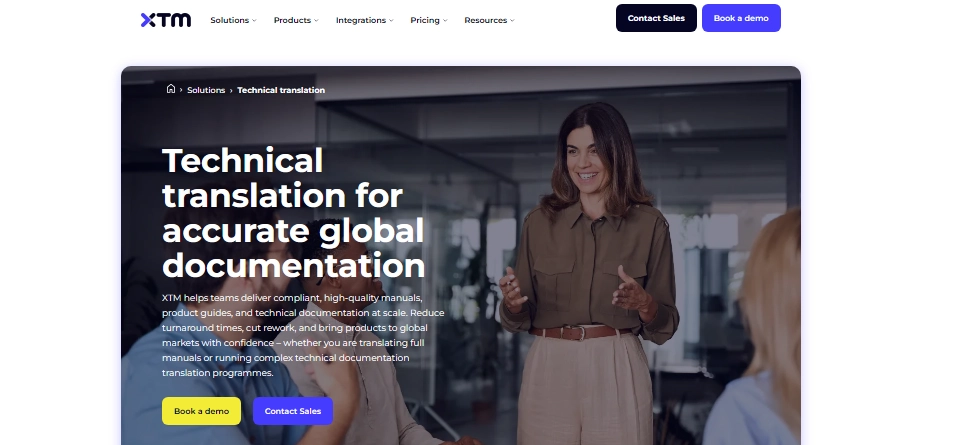
XTM Cloud is an enterprise translation platform. Proposed fit: complex healthcare documentation programs. Test structured or layout-heavy medical documents, then confirm exact formats and the reviewer workflow.
Why XTM Cloud Fits Healthcare Teams
Best for large teams with many document types and multi-step review.
XTM Cloud: Features, AI & Quality
Check workflow orchestration, memory, terminology, QA, and AI. XTM’s pages describe SaaS, private cloud, and on-premises options.
XTM Cloud: Pricing & Customer Feedback
G2 lists plans from about $16,500 a year up to $60,000, with a 30-day trial. G2: 4.3/5 from about 140 reviews.
XTM Cloud: Limitations & Buyer Checks
XTM states ISO 27001, GDPR, and HIPAA compliance. Treat that as a vendor claim and confirm the contract. Some G2 reviewers find setup hard.
6. Trados Studio — translator-led medical document production
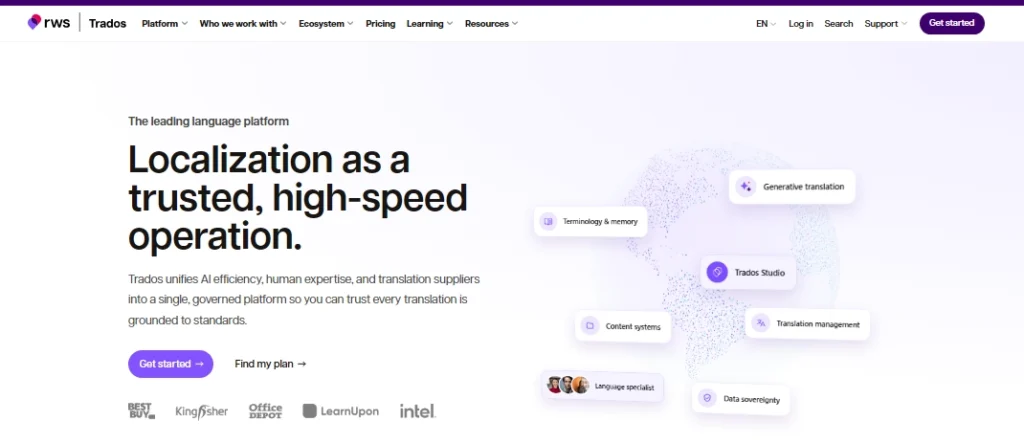
Trados Studio is a desktop CAT tool for translator-led production. Proposed fit: medical documents handled by specialist linguists. Assess controlled editing, terminology and QA, and identify separate collaboration and qualified medical review needs.
Why Trados Studio Fits Healthcare Teams
Best for translators and small teams producing medical documents in a familiar CAT environment.
Trados Studio: Features, AI & Quality
Studio 2026 adds large language model access through Language Weaver Pro. Check terminology, QA checks and format support for your documents.
Trados Studio: Pricing & Customer Feedback
Freelance runs $52–63 monthly depending on contract; Professional is quoted. Capterra rates value for money 3.5 from 74 reviews.
Trados Studio: Limitations & Buyer Checks
It’s a desktop tool, so file sharing, access and approvals sit outside it. Confirm how OCR and review records get produced.
7. memoQ TMS — specialist medical translation production
memoQ TMS is a server or cloud translation management system built on the memoQ editor. Proposed fit: specialist medical production. Evaluate medical termbases and reviewer handoff on synthetic instructions, then confirm formats and collaboration scope.
Why memoQ TMS Fits Healthcare Teams
Best for specialist medical translators and LSP teams wanting terminology-led production.
memoQ TMS: Features, AI & Quality
Check termbases, QA, reviewer handoff and MT connections. It runs on-premise or in memoQ’s cloud, and lists SOC 2 and ISO 27001.
memoQ TMS: Pricing & Customer Feedback
TMS Starter appears at about $242 monthly; higher tiers are quoted. Translator Pro runs near $30–44 monthly. One tracker shows 4.5/5 from 56 server reviews.
memoQ TMS: Limitations & Buyer Checks
HIPAA isn’t stated in the sources we read, so confirm data terms. Users cite opaque server pricing.
8. DeepL Pro / Enterprise — paid document drafting with medical review
DeepL Pro and Enterprise are paid plans for DeepL’s translation engine. Proposed fit: drafting administrative and patient-facing documents before qualified review. Compare meaning and layout defects afterwards, and don’t assume healthcare compliance.
Why DeepL Pro / Enterprise Fits Healthcare Teams
Best for teams needing quick, fluent drafts inside a separate review process.
DeepL Pro / Enterprise: Features, AI & Quality
Glossaries, document translation and API access matter here; Advanced adds CAT tool integration. DeepL has no medical review workflow of its own.
DeepL Pro / Enterprise: Pricing & Customer Feedback
Starter, Advanced, and Ultimate run about $8.74, $28.74 and $57.49 per user monthly on annual billing in several listings; Enterprise is quoted. Prices have shifted.
DeepL Pro / Enterprise: Limitations & Buyer Checks
DeepL announced HIPAA compliance in May 2025. Confirm which plans and BAA terms apply, and keep review, approvals, and OCR checks elsewhere.
9. SYSTRAN — enterprise MT with healthcare deployment constraints
SYSTRAN is an enterprise machine translation vendor with cloud and on-premises options. Proposed fit: healthcare organisations with deployment constraints. Specify deployment, data-processing boundaries and exact language support, and test critical clinical terms.
Why SYSTRAN Fits Healthcare Teams
Best for IT-led teams needing translation to stay inside their own infrastructure.
SYSTRAN: Features, AI & Quality
Third-party sources describe on-premises server deployment, custom models and dictionaries, and 55+ languages. Confirm file formats and OCR.
SYSTRAN: Pricing & Customer Feedback
Translate Pro lists at $25.99–49.99 per user monthly; Server and Enterprise are quoted. Capterra: 4.7/5, but only 6 reviews.
SYSTRAN: Limitations & Buyer Checks
Language coverage is stated as 55+, so check your exact pairs. One third-party site mentions HIPAA-compatible configurations; ask SYSTRAN directly.
10. Smartcat — AI-assisted healthcare content operations
Smartcat is an AI-assisted translation platform with editors and a vendor marketplace. Proposed fit: healthcare content operations. Test intake, specialist editing and release accountability with synthetic content, and check any security or contract claims independently.
Why Smartcat Fits Healthcare Teams
Best for teams wanting AI drafts with managed human editing at volume.
Smartcat: Features, AI & Quality
Listings cite AI translation across 280+ languages, memory, and glossaries. Confirm QA, OCR handling, and how specialist medical editors are assigned.
Smartcat: Pricing & Customer Feedback
Basic is $1,200 a year; Enterprise is quoted. Capterra: 4.5/5 from 140 reviews.
Smartcat: Limitations & Buyer Checks
We found no healthcare-specific compliance statement. Request data terms before any PHI.
Which shortlist fits medical linguist production, document operations, or enterprise healthcare programs?
| If your priority is… | Consider | Why | Verify first |
| AI-led medical content workflow candidate | CENTROID by VerboLabs | AI workflow, approved terms | Data terms, reviewers |
| Healthcare document translation teams | Pairaphrase | File-based, review in one place | Scan fidelity, BAA |
| Enterprise healthcare localization and services | Smartling | Platform plus services | Services scope |
| Controlled medical content workflows | Phrase TMS | Governed workflow | Medical termbase fit |
| Complex healthcare documentation programs | XTM Cloud | Structured, multi-step | Exact formats |
| Translator-led medical document production | Trados Studio | Desktop CAT depth | Collaboration gap |
| Specialist medical translation production | memoQ TMS | Terminology-led production | Format scope |
| Paid document drafting with medical review | DeepL Pro / Enterprise | Fast fluent drafts | Plan and BAA scope |
| Enterprise MT with healthcare deployment constraints | SYSTRAN | On-premise option | Language pairs |
| AI-assisted healthcare content operations | Smartcat | AI drafts, managed editing | Security scope |
What should your vendor pilot prove?
Use synthetic documents: a discharge instruction, a consent form, and a medication information sample. Seed dosage, negation and abbreviation issues, then have qualified reviewers assess meaning, readability and layout. Measure extraction omissions, dosage, unit and negation errors, readability defects, layout defects and documented reviewer approval. Ask every vendor: “Who validates extraction, who reviews medical meaning and who signs off the released target document under the approved data-processing arrangement?” Keep input, scope and success criteria identical. If shortlisted platforms do not include the required medical review, compare certified medical translation providers on reviewer qualifications and the scope they can deliver. Record baseline, result, reviewer, and open issues, and publish measured findings only after real testing.
Final recommendation
There’s no universal winner. Choose by workflow: document operations, specialist linguist production, and enterprise programs each point to different tools, and none of them replaces qualified medical review. CENTROID by VerboLabs merits a demo if an AI-led medical content workflow fits your process, while Pairaphrase, Smartling, Phrase TMS, and the rest stay credible alternatives. OCR handling, data contracts, and reviewer accountability remain open checks for every vendor. If the work also requires specialist linguistic delivery, evaluate medical records translation providers against the same review and data-handling requirements.
Book a CENTROID demo with synthetic healthcare documents, medical terminology, and a defined reviewer workflow.

Expand your global reach with VerboLabs! Get accurate, culturally adapted localization services to connect with new markets. Contact us today for expert solutions!
Frequently Asked Questions
No. Use AI for drafts and triage inside an approved workflow, but qualified medical-language reviewers must check meaning, dosage, negation, and intended use.
Test OCR on its own first, including degraded scans, units, and negation. Compare the extracted text with the original before judging any translated output.
Verify the specific processing contract, access, retention, and applicable privacy requirements, including a BAA where HIPAA applies. Use synthetic documents until your compliance team approves the workflow.
No. Don’t assume integration with any EHR. Ask about your named system, the data boundary, who owns the connector, and who approves it.