


Picture that your engineering, marketing, and legal teams are collaborating on the same product. Engineers refer to a part as a “control module,” but marketing thinks it is a “smart controller,” while the legal department uses a different expression in the documentation. When the translation team gets to work, they find that all people have different understandings of the issue.
This guide analyzes ten possibilities for the acquisition of the tools that help in forming coherent language.
- CENTROID from VerboLabs: Term usage in the AI-driven localization environment; verify whether governance functions are present.
- MultiTerm: Usage of terminology for structured terminology management in Trados talks.
- Qterm: A potential candidate to govern a collaborative termbase; clarify existing functions.
- Phrase TMS: Term usage in the program for translations.
- XTM Cloud: Household term work in connection with translation.
- Acrolinx: Term usage in the course of the content creation.
- Congree TermTiger: Browser-based term processing system.
- TermWeb from Interverbum Technology: Term processing solution designed for enterprises.
- Across crossTerm: Term processing in the context of the Across ecosystem.
- STAR TermStar: Corporate term processing on the basis of STAR solutions.
Compare the 10 Options by Buying Requirement
| Tool | Platform or Category | Pricing Approach | Main Buyer Check |
| CENTROID | AI-led localization platform | Contact sales | Term approval, audit history and export |
| MultiTerm | Dedicated terminology solution | License or subscription; confirm current terms | Trados integration and access |
| Qterm | Collaborative terminology platform | Contact vendor | Current governance and integration features |
| Phrase TMS | Translation management system with termbases | Subscription; plan-dependent | Approval and enforcement workflow |
| XTM Cloud | Enterprise TMS with terminology features | Contact sales | Termbase controls and integrations |
| Acrolinx | Content governance and authoring platform | Contact sales | Terminology checks in target editors |
| Congree TermTiger | Dedicated web-based term management | Contact sales | Roles, search and data exchange |
| TermWeb | Dedicated terminology system | Contact sales | Lifecycle controls and API/TBX exchange |
| Across crossTerm | Terminology within Across | Contact sales | External access and ecosystem fit |
| STAR TermStar | Corporate terminology software | Contact sales | Integration and distribution options |
What Should Enterprises Look for in Terminology Management Tools?
Dedicated Terminology Versus a TMS Glossary
The purpose of a glossary is not the same as that of a full-fledged terminology management system. As a rule, a glossary includes words, their definitions, and translations. However, a glossary would work well to manage terminology for small teams with a limited number of terms. In contrast, a specialized terminology system gives users a better chance of managing all aspects of term creation, checking, approval, updating, and retirement. At the same time, a translation management system (TMS) has an added advantage of having a termbase that can assist translators in using only the terms that have been previously approved. The language translation explained sets out the core purpose and workflow of translating meaning between languages
Term Model and Multilingual Metadata
A good term entry should provide not only the name of the term and its translation. Instead, it should explain the term and specify how it is to be used. For example, the term “dashboard” can mean a screen of software or an element of a car. These terms should not be considered identical.
Approvals, Access and Ownership
A terminology system should have distinct responsibilities assigned to individuals. Anyone should be able to suggest new terms, but not all should approve them.
Find out if the solution allows for the coordination of different functions. Also see if it provides tracking capabilities so that people know who modified a term.
Interoperability and Content Enforcement
The system should be available whenever an employee creates or translates content. Look for TBX or CSV import/export capabilities, API availability, CAT application compatibility, as well as connections to content authoring tools. Also differentiate between a tool that only offers suggestions and a tool that identifies unapproved terms.
Search, Adoption and Total Cost
A terminology system serves no purpose if it is difficult to locate and use. Find out whether people with no linguistic training can locate terms easily, whether a paid account is necessary to access it, and whether employees are able to add new terms. Don’t forget also the time needed to clean up old glossaries and train users to ensure the system is effective.
How Did We Evaluate the Shortlist?
This is a desk-researched shortlist of products based on the information currently available about them and their relevance for terminology processes. The products haven’t been tested for the purposes of this article. The comparison takes into account whether a particular product offers dedicated functionality for terminology management and terminology features within another system. The comparison considers term structure, approvals, access, integration, and enforcement too.
The 10 Best Terminology Management Tools and Platforms for B2B Teams
1. CENTROID by VerboLabs – Terminology Within an AI Localization Workflow
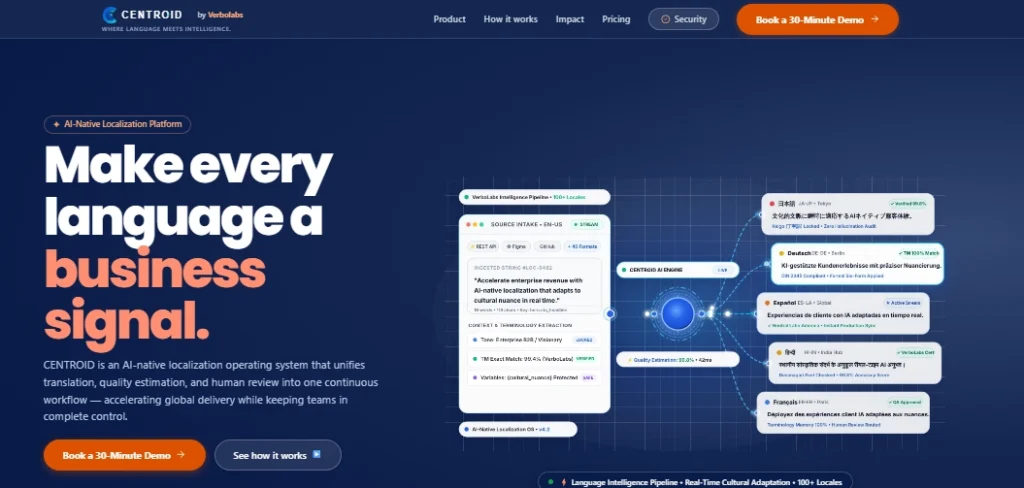
VerboLabs’ CENTROID is an AI-driven localization platform that incorporates terminology management in its overall language workflow. It could be appropriate for companies wishing to connect their terminology with translation, quality control, and human proofreading. However, teams in search of a specialized glossary should make sure CENTROID has the necessary functionality. The translation project management software compares platforms for assignment, scheduling, vendor coordination, progress tracking, and delivery.
Why CENTROID by VerboLabs Fits Terminology Teams
The CENTROID platform is relevant for localization teams wishing to use terminology as part of the translation process instead of keeping it disconnected. Official information about CENTROID states that terminology management is incorporated into a bigger localization cycle.
CENTROID by VerboLabs: Features, AI and Quality
CENTROID technology refers to technologies such as contextual AI, translation memory, automated quality estimation, and adherence to terminology compliance. The compare CAT tools for B2B teams compares workbenches that combine translation memory, terminology controls, quality checks, and AI assistance.
CENTROID by VerboLabs: Pricing and Customer Feedback
If you are interested in CENTROID technology, you need to contact its sales department to get information about the plan pricing and schedule a demo.
CENTROID by VerboLabs: Limitations and Buyer Checks
The platform cannot be regarded as a purely dedicated terminology system. Before choosing the platform, you should check if the platform operates in the grade system of the terminology being needed, etc.
2. MultiTerm – Structured Terms in a Trados Environment
Why MultiTerm Fits Terminology Teams
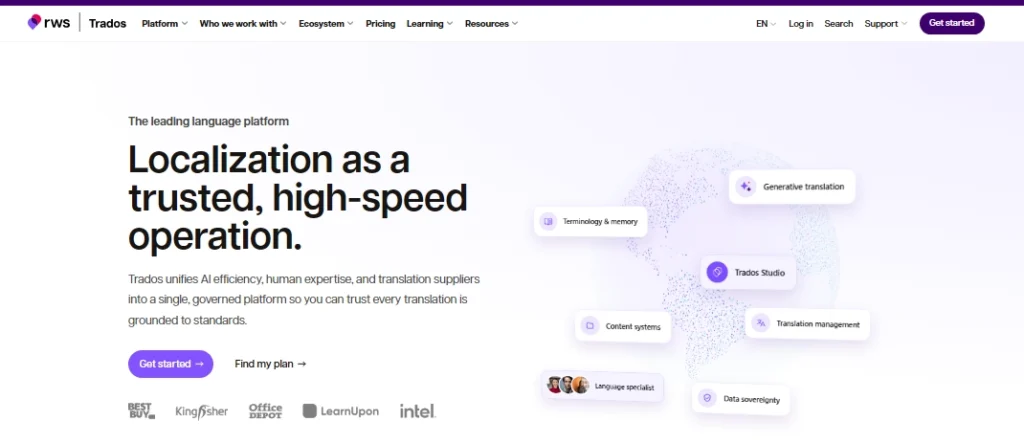
MultiTerm enables central terminology management and sharing among translators and content creators. RWS finds it a solution for deploying consistent language throughout departments, content, and market releases. RWS.org defines MultiTerm in specifications that somehow forbid independence in its practical usage.
MultiTerm: Features, AI and Quality
Documented functions include multilingual termbases, real-time term search, customizable displays, and integration with Trados Studio and other applications. Users can look up a term while reading, writing, or translating content.
MultiTerm: Pricing and Customer Feedback
RWS provides an option to purchase MultiTerm; however, the total cost depends on the licensing arrangement and the details. Check with RWS for current licensing, hosting, and access options.
MultiTerm: Limitations and Buyer Checks
It’s most likely to find its greatest fit in organizations already working within the Trados environment. Ask how non-Trados users can access terminology and whether it fits into your broader authoring approval process.
3. Qterm – Collaborative Termbase Governance

Why Qterm Fits Terminology Teams
The suggested position on the shortlist is for collaborative terminology management, which makes it interesting for teams with terminology that needs to go beyond a limited circle of translators, so it can be explored and verified.
Qterm: Features, AI and Quality
Ask the supplier for a demonstration of how terms are added, validated, approved, and disseminated. Look for the ability to keep language variations, definitions, preferred forms, and banned synonyms.
Qterm: Pricing and Customer Feedback
There is no publicly available pricing or verified review data used for this analysis. Make sure to ask for the personalized price depending on the number of editors, viewers, languages, and integrations.
Qterm: Limitations and Buyer Checks
Confirm the owner of the product, the current availability status, as well as supported file types and integrations. Additionally, the buyer needs to check the governance workflow of the system and ensure that this workflow meets the requirements of managers without linguistic qualifications.
4. Phrase TMS – Terminology Within a Translation Program

Why Phrase TMS Fits Terminology Teams
Phrase provides termbases in several languages for projects of different sorts. It has features that provide users with the ability to have term suggestions while working on translations to ensure that they use the approved terminology.
Phrase TMS: Features, AI and Quality
Apart from offering termbases, it provides groups of concepts, translations, synonyms, and statuses of terms. It is possible to mark terms as preferred or forbidden, and some quality checks can signal problems with terminology usage as well. Users can also choose to define all access levels and sets of fields for individual cases.
Phrase TMS: Pricing and Customer Feedback
Phrase has subscription-based solutions with different functions depending on the plan chosen by a user. Double-check if your subscription has all the necessary termbase features and user roles you need.
Phrase TMS: Limitations and Buyer Checks
Phrase TMS is definitely a termbase and term management system, but it can not always act as a replacement for the real termbase, as described by the Phrase guides.
5. XTM Cloud – Enterprise TMS Terminology Workflows
Why XTM Cloud Fits Terminology Teams
XTM talks about the ability to create, upload, and widen termbases. Its terminology programs have been created with the aim of helping translators use correct words when carrying out localization tasks.
XTM Cloud: Features, AI and Quality
XTM’s published materials mention an AI-termbase creator, which can find necessary terms and equivalents in documents. The Language Guard tool can identify wrong or disallowed terminology during the process of translation.
XTM Cloud: Pricing and Customer Feedback
XTM Cloud is classified as an enterprise solution. The price can be determined with the provider based on the volume of the project, number of users, integrations, and implementation specifics.
XTM Cloud: Limitations and Buyer Checks
The tools for terminology are included in the general TMS processes. Should you require independent term management throughout your company, please ask about advanced approvals and custom processes, as well as integration with its terminology systems such as TermWeb.
6. Acrolinx – Upstream Terminology Enforcement in Authoring
Why Acrolinx Fits Terminology Teams
Unlike a termbase, which is solely dedicated to translation, Acrolinx serves the authoring process. Hence, it might be useful for technical writers, content teams, and organizations that would like to have language rules implemented before the content production process starts.
Acrolinx: Features, AI and Quality
Request a demo of the way terminology rules are implemented, the way preferred terms are presented, and checks are carried out in the editors used by the writers in your organization. Make sure that the way the multilingual terminology is processed is suitable and that the checks indicate what alternatives are allowed and what options can be considered forbidden.
Acrolinx: Pricing and Customer Feedback
The decision about the price should be made directly with the provider. Make sure that you understand all the integration options, user access requirements, and deployment model before comparing the final price to the prices of a dedicated termbase.
Acrolinx: Limitations and Buyer Checks
Acrolinx and a dedicated terminology database provide similar but not identical solutions. Check whether it covers the terminology lifecycle and supports the multilingual structure, or whether additional terminology systems are required to meet the company’s needs.
7. Congree TermTiger – Browser-Based Term Governance
Why Congree TermTiger Fits Terminology Teams
With its support for multiple termbases, multilingual data, and customizable views, TermTiger fits organizations that need employees to be able to access terminology without fully relying on a translation editor.
Congree TermTiger: Features, AI and Quality
The features listed in the documentation include a configurable data model, filters, import and export features, language checks, and duplicate checks.
Congree TermTiger: Pricing and Customer Feedback
There is no public pricing for this software since you will have to ask Congree for information regarding software components required for licensing user access and implementation of the program.
Congree TermTiger: Limitations and Buyer Checks
Find out how this platform deals with approval roles and change history, and find out whether the data model is able to express the relationships and metadata your business needs.
8. TermWeb by Interverbum Technology – Dedicated Enterprise Term Lifecycle
Why TermWeb by Interverbum Technology Fits Terminology Teams
TermWeb is placed in the context of terminology management and not just translation project management. The program provides web access to anyone interested in searching, acquiring, and managing terminology.
TermWeb by Interverbum Technology: Features, AI and Quality
Some of the functions presented by the software include features such as search autocomplete, tab working, grid editing, and administration panel usage. Integration options are also reported.
TermWeb by Interverbum Technology: Pricing and Customer Feedback
Contact Interverbum Technology for updates on licenses and implementation. The public customer ratings are not available for this comparison.
TermWeb by Interverbum Technology: Limitations and Buyer Checks
Request a demo of how the term will be proposed, accepted, owned, or retired, and test the TBX and API transfer and user rights.
9. Across crossTerm – Terminology Inside the Across Ecosystem

Why Across crossTerm Fits Terminology Teams
What makes this tool attractive is the link between terminology scope and the entire Across environment. Teams must establish whether this makes sharing the glossary definitions with translators and other stakeholders easier.
Across crossTerm: Features, AI and Quality
During the demo, check the term creation process as well as multilingual records management, the search function, editing rights, and access to terminology outside the translation system. Make sure you understand how term changes are processed on the platform.
Across crossTerm: Pricing and Customer Feedback
The pricing policy depends on your options. Ask for a quote clearly stating the costs of terminology apart from the main system.
Across crossTerm: Limitations and Buyer Checks
Ecosystem compatibility is the most important factor here. If your company uses several translation and authoring systems, make sure that it is possible to share terminology with others and exchange data in the necessary formats.
10. STAR TermStar – Corporate Terminology with STAR Assets

Why STAR TermStar Fits Terminology Teams
The suggested use is centralized terminology management for technical and corporate materials. Purchasers must consider its connection to existing translation, documentation, and terminology operations.
STAR TermStar: Features, AI and Quality
Have the vendor present how terms are produced, verified, released, and changed. Verify if it has the capacity to support multilingual terminology records, synonyms, definitions, relationships, and their exchange.
STAR TermStar: Pricing and Customer Feedback
Inquire about STAR’s up-to-date price list and licensing information. The numbers proving public, independent reviews are not available for this comparison.
STAR TermStar: Limitations and Buyer Checks
Ascertain what features belong to TermStar and what functions require the help of other STAR solutions. Verify available integrations and responsibilities taken in the process of terminology database management.
Which Shortlist Fits Your Terminology Requirements?
| If your priority is… | Consider | Verify first |
| Terminology within AI localization | CENTROID | Term approval, audit history and export |
| Structured terms in Trados | MultiTerm | Access for non-Trados users |
| Collaborative termbase governance | Qterm | Current approval and integration features |
| Terminology within a TMS | Phrase TMS | Term status and QA workflow |
| Enterprise translation workflows | XTM Cloud | Advanced governance requirements |
| Authoring-stage language checks | Acrolinx | Multilingual term lifecycle |
| Browser-based term governance | Congree TermTiger | Roles, search and data exchange |
| Dedicated enterprise term management | TermWeb | TBX/API and approval workflow |
| Terminology in the Across ecosystem | Across crossTerm | External access and interoperability |
| Corporate terminology with STAR tools | STAR TermStar | Product boundaries and integrations |
What Should Your Vendor Pilot Prove?
The product demo must present more information than a glossary. The entire word lifecycle should be tested.
Begin with about 30 terms. Create definitions, preferred versions, disallowed synonyms, and language variations.
Then, ask the vendor to conduct the following tests:
- Suggestion – Can the employee request a new term?
- Verification – Can a subject matter expert verify its meaning?
- Authorization – Can the competent authorities approve or reject it?
- Decommissioning – Is it possible to indicate that the term is out of use?
- Supply – Does the approved term reach copywriters and translators?
- Transmission – Is it possible to transfer the data to another system without losing valuable information?
Monitor the number of unapproved terms in released papers, the approval period, the number of duplicates, as well as the adoption of the search function and metadata losses. The compare software localization tools compares platforms for repositories, string workflows, context, testing, and release cycles.
Repeat tests with the same sample and success criteria for each of the platforms and write down the results instead of only depending on demos.
Final Recommendation
Choosing the appropriate terminology management software depends on the processes by which your organization produces, validates, and translates content. For instance, if a business mainly uses Trados, it could successfully apply MultiTerm, but if it has implemented a TMS, it might opt for a built-in termbase instead.
Companies engaged in content quality checking can turn to Acrolinx, while the teams needing web-based term management will prefer Congree TermTiger or TermWeb. The manufacturing translation management systems compares systems for product manuals, structured content, terminology, and layout-heavy documentation
CENTROID by VerboLabs is a credible alternative that deserves to be shown to the organizations that need a term management app combined with the AI-supported localization process. However, if dedicated termbase management is vital for you, it is important to check its approval process, data structure, audit history, and export options before coming to a decision.

Expand your global reach with VerboLabs! Get accurate, culturally adapted localization services to connect with new markets. Contact us today for expert solutions!
Frequently Asked Questions
A terminology database holds concepts, validated terminologies, definitions, and translations.
A TM system comes in handy when managing the terminology of other departments, such as engineering, marketing, legal departments, localization departments, and more.
You must at least have the concept definition, the preferred term, the forbidden term, the language or dialect of the term, the usage situation, the owner, the approval level of the term, and the source.
Test document preparation of accepted terms and forbidden alternatives is necessary. In the test document, terminology checks available on the platform should be applied, and test results should be examined. Finally, update terminology and check that it is available for the writers and translators who need it to work.